
Giverny — The Village Where Monet Painted His Gardens
Giverny is a small village in Normandy where Claude Monet lived and painted. His house and gardens still draw visitors from around the world.
The village lies in a fold of the Seine valley in the Eure department, about 75 km north-west of Paris, where the river bends around low chalk hills and the light is soft and changeable. It is a village of fewer than 500 people, with a church, a few lanes of stone houses, a museum and the most famous garden in France. Monet came here in 1883, when he was 43 and already a successful painter, and he stayed for the rest of his life, 43 years, painting the water lilies in the pond he had dug in his own garden. The village is now one of the most visited places in Normandy, and on a summer day the lanes fill with visitors from every country, all of them walking towards the pink house with the green shutters.
Quick Facts
- Commune: Giverny, in the Eure department of Normandy, in northern France.
- Setting: in the valley of the Seine, about 75 km north-west of Paris and about 5 km east of Vernon.
- Residents: 430 people, on the INSEE census of 2023.
- River: the Seine flows past the village to the south, and the Epte, a tributary, runs nearby to the east.
- Famous resident: Claude Monet, who lived here from 1883 until his death in 1926 and painted his water lily series here.
- House museum: the house and gardens of Monet, open to the public since 1980, run by the Fondation Claude Monet.
- Season: the house and gardens are open from 1 April to 1 November, every day, from 10:00 to 18:00, with last admission at 17:30.
- Other museum: the Museum of Impressionisms, opened in 2009, with exhibitions on Monet and the painters of his circle.
- Tongue: French; the museum staff and the restaurants speak English as well.
- World Heritage nearby: the Banks of the Seine in Paris (600), listed 1991 under criteria (i), (ii) and (iv); western end at the Pont d’Iena, about 61 km off.
Geography of Giverny
Giverny stands on the northern bank of the Seine, in a bend of the river where the valley is wide and flat and the hills rise gently to the north. The village itself is built on the low slope above the flood plain, with the church on the highest ground and the houses strung along the lanes that run down towards the river. The Seine flows past to the south, broad and slow, and the meadows between the village and the river flood in winter, when the water rises over the banks and turns the fields into a shallow lake. The Epte river, a tributary of the Seine, runs to the east of the village, and it once marked the border between Normandy and the Ile de France, so that Giverny stood on the Norman side of an old frontier.
The landscape around Giverny is the classic landscape of the Norman Seine valley: chalk hills covered with woodland, fields of wheat and rapeseed, and the river winding through meadows with poplar trees along its banks. The hills to the north rise to about 150 m, and they are wooded with beech and oak, while the valley floor is flat and open, with the river and its islands and the meadows that flood in winter. The light in the valley is the light that drew the painters here: soft, changeable, with clouds that move fast across the sky and throw shadows over the fields, and a haze in the morning that burns off by midday. Monet painted the same haystacks and the same poplars again and again, because the light was never the same twice.
The climate of Giverny is the climate of northern France, mild and damp, with cool winters and warm summers and rain in every month of the year. The average temperature in July is about 20 degrees, and in January it is about 4 degrees, and frost is common in winter, when the mist hangs over the river in the morning. Rain falls on about half the days of the year, and the gardens are green from March to November, because the soil is rich and the rain is regular. The best light for the gardens is in the morning and in the late afternoon, when the sun is low and the colours of the flowers are at their strongest, and the water lilies are at their best in June and July, when the pond is covered with flowers.
The village is small, with fewer than 500 residents, and it is built around two streets: the Rue Claude Monet, which runs from the church down to the house and gardens, and the Rue du Milieu, which runs through the village from east to west. The houses are built of stone and brick, with steep roofs of slate and tile, and many of them have gardens with roses and wisteria, in the Norman style. The church of Sainte Radegonde stands on the hill at the western end of the village, with a view over the Seine valley, and the cemetery beside it holds the grave of Monet and of his family. The Hotel Baudy, an old inn on the main street, was the centre of the artists’ colony in the 1880s and 1890s, and it is still a hotel and restaurant today.
Giverny is about 75 km north-west of Paris, and about 5 km east of Vernon, the nearest town, which stands on the Seine with a railway station on the line from Paris Saint Lazare. The road from Vernon to Giverny runs through fields and woods, and it takes about ten minutes by car or bus, or about an hour on foot. The village is a good base for the Seine valley, with the town of Les Andelys and the ruined castle of Chateau Gaillard about 15 km to the north-west, and the city of Rouen, the capital of Normandy, about 60 km to the north-west, down the river. Paris is about an hour away by train, and the village is an easy day trip from the capital, which is why it is so crowded in summer.
The pond in Monet’s garden is the most famous piece of water in France, and it is smaller than visitors expect, a shallow oval pond about 50 m long, dug by Monet in the field behind his house and fed by the Ru, a small stream that runs through the village. The pond is planted with water lilies, and it is crossed by the Japanese bridge, painted green, with wisteria growing over it, and it is surrounded by bamboo, willows and irises. The flower garden in front of the house, the Clos Normand, is a rectangular garden of about a hectare, planted with flowers in long beds, with arches of roses and nasturtiums, and it is the garden that Monet painted in his early years at Giverny, before he dug the pond.
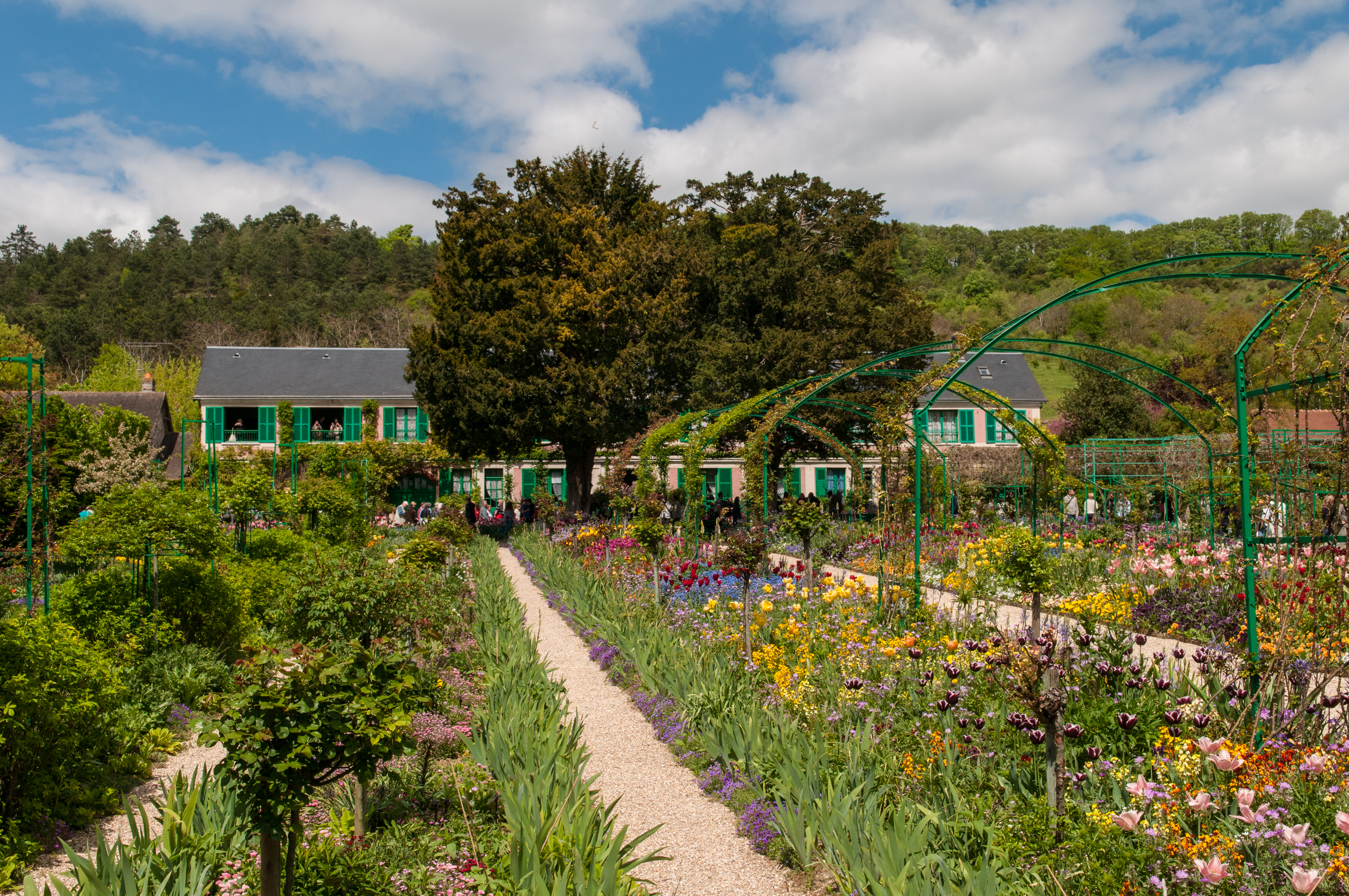
The house and garden of Claude Monet in Giverny — CC BY 2
History of Giverny
Giverny is an old village, and its history goes back to the Middle Ages, when it was a small farming village on the Seine, with a church and a mill and a handful of farms. The church of Sainte Radegonde was built in the 12th century, in the Romanesque style, with a nave and a choir and a tower, and it was enlarged in the 15th and 16th centuries, when the village grew. The village belonged to the lords of the region, and then to the abbey of Saint Denis, and it lived from farming and from the river, with the mill on the Epte and the ferry across the Seine. The village was quiet and unknown, and nothing in its history suggested that it would become one of the most famous villages in France.
The change came in 1883, when Claude Monet was looking for a house in the country. Monet was 43, and he had just come into money from the sale of his paintings, and he wanted a house with a garden where he could paint out of doors. He saw Giverny from the window of the train, as it ran along the Seine valley from Paris to Vernon, and he was struck by the light and the landscape, and he came to look at the village. He rented a large house with a garden, a house that had belonged to a local family, and he moved in with his second wife, Alice Hoschede, and their eight children, and he set about making the garden that would become his life’s work.
Monet bought the house in 1890, and he spent the next 36 years building the gardens and painting them. The flower garden in front of the house, the Clos Normand, was planted first, with flowers in long beds, and then, in 1893, Monet bought the field behind the house and dug the water garden, with a pond for water lilies and a Japanese bridge over it. The pond was fed by the Ru, a small stream, and it was planted with water lilies that Monet ordered from Japan and from Egypt, and with bamboo and willows around its edges. Monet painted the pond again and again, in every light and every season, and the water lilies became the great work of his last years, a series of about 250 paintings, some of them enormous, that now hang in museums around the world.
Other painters followed Monet to Giverny, and the village became an artists’ colony in the 1880s and 1890s. American painters came first, drawn by Monet’s fame and by the cheap rents, and they stayed at the Hotel Baudy, the inn on the main street, and painted the village and the river and the fields. Theodore Robinson, Willard Metcalf and John Leslie Breck were among the first, and they were followed by dozens of others, from America and from Europe, so that by 1900 there were more painters than farmers in the village. The colony faded after the First World War, when the painters went home, but the village kept its reputation as a place for painters, and the Museum of Impressionisms, opened in 2009, keeps that history alive.
Monet died at Giverny in 1926, at the age of 86, and he was buried in the cemetery of the church of Sainte Radegonde, beside his family. His son Michel inherited the house and the gardens, and he kept them as they were, but after his death in 1966 the house was left to the Academie des Beaux-Arts, the French Academy of Fine Arts, and it fell into disrepair. The house was restored between 1977 and 1980 by the Fondation Claude Monet, with the help of American donors, and it was opened to the public in 1980. The gardens were replanted from Monet’s own notes and from the photographs of the time, and the house was furnished with the furniture and the pictures that Monet had collected, including the Japanese woodblock prints that hang in his studio.
Today Giverny is one of the most visited villages in France, with more than half a million visitors a year, most of them coming to see the house and the gardens. The village has kept its quiet character, with the church and the lanes and the stone houses, but the summer brings crowds, and the Rue Claude Monet is full of visitors from April to October. The house and the gardens are the reason people come, and they are kept as Monet left them, with the pink house and the green shutters, the flower garden in front and the water garden behind, and the pond with the Japanese bridge and the water lilies, still the same in the morning light.

The home of Claude Monet behind the garden in Giverny — CC BY-SA 4
Travel to Giverny
The easiest way to reach Giverny is by train from Paris, and the journey is part of the pleasure of the visit. Trains leave Paris Saint Lazare for Vernon, a journey of about 50 minutes, and from Vernon a bus runs to Giverny, a ride of about 15 minutes, or a taxi takes about ten minutes. The road from Vernon to Giverny is flat and easy, and many visitors hire bicycles at Vernon station and ride to the village, a journey of about 5 km along a quiet road through fields and woods. Drivers from Paris take the motorway west to Vernon and then the road to Giverny, a drive of about 80 km that takes about an hour and a half, and there is a car park at the entrance to the village, because the lanes of Giverny are narrow and parking is limited.
The house and gardens of Monet are the reason most people come, and they are open from 1 April to 1 November, every day, from 10:00 to 18:00, with last admission at 17:30. The hours and the season are set by the Fondation Claude Monet, and they should be checked on the official site before travelling, because they can change. Tickets are best bought online, because the queues at the entrance can be long in summer, and the house is small, so the number of visitors inside is limited. A visit takes about two hours, an hour for the gardens and an hour for the house, and the water garden is at its best in the morning, when the light is on the pond and the water lilies are open.
The village itself is small and it is walked on foot, and no car is needed once you are there. The house and gardens are at the eastern end of the village, the church is at the western end, and the Museum of Impressionisms is in the middle, on the main street, so the walk from one end of the village to the other takes about 15 minutes. The Hotel Baudy is on the main street, and it is a good place for lunch, with a garden and a studio that the painters used, and there are cafes and restaurants in the village and in Vernon, a short drive away.
The best time to visit Giverny is from May to September, when the gardens are at their best, with the flowers in the Clos Normand in full bloom and the water lilies on the pond. June and July are the best months for the water lilies, and May is the best month for the flowers in the front garden, with the tulips and the irises and the roses. April is quieter, with fewer visitors, and October brings the autumn colours, with the leaves turning gold and red in the garden. Winter is the quiet season, when the house is closed and the village is empty, and the gardens are bare, so the summer is the time to come.
Notable Places in Giverny
The house and gardens of Monet are the heart of Giverny, and they are the reason most visitors come. The house is a long pink building with green shutters, built in the 19th century, and it is furnished as Monet left it, with the yellow dining room, the blue kitchen, the studio with the Japanese woodblock prints, and the bedroom with the view over the garden. The flower garden in front of the house, the Clos Normand, is a rectangular garden of about a hectare, with long beds of flowers, arches of roses and nasturtiums, and a central path that runs from the house to the gate. The water garden behind the house is a pond with water lilies, crossed by the Japanese bridge, with wisteria growing over it, and bamboo and willows around its edges, and it is the place that Monet painted more than any other in his life.
The Museum of Impressionisms stands on the main street of the village, in a modern building of stone and glass, and it holds exhibitions on Monet and the painters of his circle, and on the history of Impressionism. The museum was opened in 2009, and it has a permanent collection of paintings by Monet and by the American painters of Giverny, and a programme of temporary exhibitions that change through the year. The museum is a good place to go after the house and gardens, because it puts Monet’s work in its context, and it is quieter than the house, with space to look at the pictures.
The church of Sainte Radegonde stands on the hill at the western end of the village, with a view over the Seine valley, and it is the oldest building in Giverny, built in the 12th century in the Romanesque style. The church has a nave and a choir and a tower, and it was enlarged in the 15th and 16th centuries, when the village grew. The cemetery beside the church holds the grave of Monet, a simple grave with a stone slab, and the graves of his family, and it is a quiet place, away from the crowds of the gardens. The church is open to visitors in the day, and it is worth the walk up the hill for the view over the valley.
The Hotel Baudy is an old inn on the main street, and it was the centre of the artists’ colony in the 1880s and 1890s. The American painters stayed here, and they painted in the studio at the back of the inn, and they ate in the garden under the trees. The hotel is still a hotel and restaurant today, with a garden and a studio that is kept as it was, and it is a good place for lunch, with a menu of Norman food, and for a sense of what Giverny was like when the painters were here.
The village lanes are worth walking for themselves, with the stone houses and the gardens with roses and wisteria, and the views over the Seine valley. The Rue Claude Monet runs from the church down to the house and gardens, and it is the busiest street in the village, with the shops and the cafes and the visitors. The Rue du Milieu runs through the village from east to west, and it is quieter, with the houses of the village and the gardens, and the fields beyond. The walk from the village to the Seine takes about 15 minutes, down the lane to the river, where the meadows flood in winter and the poplars stand along the banks.
Frequently Asked Questions
When is the best time of year for Giverny?
May to September, when the gardens bloom. June and July are best for the water lilies, May for the flowers.
How do I travel from Paris to Giverny?
Train from Paris Saint Lazare to Vernon, about 50 minutes, then the bus or a taxi, about 15 minutes.
What are the opening hours of Monet’s house?
From 1 April to 1 November, every day, 10:00 to 18:00, last admission 17:30. Check the official site first.
How long should I stay in Giverny?
A day covers the house, the gardens and the museum. Two days add Vernon, Les Andelys and the Seine valley.
Is Giverny a UNESCO World Heritage Site?
No. The nearest listed property is the Banks of the Seine in Paris, ref 600, about 61 km off.
Where is Monet buried?
In the cemetery of Sainte Radegonde church, at the western end of the village, beside his family.
Verified
- Giverny is a commune in the Eure department of Normandy, at 49.0761° N, 1.5292° E, Wikidata Q165061, confirmed against the registry.
- The population was 430 on the INSEE census of 2023, and the village lies about 75 km north-west of Paris.
- Monet lived at Giverny from 1883 until his death in 1926, and he bought the house in 1890.
- The house and gardens were opened to the public in 1980, after restoration by the Fondation Claude Monet, and the water lily series numbers about 250 paintings.
- Monet’s house opens 1 April to 1 November; the foundation’s site lists the hours, checked 30 September 2026.
- The Banks of the Seine, ref 600, were listed in 1991; the Pont d’Iena end lies about 61 km off.
- France holds 56 World Heritage properties, confirmed against the corpus counts of 23 November 2026.
Sources
- UNESCO World Heritage Centre, Banks of the Seine, ref 600, https://whc.unesco.org/en/list/600/
- Fondation Claude Monet, official site, fondation-monet.com, hours checked 30 September 2026
- Giverny, Wikipedia
- Monet at Giverny, Wikipedia
- Museum of Impressionisms Giverny, official site
Unverified
- The exact number of visitors to Giverny each year, which the village does not publish in a single figure.
- The opening hours of the Museum of Impressionisms, which vary by season and should be checked before visiting.
- Bus times from Vernon to Giverny, which change by season and should be checked locally.
Illustrations
- Hero: Giverny. Free image: https://upload.wikimedia.org/wikipedia/commons/d/d0/Rue_Claude_Monet_%C3%A0_Giverny%2C_Eure-1000871.jpg — CC BY-SA 4.0.
- In body, garden: The house and garden of Claude Monet in Giverny. Free image: https://upload.wikimedia.org/wikipedia/commons/b/b7/Claude_Monet_house_and_garden_in_Giverny_%288741496041%29.jpg — CC BY 2.
- In body, garden: The home of Claude Monet behind the garden in Giverny. Free image: https://upload.wikimedia.org/wikipedia/commons/8/8c/Claude_Monet%27s_home_behind_garden%2C_Giverny_2017-05-31.jpg — CC BY-SA 4.