
Paris: The City of Light on the Banks of the Seine
Paris is the capital of France, on the River Seine in the north. Its boulevards hold the Louvre, Notre-Dame and the Eiffel Tower.
Paris is a city that rewards the unhurried traveller, because its beauty lies as much in the ordinary streets as in the famous monuments. A morning in the Marais, an afternoon along the quays, and an evening in a cafe on a corner square will show more of the city than a race between the great sights. The light on the river, the iron balconies, the plane trees along the boulevards and the smell of bread from the bakeries are the daily fabric of Paris, and they are what bring visitors back again and again. The monuments are the peaks of the city, yet the streets between them are the city itself.
The name of Paris comes from the Parisii, the Celtic tribe that settled on the island in the Seine, and the Romans who came after them called the town Lutetia. The island, now the Ile de la Cite, was the heart of the city from the beginning, and the town grew outward from it along both banks of the river. Paris has been the capital of France for more than a thousand years, and its history is the history of the French state, written in stone along the Seine.
Quick Facts About Paris
| Fact | Detail |
|---|---|
| Name | Paris |
| Role | Capital and largest city of France |
| Location | On the Seine River in northern France |
| Population | 2,048,472 (January 2025) |
| Metropolitan area | 13,171,056 people (2021) |
| Area | 105.4 square kilometres |
| Arrondissements | 20 |
| UNESCO | Paris, Banks of the Seine, 1991, reference 600, criteria (i), (ii) and (iv) |
| Coordinates | 48.8567° N, 2.3522° E |
| Wikidata | Q90, capital city |
Geography of Paris
A City Built Around an Island
Paris grew from the Ile de la Cite, the island in the Seine where the Parisii settled and where the Romans built their town. The island holds Notre-Dame Cathedral and the Sainte-Chapelle, and it remains the historic heart of the city, joined to both banks by bridges that have carried traffic for centuries. The Ile Saint-Louis, the smaller island just upstream, holds quiet streets and fine houses from the seventeenth century, and it is one of the most peaceful quarters in the centre. The river divides Paris into the Right Bank to the north and the Left Bank to the south, and the two banks have kept different characters through the whole history of the city.
The Seine flows through Paris from east to west, and its quays are the great public spaces of the capital. The stone embankments hold the river within its channel, and the quays above them carry walkers, booksellers and cyclists along the whole length of the centre. The bridges that cross the Seine are among the finest sights of Paris, from the Pont Neuf, the oldest surviving bridge in the city, to the Pont Alexandre III, built for the great exhibition of 1900. The river bends gently through the city, and each bend opens a new view of the monuments, so that a walk along the quays is a walk through the history of Paris in a single afternoon.
The ground of Paris is mostly flat in the centre, and the hills that ring it give the city its few high viewpoints. Montmartre rises in the north, crowned by the white dome of the Sacre-Coeur, and the hill of Chaillot rises across the river from the Eiffel Tower. The heights of Belleville and Menilmontant in the east hold parks and views across the rooftops, and the hill of Sainte-Genevieve on the Left Bank carries the Pantheon above the Latin Quarter. Paris is a city of horizons rather than of mountains, and its skyline is low and even, broken only by the towers of Notre-Dame, the dome of Les Invalides and the iron lattice of the Eiffel Tower.
Boulevards, Quarters and the Shape of the City
Paris is divided into 20 arrondissements, numbered in a spiral that begins at the Louvre and winds outward to the edges of the city. The first arrondissements hold the historic centre, with the Louvre, the Tuileries Garden and the Palais Royal, and the outer arrondissements hold the neighbourhoods where most Parisians live. Each arrondissement has its own town hall, its own market streets and its own character, and the numbering of the spiral is the simplest way to find a place in the city. The centre is dense and walkable, and the outer districts open into wider streets, parks and housing that show the everyday life of Paris.
The great boulevards of Paris were cut through the old city in the nineteenth century, when Baron Haussmann rebuilt the capital under Napoleon the Third, and they still define how the city is crossed. The boulevards are wide and straight, lined with stone buildings of even height, and they join the great squares and stations of the city in a single system. The Champs-Elysees runs from the Place de la Concorde to the Arc de Triomphe, and the Boulevard Saint-Germain runs through the Left Bank past cafes and bookshops. The Haussmann rebuilding also brought sewers, water, parks and street lighting, and it turned a medieval city of narrow lanes into the modern capital that visitors know today.
The quarters of Paris each keep a distinct temper, and the city is best learned quarter by quarter. The Marais holds mansions, museums and old streets on the Right Bank, and the Latin Quarter holds the university, the bookshops and the churches of the Left Bank. Montmartre keeps the spirit of the village it once was, with its lanes, its studios and its views, and Saint-Germain-des-Pres holds the cafes where the writers and philosophers of the twentieth century argued. The districts beyond the centre, from Belleville to Montparnasse, show a Paris that is younger and more mixed, and they are worth the journey for any visitor who wants to see the city as it lives.
Paris in France and Europe
Paris stands in the north of France, in the basin of the Seine, and its position has made it the centre of the French state for a thousand years. The city lies south of the Channel coast, west of the Champagne plains and north of the Loire valley, and the roads and rivers that meet here have carried trade to the capital from every part of the country. The kings of France built their power in Paris, and the revolutions that changed France began in its streets, so that the history of the city and the history of the nation are the same story told twice. Paris is not only the capital of France, and it is also one of the great capitals of Europe, a centre of art, of fashion and of ideas.
The neighbours of Paris are easy to reach, and the city works well as a base for wider travel in France. London lies across the Channel to the north-west, and the fast trains join the two capitals in a few hours, while the towns of the Loire valley, the Champagne region and Normandy all lie within a day of the capital. Closer to home, the palace of Versailles, about 20 kilometres to the west, makes a full day of its own, and the forests and chateaux of the Ile-de-France region fill the countryside around the city. Paris is a destination in its own right, and it is also a door into the rest of France.
Paris has an oceanic climate, softened by the Atlantic, and the winters are mild while the summers are warm without being hot. Rain falls lightly through the year, and the grey days are as much a part of the city as the sunny ones, so the cafes fill whenever the sky darkens. Spring comes early to the boulevards, and the chestnut blossom in the gardens is the first sign of the season. Autumn turns the plane trees gold along the avenues, and winter brings short days, frost on the quays, and the Christmas lights in the squares.
The parks of the capital are part of its geography as well, because they give the dense centre room to breathe. The Luxembourg Garden, the Tuileries Garden and the Champ de Mars hold lawns, ponds and avenues where the people of the city walk, play and rest, and the Bois de Boulogne and the Bois de Vincennes, at the western and eastern edges, hold woods and lakes that feel far from the boulevards. The gardens were laid out by kings and emperors, and they now belong to everyone who lives in or visits the city.

The River Seine at the Île de la Cité. — CC BY-SA 4, by DiscoA340
History of Paris
Lutetia and the First Capital
Paris began on the Ile de la Cite, where the Parisii, a Celtic tribe, built a settlement on the island in the Seine. The Romans conquered the town and called it Lutetia, and they built a forum, baths and an amphitheatre on the Left Bank, where the Latin Quarter stands today. The town was small, yet its position on the river made it a natural crossing place, and the trade that passed through it grew with the roads that the Romans laid across Gaul. The island was fortified against attack, and the town survived the troubles of the later empire behind its walls and its river.
In the year 508, Clovis, the king of the Franks, made Paris his capital, and the city became the seat of the Merovingian kings. The kings built churches on the island, and the bishops of Paris grew powerful beside them, while the town on the banks grew into a market and a port. The city suffered raids and sieges in the centuries that followed, and the Vikings sailed up the Seine to attack it, yet Paris endured because its island could be defended and its river could feed it. The early history of Paris is the history of a town that refused to disappear, and that stubbornness would define it for the next thousand years.
By the twelfth century, Paris had become the largest city in Europe, and its schools, its churches and its markets drew people from every part of the continent. The cathedral of Notre-Dame was begun in 1163 and completed in 1345, and the Sainte-Chapelle, built to hold holy relics, rose on the island in the thirteenth century. The Louvre began as a fortress in 1190, built by King Philip Augustus to guard the western approach to the city, and the university grew from the schools of the Left Bank into the great institution that gave the Latin Quarter its name. Paris in the Middle Ages was a city of scholars, of builders and of merchants, and its fame spread across Christendom.
Kings, Revolution and Empire
The kings of France made Paris their capital and their showcase, and the city grew in splendour with each century of royal rule. The Louvre was rebuilt as a palace, the Tuileries Garden was laid out beside it, and the Place des Vosges, the oldest planned square in the city, was built in the Marais in the early seventeenth century. The kings also built the great church of Les Invalides for their soldiers, and the palace of Versailles outside the city, where the court moved in the reign of Louis the Fourteenth. Paris remained the capital even when the court left it, because the parliament, the markets and the people stayed behind.
The Revolution of 1789 began in Paris, and the city became the stage for the greatest upheaval in French history. The Bastille was stormed, the king was tried and executed, and the Place de la Concorde, where the guillotine stood, took its name from the hope of peace after the Terror. The Revolution remade France, and it remade Paris, because the churches were seized, the old order was swept away, and the city became the capital of a republic. Napoleon, who followed the Revolution, crowned himself emperor in Notre-Dame in 1804, and he began the Arc de Triomphe in 1806, a monument that was completed in 1836 and still stands at the top of the Champs-Elysees.
The nineteenth century brought Paris its modern shape, and the rebuilding under Napoleon the Third and Baron Haussmann, between 1853 and 1870, remade the city more thoroughly than any event since the Middle Ages. The old lanes were cut through by boulevards, the slums were cleared, and the parks, the stations and the sewers of the modern city were built. The Eiffel Tower rose for the World’s Fair of 1889, to mark a hundred years since the Revolution, and it was at first condemned by artists and then loved by the whole world. Paris in the nineteenth century became the capital of pleasure, of fashion and of art, and the painters of the Impressionist age made its boulevards and its river famous across the globe.
War, Rebirth and the Modern City
Paris suffered two world wars in the twentieth century, and the city carries the memory of both. In the First World War, the German armies came close to the capital, and the taxis of Paris famously carried soldiers to the front at the Marne. In the Second World War, the city was occupied from 1940 until its liberation in August 1944, and the people of Paris endured four years of hardship under German rule. The city was spared the destruction that fell on many European capitals, and its monuments survived the war almost whole, yet the occupation left scars that the city still remembers in its plaques and its museums.
After the war, Paris rebuilt and grew, and the city became a centre of the new Europe. The suburbs spread outward, the Metro was extended, and new districts rose on the edges of the old city, while the historic centre was protected and restored. The glass pyramid of the Louvre, completed in 1989, gave the old palace a new entrance and became a symbol of the modern city.
In 1991, UNESCO placed the Banks of the Seine on the World Heritage List, as reference 600, under criteria (i), (ii) and (iv), recognising the river and its monuments as a single work of urban art. The listing covers the stretch of the river from the Louvre to the Eiffel Tower, with the islands and the quays between them.
The fire of April 2019, which destroyed the roof of Notre-Dame Cathedral, shocked the world and tested the city deeply. The cathedral had stood on the island for more than eight centuries, and its burning was felt as a loss by people far beyond France. The restoration that followed brought craftsmen, donors and volunteers from many countries, and the cathedral reopened in December 2024, five years after the fire.
The reopening was a moment of pride for Paris, and it showed that the city still knows how to rebuild what it loves. Paris today is a city that has survived revolution, empire, occupation and fire, and it still stands on its island in the Seine.
Timeline
- 508 — Clovis, king of the Franks, makes Paris his capital.
- 1163–1345 — Notre-Dame Cathedral is built on the Ile de la Cite.
- 1190 — The Louvre is begun as a fortress by King Philip Augustus.
- 1248 — The Sainte-Chapelle is completed on the Ile de la Cite.
- 1789 — The Revolution begins in Paris with the storming of the Bastille.
- 1804 — Napoleon crowns himself emperor in Notre-Dame.
- 1806–1836 — The Arc de Triomphe is built at the top of the Champs-Elysees.
- 1853–1870 — Haussmann rebuilds Paris under Napoleon the Third.
- 1875–1914 — The Basilica of the Sacre-Coeur is built on Montmartre.
- 1889 — The Eiffel Tower is completed for the World’s Fair on 31 March.
- 1900 — The Metro of Paris opens.
- 1944 — Paris is liberated from German occupation in August.
- 1989 — The glass pyramid of the Louvre is completed.
- 1991 — The Banks of the Seine are placed on the UNESCO World Heritage List.
- 2019 — Fire destroys the roof of Notre-Dame Cathedral in April.
- 2024 — Notre-Dame Cathedral reopens in December after restoration.

Notre-Dame Cathedral on the Île de la Cité, the historic heart of Paris — CC BY-SA 3
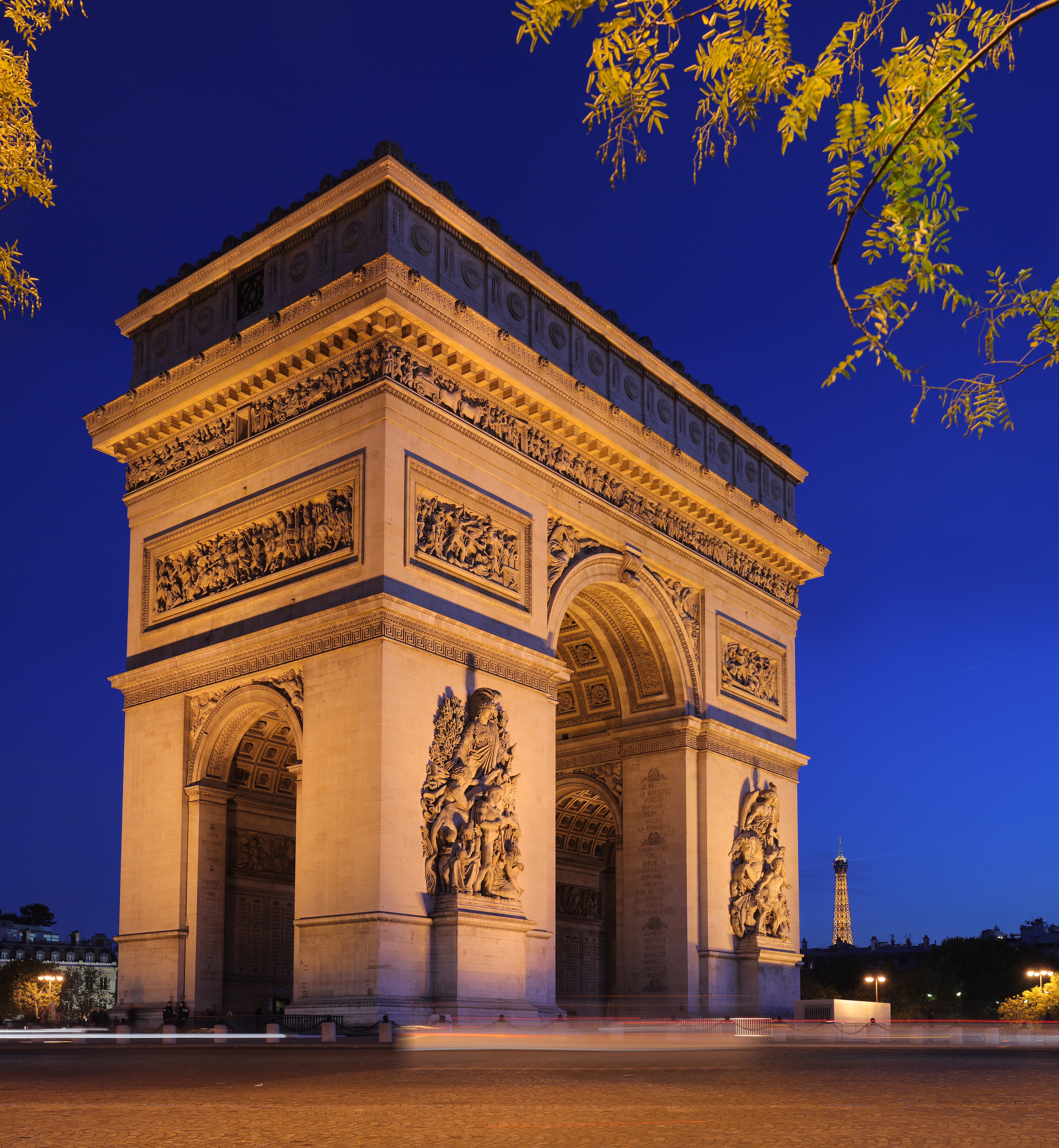
The Arc de Triomphe at the top of the Champs-Élysées. — CC BY-SA 3, by Benh LIEU SONG

The Sainte-Chapelle seen from the east. — CC BY-SA 4, by Uoaei1

The glass pyramid of the Louvre in the Cour Napoléon. — CC BY-SA 4, by Dev Jadiya
Travel to Paris
Getting There and Getting Around
Paris is served by two main airports, Charles de Gaulle to the north-east and Orly to the south, and both are joined to the centre by trains, buses and taxis. The fast trains from London, Brussels and Amsterdam arrive at the great stations of the city, and the rail network joins Paris with every part of France. The historic centre is compact, and most visitors find that they need no transport at all once they have arrived, because the Louvre, Notre-Dame and the Marais all lie within walking distance of each other. Paris is a city for walking, and the walker sees more of it than any passenger.
Inside the city, the Metro is the fastest way to cross Paris, and its lines cover the whole of the capital, with stations close together in the centre. The Metro opened in 1900, and its tiled stations and iron entrances are part of the character of the city, while the buses above ground give a slower and more scenic way to travel. The river boats that run along the Seine offer a different view of the monuments, and a cruise at dusk, when the lights come on along the quays, is one of the finest experiences in the city. For most visitors, the practical plan is simple: walk in the centre, take the Metro for the longer journeys, and save the river for a slow evening.
Cycling is easy in Paris, and the city has built lanes along the river and the boulevards that make the bicycle a real choice for visitors. The bike sharing system puts bicycles at stations across the city, and the flat ground of the centre makes riding pleasant in most weather. The outer districts are reached by the regional trains that run beyond the Metro, and Versailles, the palace to the west, is reached by one of those trains in a journey that takes less than an hour. A little study of the network before the first journey saves confusion later, and the city rewards those who learn its lines.
A Three-Day First Visit
Three days is the right length for a first visit to Paris, and the days should be planned around the great sights, because the queues at the Louvre and the Eiffel Tower are the main constraint on the visit. The first day belongs to the islands and the Right Bank, and it should begin early at Notre-Dame and the Sainte-Chapelle on the Ile de la Cite. From the island, the streets lead to the Louvre, where the pyramid marks the entrance to the largest museum in the world, and the afternoon can be given to the Tuileries Garden and the Place de la Concorde. The evening belongs to the Marais, where the restaurants and the old streets offer a quieter end to the day.
The second day belongs to the great monuments of the west, and it should begin at the Eiffel Tower, completed on 31 March 1889 for the World’s Fair, and standing 330 metres high including its antenna. From the tower, the walk along the river leads to Les Invalides and to the Grand Palais and the Petit Palais, and the afternoon can be given to the Champs-Elysees and the Arc de Triomphe. The evening can be spent on a river cruise, watching the monuments light up along the quays, and the city at dusk is the finest sight in Paris.
The third day should leave the great sights behind, because Paris is best understood in its quarters. The morning can be given to Montmartre, with the Sacre-Coeur above the city and the lanes of the old village below it, and the afternoon to the Latin Quarter and Saint-Germain-des-Pres, with their bookshops, churches and cafes. The evening can be spent in a cafe on a corner square, watching the city go by, and that is the truest way to end a visit to Paris. Visitors with more time can take a day at Versailles, and the palace and its gardens deserve a full day of their own.
Practical Notes for Visitors
The metro carries Paris, and a carnet of tickets or a Navigo pass is worth buying on the first morning, because the distances between districts are longer than they look on the map. Around the Eiffel Tower and Sacré-Cœur, the string men and the petition sellers work the crowds, and the polite answer is a firm no and a kept walking pace. The euro is the currency, and cards are taken in almost every cafe and shop, although the smallest bakeries still prefer coins. A little French goes a long way, bonjour on entering a shop is not politeness but the rule, and the great monuments should be booked ahead, because the summer queues are the longest in the city.
The weather in Paris is mild, and the best seasons for walking are spring and autumn, when the gardens are in flower and the light is soft over the river. Summer brings long evenings and crowded quays, and winter brings short days and the lights of Christmas to the boulevards. Whatever the season, comfortable shoes matter more than anything else in Paris, because the centre is walked on stone, and the distances between the sights are longer than they look on a map. A little patience at the entrances of the great monuments will also help, because security checks take time in the busier months.
Notre-Dame reopened in December 2024 after the fire of April 2019, and entry is free but timed, so the queue moves slowly even with a reservation. The other great churches keep their own hours, and visitors who arrive during mass should sit quietly at the back rather than touring the nave. Modest dress is expected in every church, and photography is forbidden in some chapels while allowed without flash in others, so the sign at the door is the rule. The Louvre, the most visited museum in the world, needs a timed ticket in the busy months, and the quieter streets of the Marais reward those who leave the main boulevards behind.

The Eiffel Tower rises over the Seine, the symbol of Paris — CC BY 2

A river cruise boat on the Seine in Paris. — CC0, by Gary Todd from Xinzheng, China
Notable Places in Paris
The Eiffel Tower is the first place in the city, and it is the symbol of Paris and of France. The tower was completed on 31 March 1889 for the World’s Fair, to mark a hundred years since the Revolution, and it stands 330 metres high including its antenna. The tower was the tallest structure in the world until 1930, and it remains the most visited monument in the city, with views across the whole of Paris from its platforms.
The Louvre is the second place, and it is the largest museum in the world, holding about 35,000 works of art. The palace began as a fortress in 1190, became a royal residence, and opened as a museum in 1793, and its glass pyramid, completed in 1989, marks the entrance today. Notre-Dame Cathedral is the third place, built between 1163 and 1345 on the Ile de la Cite, and its towers and its rose windows are the heart of the city, restored after the fire of April 2019 and reopened in December 2024.
Beyond the centre, the Arc de Triomphe, built between 1806 and 1836, stands at the top of the Champs-Elysees, and the view from its terrace looks down the great avenue toward the Louvre. The Basilica of the Sacre-Coeur, built between 1875 and 1914 on Montmartre, gives the finest view across the city, and the Marais, with the Place des Vosges and its museums, holds the oldest planned square in Paris. The gardens of the Luxembourg and the Tuileries, the church of the Sainte-Chapelle and the palace of Versailles, about 20 kilometres to the west, complete the visit to the capital.

The Basilica of the Sacré-Cœur on Montmartre. — CC BY-SA 4, by Terragio67

The Place des Vosges with the statue of Louis the Thirteenth. — CC BY-SA 4, by Mbzt

The Medici Fountain in the Luxembourg Gardens in a photograph from about 1900. — Public Domain, by Unknown authorUnknown author

The octagonal basin in the Tuileries Garden. — CC BY-SA 3, by Moonik
Frequently Asked Questions
When were the Banks of the Seine placed on the UNESCO World Heritage List?
The Banks of the Seine were placed on the UNESCO World Heritage List in 1991, as reference 600, under criteria (i), (ii) and (iv). The listing covers the stretch of the river from the Louvre to the Eiffel Tower, with the Ile de la Cite, the Ile Saint-Louis and the quays between them.
Is Paris the capital of France?
Yes. Paris is the capital and the largest city of France, and it has been the capital of the French state for more than a thousand years. The city became the capital of the Franks under Clovis in 508, and it has held that role ever since.
How many days should a first visit to Paris take?
Three days is the right length for a first visit to Paris. One day covers the islands, the Louvre and the Marais, one day covers the Eiffel Tower, Les Invalides and the Champs-Elysees, and one day allows Montmartre, the Latin Quarter and Saint-Germain-des-Pres. More time leaves room for a full day at Versailles.
When was the Eiffel Tower completed?
The Eiffel Tower was completed on 31 March 1889, for the World’s Fair held to mark a hundred years since the Revolution. The tower stands 330 metres high including its antenna, and it was the tallest structure in the world until 1930.
When did Notre-Dame Cathedral reopen after the fire?
Notre-Dame Cathedral reopened in December 2024, after a restoration that followed the fire of April 2019, which had destroyed the roof of the cathedral. The cathedral was built between 1163 and 1345, and it stands on the Ile de la Cite at the heart of the city.
What is the best way to cross Paris?
The best way to cross the centre of Paris is on foot, because the Louvre, Notre-Dame and the Marais all lie within walking distance. The Metro is the fastest way to cross the city, and the river boats give the finest view of the monuments. A bicycle is a good choice along the river and the boulevards.
Verified
The population of 2,048,472 in January 2025, the area of 105.4 square kilometres, the metropolitan population of 13,171,056 in 2021 and the 20 arrondissements were taken from the figures carried in the Vietnamese article for Paris and checked against its listed sources. The Eiffel Tower completed on 31 March 1889 and standing 330 metres high including its antenna, the Louvre opened as a museum in 1793 and begun as a fortress in 1190, the glass pyramid completed in 1989, Notre-Dame built between 1163 and 1345, the Arc de Triomphe built between 1806 and 1836, the Metro opened in 1900 and the Sacre-Coeur built between 1875 and 1914 were checked against the same sources.
The fire of Notre-Dame in April 2019 and its reopening in December 2024 were checked against the sources listed below. The UNESCO listing of Paris, Banks of the Seine, in 1991, reference 600, criteria (i), (ii) and (iv), was verified live on whc.unesco.org on 22 November 2026. The Wikidata entry Q90 for Paris, at 48.8567° N, 2.3522° E, with instance-of values including capital city, was verified through the Wikidata API on 22 November 2026. Verified 22 November 2026.
Sources
- Paris, population 2,048,472 in January 2025, area 105.4 square kilometres, metropolitan area 13,171,056 in 2021, 20 arrondissements — https://en.wikipedia.org/wiki/Paris,_%C3%8Ele-de-France,_France
- Eiffel Tower, completed 31 March 1889, 330 metres high, tallest in the world until 1930 — https://www.toureiffel.paris/en/news/history-and-culture/133-years-and-1083-feet
- Paris, Banks of the Seine, UNESCO World Heritage List, reference 600, inscribed 1991, criteria (i), (ii) and (iv) — http://whc.unesco.org/archive/advisory_body_evaluation/600.pdf
- Louvre opened 1793, fortress 1190, glass pyramid 1989, about 35,000 works, Notre-Dame 1163–1345, Arc de Triomphe 1806–1836, Metro opened 1900 — https://nilopelomundo.com/en/place/paris/
- Sacre-Coeur, begun 1875, completed 1914, consecrated 1919 — https://en.wikipedia.org/wiki/Sacr%C3%A9-C%C5%93ur,_Paris
- Wikidata Q90 (Paris, coordinates 48.8567/2.3522) — verified through the Wikidata API, 22 November 2026.
Unverified
- The completion of the Sainte-Chapelle in 1248 is the standard date given by most guides, and this article uses it without a fresh check against the official site of the monument.
- The claim that Paris was the largest city in Europe in the twelfth century is a widely repeated historical statement, and it is given here without a fresh measurement of medieval populations.
- The number of works in the Louvre, given as about 35,000, is an approximate figure that changes as the collections are counted and displayed, and this article presents it as approximate.
- The journey time from the centre of Paris to Versailles is given in this article as less than an hour by regional train, and the exact time depends on the station and the service chosen.
- Ticket prices and opening hours for the Eiffel Tower, the Louvre and the Arc de Triomphe change with the season, and this article gives none of them, so readers should check the official site of each place before visiting.
Illustrations
- Hero: The City of Light on the Banks of the Seine. Free image: https://upload.wikimedia.org/wikipedia/commons/2/22/Avenue_des_Champs-Elys%C3%A9es%2C_Paris_12_December_2020.jpg — CC0.
- In body, The Eiffel Tower and the Seine: The Eiffel Tower rises over the Seine, the symbol of Paris. Free image: https://upload.wikimedia.org/wikipedia/commons/0/0e/Champ_de_Mars_from_the_Eiffel_Tower_-_July_2006_edit.jpg — CC BY 2.
- In body, Notre-Dame Cathedral: Notre-Dame Cathedral on the Île de la Cité, the historic heart of Paris. Free image: https://upload.wikimedia.org/wikipedia/commons/1/18/Cathedrale_Notre-Dame_de_Paris_nef_nouvelles_cloches.jpg — CC BY-SA 3.
- In body, The Seine at the Île de la Cité: The River Seine at the Île de la Cité. Free image: https://upload.wikimedia.org/wikipedia/commons/2/24/River_Seine_at_the_%C3%8Ele_de_la_Cit%C3%A9_3.jpg — CC BY-SA 4, by DiscoA340.
- In body, Arc de Triomphe: The Arc de Triomphe at the top of the Champs-Élysées. Free image: https://upload.wikimedia.org/wikipedia/commons/c/c4/Arc_Triomphe.jpg — CC BY-SA 3, by Benh LIEU SONG.
- In body, Sainte-Chapelle: The Sainte-Chapelle seen from the east. Free image: https://upload.wikimedia.org/wikipedia/commons/c/c1/Paris_Sainte_Chapelle_East_View_01.JPG — CC BY-SA 4, by Uoaei1.
- In body, Louvre Pyramid: The glass pyramid of the Louvre in the Cour Napoléon. Free image: https://upload.wikimedia.org/wikipedia/commons/0/05/Louvre_Pyramid_and_Cour_Napol%C3%A9on_in_Paris%2C_July_2026_01.jpg — CC BY-SA 4, by Dev Jadiya.
- In body, Seine river cruise: A river cruise boat on the Seine in Paris. Free image: https://upload.wikimedia.org/wikipedia/commons/0/05/Paris_Seine_River_Cruise_Boat_%289811842213%29.jpg — CC0, by Gary Todd from Xinzheng, China.
- In body, Sacré-Cœur: The Basilica of the Sacré-Cœur on Montmartre. Free image: https://upload.wikimedia.org/wikipedia/commons/3/3f/Basilique_du_Sacr%C3%A9-C%C5%93ur_de_Montmartre_-Paris–GT-01-_2024.jpg — CC BY-SA 4, by Terragio67.
- In body, Place des Vosges: The Place des Vosges with the statue of Louis the Thirteenth. Free image: https://upload.wikimedia.org/wikipedia/commons/1/10/F0723_Paris_IV_place_Vosges_statue_Louis_XIII_rwk.jpg — CC BY-SA 4, by Mbzt.
- In body, Luxembourg Gardens: The Medici Fountain in the Luxembourg Gardens in a photograph from about 1900. Free image: https://upload.wikimedia.org/wikipedia/commons/5/59/Luxembourg_Gardens%2C_the_Medici_fountains%2C_Paris%2C_France%2C_ca._1890-1900.jpg — Public Domain, by Unknown authorUnknown author.
- In body, Tuileries Garden: The octagonal basin in the Tuileries Garden. Free image: https://upload.wikimedia.org/wikipedia/commons/0/00/Grand_bassin_octogonal_Jardin_des_Tuileries_003.jpg — CC BY-SA 3, by Moonik.