
Nice Places to Visit in France: Sunlight, Sea and Belle Époque Streets
Nice is the largest city of the Côte d’Azur, on a curved bay between sea and Alps. Its promenade and old town have drawn winter visitors for centuries.
The list of Nice places to visit in France begins with the Promenade des Anglais, the seven-kilometre seafront walkway that curves around the Bay of Angels, and it continues through the old town of Vieux Nice, the viewpoint of Castle Hill, the museums of Cimiez and the Russian Orthodox cathedral, each of them shaped by the centuries when Nice was the winter capital of Europe. Nice is a city of light, with more than 300 days of sunshine a year, and it is a city where artists such as Matisse and Chagall chose to live, drawn by the same clear air that once drew British and Russian aristocrats. Nice places to visit in France reward a slow pace, because the city is best understood on foot, from the pebble beaches to the hilltop parks, with the Mediterranean always in view.
Quick Facts About Nice
| Fact | Detail |
|---|---|
| Location | Provence-Alpes-Côte d’Azur, south-east France, on the Mediterranean coast |
| Coordinates | 43.7019° N, 7.2683° E |
| Population | About 350,000 |
| Area | About 71.9 km² |
| Main river | Paillon, flowing through the centre to the sea |
| Airport | Nice Côte d’Azur International Airport, about 6 km from the centre |
| UNESCO | Nice, Winter Resort Town of the Riviera, inscribed 2021, reference 1635, criterion (ii) |
| Wikidata | Q33959 |
Nice is the fifth largest city of France, and the economic and cultural centre of the Côte d’Azur. Its metropolitan area holds about one million people, including the neighbouring towns of Antibes, Cannes and Grasse, and the city combines sea, mountains and urban life in a way that few French cities can match. From the centre of Nice, a visitor can walk to the beach in minutes, take a train to Monaco in twenty minutes, and ride a bus up to the hill villages of Provence within an hour.
Geography of Nice
A Curved Bay Between Sea and Hills
Nice stands on the Mediterranean coast in the south-east of France, near the border with Italy, about 20 kilometres west of Monaco and about 30 kilometres east of Cannes. The city lies in a curved bay called the Baie des Anges, the Bay of Angels, with pebble beaches stretching for about seven kilometres along the Promenade des Anglais. To the north of the city stand hills, the highest of which is Castle Hill at 92 metres, and beyond them rise the Alps, which shelter the coast and shape its mild climate. Nice places to visit in France begin with this setting, because the bay, the hills and the mountains together create the light and the warmth that made the city famous, and the view from Castle Hill across the curved bay is the classic image of the Côte d’Azur.
The River Paillon flows through the centre of Nice, from the north down to the sea, yet most of its course through the centre has been covered over and turned into a long park called the Coulée Verte, or Promenade du Paillon. The park is a green strip a little more than a kilometre long, with gardens, fountains and play areas, and it gives the centre a breathing space between the old town and the modern avenues. The Paillon is a modest river, and it runs dry in summer, yet its valley has shaped the city, because the old town grew on one bank and the new quarters grew on the other. Nice places to visit in France include the park itself, which is one of the most pleasant walks in the city, especially in the heat of the afternoon.
The beaches of Nice are covered in pebbles rather than sand, and the sea turns a deep blue in the afternoon light. The blue chairs of the promenade have become an emblem of the city, and they invite passers-by to sit and watch the bay, with the hills behind and the Alps in the distance.
Climate, Light and the Seasons
Nice has a Mediterranean climate, with hot dry summers of about 25 to 30 degrees Celsius and mild winters of about 8 to 15 degrees. The city counts more than 300 days of sunshine a year, and it is one of the sunniest places in France, which is why the winter here is warmer than in Paris or London and why the city became a winter resort in the nineteenth century. Summer is the peak season, with crowded beaches and higher room prices, while spring and autumn offer warm weather, clear light and fewer visitors. Winter in Nice is cool and quiet, with temperatures of about 10 to 15 degrees, and it is a good time to explore the city without the crowds, although the sea is too cold for most swimmers.
The city has good public transport, with trams, buses and trains serving the centre and the suburbs. Nice Côte d’Azur Airport is the third busiest airport in France, with flights across Europe and beyond, and the tram from the airport reaches the city centre in about thirty minutes. The railway station links Nice with Monaco, Cannes, Italy and Paris, and the buses climb to the hill villages of the hinterland.
The City and Its Neighbours
Nice is the centre of a coastal conurbation that stretches along the Côte d’Azur from Monaco in the east to Cannes in the west, and the towns of the coast are linked by train, bus and a coastal road that is itself one of the great drives of France. Antibes, with its old port and its Picasso museum, lies a short train ride to the west, and Cannes, with its film festival and its palm-lined Croisette, lies a little further on. Further west still, Marseille, the great port of Provence, makes a longer day trip by train.
The hill villages of Èze, Saint-Paul-de-Vence and Gourdon stand above the coast, and they make easy half-day trips from Nice by bus. Nice places to visit in France are often combined with these neighbours, and the city works well as a base for the whole Riviera, because its airport, its station and its bus network reach every town on the coast.

Promenade des Anglais (Nice), France — CC BY-SA 4

Place Masséna, the main square of Nice, with its red facades — CC BY-SA 4
History of Nice
Nikaia, a Greek Foundation of About 350 BC
Nice was founded in about 350 BC by Greeks from the city of Marseille, with the name Nikaia, which means victory. The city quickly became an important trading port on the Mediterranean coast, and it later belonged to the Roman Empire under the name Nicaea, with a hilltop settlement and a port that served the coast of Provence. The Greek foundation gave Nice its first identity as a port of trade and exchange, and the name of the city still carries the Greek word for victory, a reminder that the place began as a colony of a distant city. Nice places to visit in France still carry traces of this ancient past, above all on Castle Hill, where the medieval castle stood on the site of earlier settlements, and in the museum collections that hold the remains of the Greek and Roman town.
Five Centuries Under Savoy, 1388 to 1860
In 1388, Nice joined the Kingdom of Sardinia, and it belonged to that kingdom for nearly five hundred years, until 1860. During this long period, the city developed its own identity, with Niçard, a dialect of Occitan, as its language, and with architecture and culture shaped more by Italy than by France. The old town of Vieux Nice, with its narrow lanes, tall houses and baroque churches, was built in these centuries, and its colours, its markets and its street life still reflect the Italian influence of the Savoyard period. The city was a frontier town, fought over by France and Savoy, and its castle on Castle Hill was destroyed in the early eighteenth century, yet the town survived and kept its character as a Mediterranean port with a culture of its own.
In 1860, under the Treaty of Turin, Nice was annexed to France, together with the region of Savoy, and the annexation changed the future of the city completely. Nice was now part of a large country, with a railway linking it to Paris and to the other cities of France, and its population grew rapidly, with new quarters, avenues, squares and villas rising beyond the old town. The annexation brought French administration, French schools and French law, yet the city kept its Niçard traditions, its Italian cooking and its Mediterranean street life, and the mixture of French and Italian influences is still visible in the streets today. Nice places to visit in France show this double heritage everywhere, from the Italianate facades of the old town to the French boulevards of the new quarters.
The Winter Resort of Europe
In the eighteenth and nineteenth centuries, Nice became the most famous winter resort in Europe. From the middle of the eighteenth century, British aristocratic families began to spend their winters in Nice to escape the cold of England, and they were the first to build villas and hotels along the coast. The Promenade des Anglais, the most famous seafront walkway in the city, was built in the 1820s and named after these English winter visitors, and it remains the symbol of Nice to this day. The winter residents became the driving force behind the growth of the city, and their money, their taste and their demand for hotels, villas and promenades shaped the new quarters that rose beside the medieval old town.
In the nineteenth century, Nice attracted visitors from all over Europe, including the Russian imperial family, artists and writers, and Queen Victoria of England spent many winters here. The city became an international centre, with English, Russian, Italian and German communities, and its hotels and villas grew grander with each decade. The Russian Orthodox Cathedral of Saint Nicholas, opened in 1912, was built to serve the large Russian community, and it is the largest Russian Orthodox church outside Russia. The Nice places to visit in France from this period include the Belle Époque hotels along the promenade, the villas of Cimiez and the Russian cathedral, and together they tell the story of a city that was built by its winter guests.
From Winter Capital to Summer City
In the twentieth century, Nice gradually changed from a winter resort into a summer destination, with the beaches and the outdoor life becoming the main attraction. The city also became a centre of art, with Henri Matisse and Marc Chagall living and working here for decades, and their museums in Cimiez are among the most visited in France. On 14 July 2016, a terrorist attack on the Promenade des Anglais killed 86 people, and the city mourned on a promenade that had always been a place of pleasure.
In 2021, UNESCO inscribed Nice as a World Heritage property, under the name Nice, Winter Resort Town of the Riviera, reference 1635, recognising the role of the city in the history of European tourism. Today Nice is one of the most visited cities in France, with millions of visitors every year, and it is the gateway to the Côte d’Azur.

Nice Vieux-Nice 1 — CC BY-SA 4
Travel to Nice
When to Go and How Long to Stay
The best time to explore Nice places to visit in France is from April to June, and from September to October, when the weather is warm, the sun shines and the crowds are thinner than in summer. Summer, from July to August, is the peak season, with crowded beaches, higher room prices and temperatures that can reach 30 degrees Celsius, while winter in Nice is mild and quiet, with temperatures of about 10 to 15 degrees, and it is a good time to see the city without the crowds. Three days are enough for Nice itself, and the city rewards a slower pace, because its pleasures are the promenade, the old town, the markets and the views, all of which take time to enjoy properly.
Three days among the Nice places to visit in France can be planned as follows: the first day for the Promenade des Anglais, the old town of Vieux Nice and Castle Hill, the second day for the museums, the Cimiez quarter and the Belle Époque streets, and the third day for a trip to Monaco, Èze or Cannes, each less than an hour away by train or bus. Visitors who stay longer can add the hill villages of the hinterland, the markets of the old town and the beaches of the bay, and the city has enough depth for a week without repetition. Nice places to visit in France are best seen on foot, because the centre is compact and the most interesting streets are the narrow lanes of the old town, where cars cannot go.
Getting Around the City
The best way to explore the centre of Nice is on foot, because many of the main sights lie within walking distance of the Promenade des Anglais and the old town. The tram is the most convenient way to go further, with a line running along the coast and into the centre, and the buses reach the suburbs and the hill villages, while the trains run to Monaco, Cannes and Italy.
Nice places to visit in France are easy to reach without a car, because the centre is compact and the tram runs along the coast, yet a car is useful for the hill villages and the mountain roads behind the city. Nice Côte d’Azur Airport stands about six kilometres from the centre, and the tram from the airport reaches the centre in about thirty minutes, which makes it the cheapest and simplest choice. Taxis and airport buses are available too, yet the tram is the option that most visitors choose, because it is fast, frequent and inexpensive.
Eating in Nice
The food of Nice is one of the great attractions of the city, with the specialities of Provence and the Mediterranean on every menu. The most famous dish is the salade niçoise, with tuna, eggs, green beans, tomatoes and olives, and the socca, a thin pancake made from chickpea flour, baked in an oven and eaten hot, is the street food of the city. The Cours Saleya market in the old town is the best place to try socca, with stalls selling the traditional street food of Nice, and the market also sells flowers, vegetables, olives and local specialities. Nice places to visit in France for food lovers include the market itself, the restaurants of the old town and the cafés of the port, where the cooking reflects the mixture of French, Italian and Mediterranean traditions that defines the city.
Notable Places in Nice
Promenade des Anglais — the Seafront Walkway
The Promenade des Anglais is a seafront walkway about seven kilometres long, running along the Bay of Angels from the airport to the port of Nice. The promenade was built in the 1820s and named after the first English winter visitors to Nice, and today it is the most famous symbol of the city, with a wide pavement, palm trees, blue chairs and a view across the Mediterranean. The promenade is a place for walking, cycling, running and sitting, and it is busy from dawn to midnight, with joggers in the morning, families in the afternoon and strollers in the evening. Nice places to visit in France begin here, because the promenade is the front room of the city, and the view from it, with the curved bay, the pebble beach and the hills behind, is the image that most visitors carry home.
Vieux Nice — the Old Town and the Cours Saleya Market
Vieux Nice, the old town of Nice, is the historic heart of the city, lying between Castle Hill and the Paillon. The quarter holds narrow stone lanes, tall houses with windows painted yellow, orange and red, baroque churches and small squares, and it is the liveliest part of Nice, with restaurants, cafés, shops and markets. The Cours Saleya, the market square of the old town, holds a daily flower and food market, and it is the best place in the city to buy olives, cheese, vegetables and the socca that is the street food of Nice. Nice places to visit in France include the old town above all, because its lanes, its colours and its street life show the Nice that existed before the grand hotels and the promenade.

The flower and vegetable stalls of the Cours Saleya market in Vieux Nice — CC BY-SA 4

The Cathedral of Sainte-Reparate in Vieux Nice — CC BY-SA 3
Castle Hill — the Best Viewpoint in Nice
Castle Hill, the Colline du Château, is a hill 92 metres high at the eastern end of the old town, where the castle of Nice once stood in the Middle Ages. The castle was destroyed in the early eighteenth century, yet the hill remains a large park, with gardens, a man-made waterfall and a viewpoint that looks out over the whole of Nice. From the top of the hill, visitors can see the Promenade des Anglais, Vieux Nice, the port and the Mediterranean Sea, and the view is the finest in the city. The climb to the top takes about twenty minutes on foot, and there is also a lift, yet the walk is part of the pleasure, because the park is quiet and green, and the view grows better with every step.

The harbour of Nice seen from Castle Hill, with the port below — CC BY-SA 4
The Matisse and Chagall Museums — Modern Art in Cimiez
The Cimiez quarter, in the north of Nice, holds the two most important art museums of the city: the Matisse Museum and the National Marc Chagall Museum. Henri Matisse lived in Nice for decades, and the Matisse Museum holds a large collection of his works, including paintings, sculptures and the paper cut-outs of his last years. The Chagall Museum holds the great biblical paintings of Marc Chagall, who also lived in the region, and its garden and its stained glass make it one of the most peaceful museums in France. Nice places to visit in France for lovers of modern art begin in Cimiez, and the quarter itself, with its Roman ruins, its monastery gardens and its Belle Époque hotels, is worth a slow morning.

The Matisse Museum in Cimiez, in its red villa above the olive trees — CC BY-SA 2
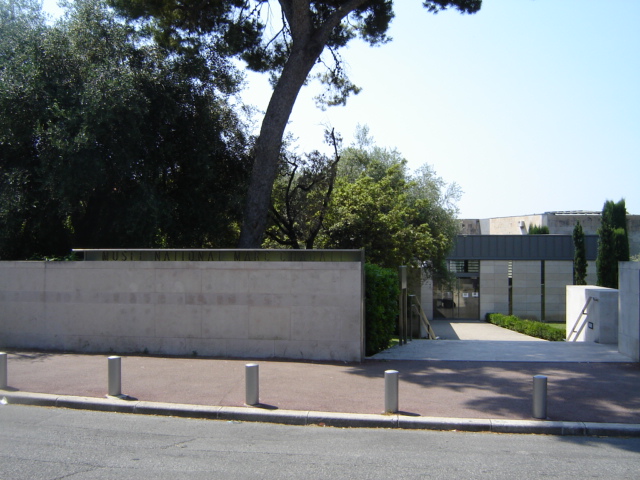
The entrance to the Marc Chagall Museum in Cimiez — CC BY-SA 3

The Russian Orthodox Cathedral of Saint Nicholas
The Russian Orthodox Cathedral of Saint Nicholas, opened in 1912, is one of the most beautiful churches in Nice, and it is the largest Russian Orthodox church outside Russia. The cathedral was built to serve the large Russian community that lived in Nice at the end of the nineteenth century and the beginning of the twentieth, when the city was a favourite destination of the Russian imperial family and the Russian aristocracy. Its onion domes, its icons and its richly decorated interior stand in striking contrast to the Mediterranean streets around it, and the cathedral is a reminder of the international character of Nice in its years as a winter resort. Nice places to visit in France include this cathedral, because it tells the story of a community that shaped the city, and its domes are visible from many points in the northern quarters.

The Russian Orthodox Cathedral of Saint Nicholas, with its onion domes — CC BY-SA 4
The Port of Nice and the Harbour Quarter
The Port of Nice, or Port Lympia, is the main harbour of the city, lying at the eastern end of the old town, below Castle Hill. The port is a place of yachts, sailing boats and ferries to Corsica and Italy, and the area around it holds seafood restaurants, cafés and shops, and it is a good place to eat in the evening and to watch the boats. The harbour quarter has a different character from the promenade, because it is a working port with fishermen, ferries and shipyards, and its streets are quieter than the old town. A walk from the port up to Castle Hill, or along the quay in the evening, is one of the most pleasant ends to a day among the Nice places to visit in France.

Yachts moored in the Port of Nice, in the Lympia basin — CC0
Frequently Asked Questions About Nice Places to Visit in France
Is Nice a UNESCO World Heritage property?
Yes, Nice was inscribed by UNESCO in 2021 as a World Heritage property, under the name Nice, Winter Resort Town of the Riviera, reference 1635, criterion (ii). The inscription recognises the role of the city in the history of European tourism, when it became the most famous winter resort in Europe in the eighteenth and nineteenth centuries.
How many days are enough for the Nice places to visit in France?
Three days are enough for the main Nice places to visit in France, with the first day for the Promenade des Anglais, Vieux Nice and Castle Hill, the second for the museums and Cimiez, and the third for a day trip to Monaco, Èze or Cannes. Visitors who stay longer can add the hill villages, the markets and the beaches without repetition.
How long is the Promenade des Anglais?
The Promenade des Anglais is about seven kilometres long, running along the Bay of Angels from the airport to the port of Nice. The walkway was built in the 1820s and named after the first English winter visitors to the city, and it remains the most famous symbol of Nice.
What is the best time of year to visit Nice?
April to June and September to October are the best months, with warm weather, clear light and fewer visitors than in summer. Winter is mild and quiet, with temperatures of about 10 to 15 degrees, while summer is the peak season, with crowded beaches and higher room prices.
How do visitors reach Nice from the airport?
Nice Côte d’Azur Airport stands about six kilometres from the city centre, and the tram from the airport reaches the centre in about thirty minutes. The tram is the cheapest and simplest choice, although airport buses and taxis are available too.
What food should visitors try in Nice?
The salade niçoise, with tuna, eggs, green beans, tomatoes and olives, is the most famous dish of the city, and the socca, a thin pancake of chickpea flour eaten hot, is its street food. The Cours Saleya market in the old town is the best place to try both, with stalls selling the traditional food of Nice.
Verified
The evidence behind this guide was gathered from the official records on 22 November 2026, and it starts with the identity of the city. The Wikidata record Q33959 describes Nice as a commune of France and a large city, with coordinates 43.701944444444 degrees north and 7.2683333333333 degrees east, and the live record returned by the Wikidata service on the check date matches those values. The city stands in Provence-Alpes-Côte d’Azur in the south-east of France, covers about 71.9 square kilometres and holds about 350,000 residents, and its airport, Nice Côte d’Azur, stands about six kilometres from the centre.
On the World Heritage question, the registry flag for Nice reads false, and that flag is wrong. UNESCO inscribed Nice in 2021 as a World Heritage property, under the name Nice, Winter Resort Town of the Riviera, reference 1635, criterion (ii), and the brief synthesis on the UNESCO World Heritage Centre website, read on 22 November 2026, describes the city as the witness to the evolution of the winter resort, shaped by British, Italian, French, Russian and other influences. The UNESCO World Heritage List counts 54 French properties, forty-five cultural, seven natural and two mixed, as recorded on the same date. This guide follows the UNESCO record rather than the registry flag, and the flag error has been recorded for the batch fix decision.
The historical facts behind the Nice places to visit in France in this guide were checked against the same round of sources. Nice was founded by Greeks from Marseille in about 350 BC under the name Nikaia, it belonged to the Kingdom of Sardinia from 1388 until the Treaty of Turin annexed it to France in 1860, and the Promenade des Anglais was built in the 1820s. The Russian Orthodox Cathedral of Saint Nicholas opened in 1912, the attack of 14 July 2016 on the Promenade des Anglais killed 86 people, and Castle Hill rises 92 metres above the old town.
Sources
- UNESCO World Heritage Centre — Nice, Winter Resort Town of the Riviera, inscribed 2021, reference 1635: https://whc.unesco.org/en/list/1635/
- UNESCO World Heritage Centre — France, 56 properties inscribed: https://whc.unesco.org/en/statesparties/fr
- Wikidata — Nice, Q33959: https://www.wikidata.org/wiki/Q33959
Unverified
- The exact current population of Nice is given as about 350,000, following the Vietnamese corpus, and the latest municipal figure was not rechecked on 22 November 2026.
- The claim that Nice counts more than 300 days of sunshine a year follows the Vietnamese corpus, and the exact figure was not rechecked against a current meteorological source on 22 November 2026.
- The ranking of Nice Côte d’Azur Airport as the third busiest airport in France follows the Vietnamese corpus, and the current passenger ranking was not rechecked on 22 November 2026.
Illustrations
- Hero: Nice Promenade des Anglais 09. Free image: https://upload.wikimedia.org/wikipedia/commons/9/94/Nice_Promenade_des_Anglais_09.jpg — CC BY-SA 4.
- In body, Promenade des Anglais: Promenade des Anglais (Nice), France. Free image: https://upload.wikimedia.org/wikipedia/commons/5/5d/Promenade_des_Anglais_%28Nice%29%2C_France.jpg — CC BY-SA 4.
- In body, Vieux Nice: Nice Vieux-Nice 1. Free image: https://upload.wikimedia.org/wikipedia/commons/1/16/Nice_Vieux-Nice_1.jpg — CC BY-SA 4.
- In body, Castle Hill: The harbour of Nice seen from Castle Hill, with the port below. Free image: https://upload.wikimedia.org/wikipedia/commons/c/c3/Nice_Harbor_from_Castle_Hill.jpg — Yair Haklai, CC BY-SA 4.
- In body, Matisse Museum: The Matisse Museum in Cimiez, in its red villa above the olive trees. Free image: https://upload.wikimedia.org/wikipedia/commons/9/96/Musee_Matisse_2.jpg — bchookang, CC BY-SA 2.
- In body, Marc Chagall Museum: The entrance to the Marc Chagall Museum in Cimiez. Free image: https://upload.wikimedia.org/wikipedia/commons/0/08/Mus%C3%A9e_Marc_Chagall.jpg — Europe22, CC BY-SA 3.
- In body, Russian Orthodox Cathedral: The Russian Orthodox Cathedral of Saint Nicholas, with its onion domes. Free image: https://upload.wikimedia.org/wikipedia/commons/d/d6/Russian_Orthodox_Cathedral%2C_Nice.jpg — Pufacz, CC BY-SA 4.
- In body, Port of Nice: Yachts moored in the Port of Nice, in the Lympia basin. Free image: https://upload.wikimedia.org/wikipedia/commons/a/ac/Nice_Port_Lympia.jpg — Suziwan, CC0.
- In body, Cours Saleya: The flower and vegetable stalls of the Cours Saleya market in Vieux Nice. Free image: https://upload.wikimedia.org/wikipedia/commons/c/c2/Cours_Saleya_flower_market_vegetable_stalls_Nice_2026.JPG — Mike is Michi, CC BY-SA 4.
- In body, Nice Cathedral: The Cathedral of Sainte-Reparate in Vieux Nice. Free image: https://upload.wikimedia.org/wikipedia/commons/0/02/Cathedrale_Sainte-Reparate_Nice.jpg — Myrabella, CC BY-SA 3.
- In body, Place Masséna: Place Masséna, the main square of Nice, with its red facades. Free image: https://upload.wikimedia.org/wikipedia/commons/5/53/Nice_-Place_Mass%C3%A9na-_View_NNW_II.jpg — Txllxt TxllxT, CC BY-SA 4.
- In body, the Monastery of Cimiez: The view over Nice from the garden of the Monastery of Cimiez. Free image: https://upload.wikimedia.org/wikipedia/commons/4/48/Nice_Monast%C3%A8re_de_Cimiez_Vue_sur_Nice_1.jpg — CC BY-SA 4, by Zairon.