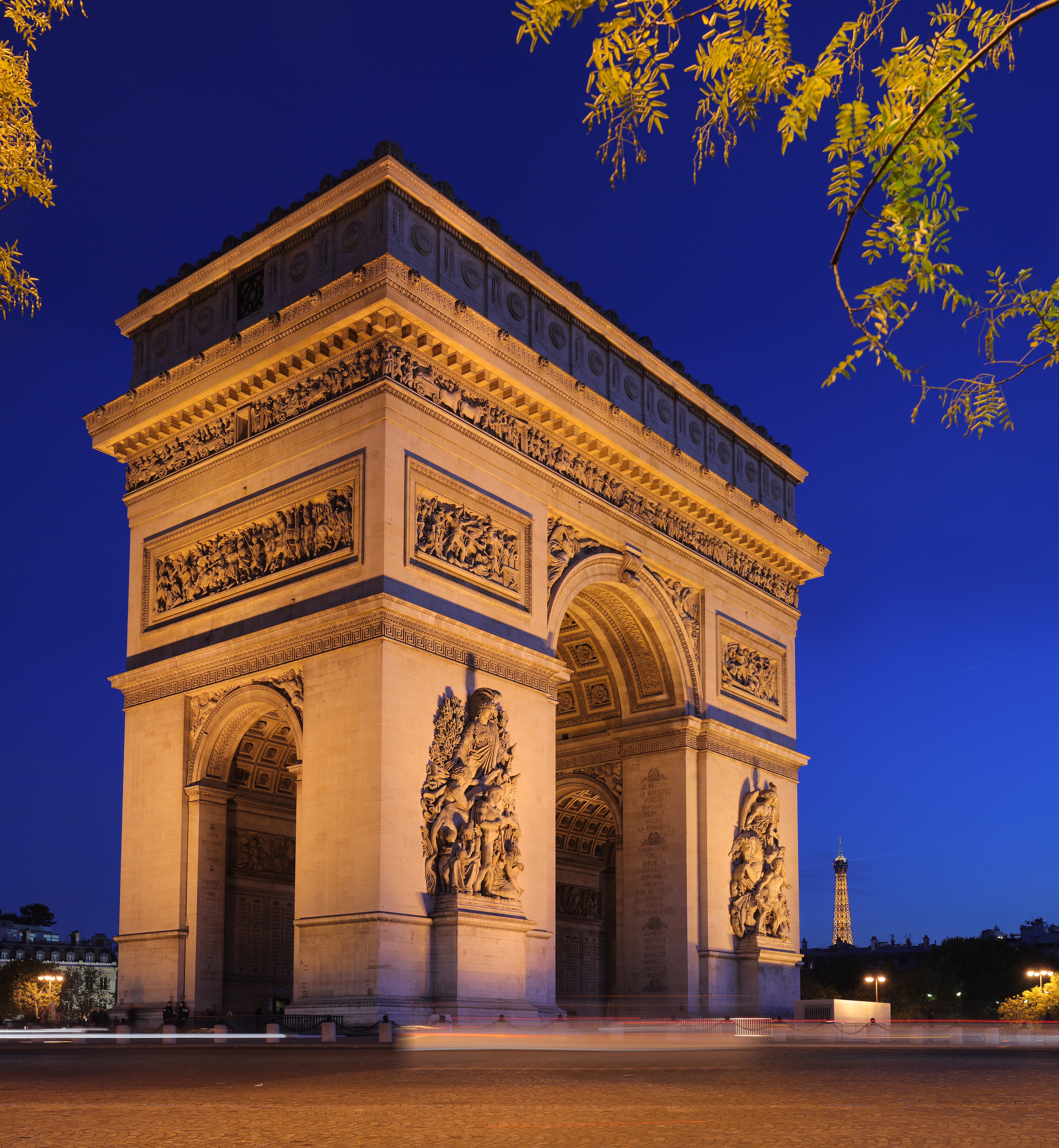
Arc de Triomphe — The Star at the End of the Champs-Élysées
The Arc de Triomphe stands at the centre of twelve broad avenues. Napoleon ordered it, but it outlived him by fifteen years.
The arch has stood there since 1836, and no other monument sums up Paris so plainly. Napoleon ordered it to honour his soldiers, and it became instead the place where France remembers its dead. The arch rises 49.54 m above the Place Charles de Gaulle, at the western end of the Champs-Élysées, where twelve avenues meet like the points of a star.
Beneath its great vault burns the flame of the Tomb of the Unknown Soldier, and on its faces are carved the names of victories and generals from the Revolutionary and Napoleonic wars. From its terrace, the whole historic axis of Paris opens out, from the Louvre in the east to the Grande Arche at La Défense in the west, and the monument stands as both a triumphal arch and a war memorial, in a city that has made it the centre of its national ceremonies.
Quick Facts
| Item | Information |
|---|---|
| Name | Arc de Triomphe de l’Étoile |
| Location | Place Charles de Gaulle, Paris, France |
| Coordinates | 48.8738° N, 2.2950° E |
| Height | 49.54 m |
| Width | 44.82 m |
| Depth | 22.21 m |
| Main arch | 29.19 m high, 14.62 m wide |
| Construction began | 15 August 1806 |
| Inaugurated | 28 July 1836 |
| Architect | Jean-François Chalgrin |
| Style | Neoclassical |
| UNESCO | Part of the Banks of the Seine, Paris, 1991, reference 600 |
| Wikidata | Q64436 |
| GeoNames | 6269533 |
Geography of the Arc de Triomphe
The Star of Twelve Avenues
The Arc de Triomphe stands on the right bank of the Seine, at the centre of a twelve-sided square whose paving stones form a star pointing toward the centre of each avenue. The site was chosen with care: in the eighteenth century the square was an open space on the Chaillot hill, where roads from every direction met, and Napoleon chose this high point for a monument that could be seen from all over Paris. The square was once called the Place de l’Étoile, the Place of the Star, and it still carries that shape, at the meeting point of the 8th, 16th and 17th arrondissements of Paris.
Twelve avenues radiate from the square, among them the Avenue Foch, the Avenue Victor Hugo and the Champs-Élysées, forming one of the most famous road junctions in Paris. The traffic circle has no traffic lights for pedestrians, and visitors should never try to cross it on foot at street level. The safe way to reach the arch is by metro to Charles de Gaulle–Étoile station, served by lines 1, 2 and 6 and by RER A, which sits directly beneath the square and has an underground passage leading straight to the foot of the monument.
The Historic Axis
The Arc de Triomphe is the central point of the historic axis that runs east to west through Paris, from the courtyard of the Louvre, through the Tuileries Garden, the Place de la Concorde, the Champs-Élysées, the arch itself, the Avenue de la Grande Armée and on to the Grande Arche at La Défense. The axis runs for about 8 km and is one of the longest and straightest urban axes in Europe, with monuments and avenues planned across many centuries.
From the terrace of the arch, the whole axis is visible: eastward along the Champs-Élysées toward the Tuileries and the Louvre, and westward along the Grande Armée toward the Grande Arche at La Défense. The Eiffel Tower stands about 2 km away, and Notre-Dame Cathedral about 5 km to the east.
The district around the square is one of the most elegant in Paris, with Haussmann buildings, grand hotels and luxury shops along the Champs-Élysées. The avenue itself runs for nearly 2 km from the Place de la Concorde to the arch, lined with cinemas, theatres, cafés and flagship stores, and it fills with crowds on national holidays and after great sporting victories. The streets behind the avenue hold quieter corners, with embassies, private mansions and small squares that show a calmer side of the district, and the whole area rewards an unhurried walk once the terrace visit is done.
The climate of Paris is mild, with moderately cold winters and warm summers, and the arch can be visited all year round. The finest light comes at sunset, when the sun shines through the main arch and the Champs-Élysées turns gold, and at night, when the monument is lit and the eternal flame burns bright beneath the vault.

Arc de Triomphe de l’Étoile at night, Paris, France — CC0
History of the Arc de Triomphe
Napoleon and Thirty Years of Building
The arch was ordered by Emperor Napoleon I in 1806, after the victory at Austerlitz on 2 December 1805, one of his greatest military triumphs. Napoleon wanted a monument to honour the Grande Armée, the army that had carried him to victory across Europe, and the architect Jean-François Chalgrin was given the design, taking his inspiration from the Arch of Titus in Rome. Laying the foundations alone took two years, and in 1810, when Napoleon welcomed his new empress Marie-Louise of Austria into Paris, a wooden model of the monument was raised to greet the procession.
Chalgrin died in 1811, and the work passed to Louis-Robert Goust, but construction stopped during the Bourbon Restoration, when the unfinished monument stood abandoned for years. Work resumed only in 1823, and the arch was finally completed under King Louis-Philippe I and inaugurated on 28 July 1836, exactly thirty years after work had begun. The total cost came to about 10 million francs, an enormous sum at the time, and Napoleon, who had ordered the monument, had died in 1821 and never saw it finished.
In 1840, the remains of Napoleon were brought back from Saint Helena, and the funeral procession carrying them passed beneath the arch on its way to Les Invalides, a symbolic moment for the history of France. The arch that Napoleon built to celebrate his victories became, in the end, the gateway through which his own body returned to Paris.
The Tomb of the Unknown Soldier and the Twentieth Century
After the First World War, the arch became the place where France remembers its fallen soldiers, when the Tomb of the Unknown Soldier was placed beneath the main vault. The eternal flame beside the tomb was lit in 1923 and burns day and night, relit every evening in a solemn ceremony. Since the tomb was placed there, every military parade, including the Bastille Day parade of 14 July, passes around the side of the monument rather than through the vault, out of respect for the unknown soldier.
The arch has witnessed many of the great moments of French history in the twentieth century. In 1919, three weeks after the victory parade that ended the First World War, the pilot Charles Godefroy flew his aeroplane through the main arch, an event caught on film that became a legend. German troops marched around the arch in 1871 and again in 1940, and French and Allied troops marched past in 1919, 1944 and 1945, after Paris was liberated. On 26 August 1944, General de Gaulle led the Free French forces in parade from the arch after the liberation of the city.
By the early 1960s the monument had turned black with coal smoke and car exhaust, and in 1965 and 1966 it was cleaned by whitening. In 1998, when France won the football World Cup for the first time, the images and names of the players were projected onto the arch, and the square filled with hundreds of thousands of celebrating fans.
The Twenty-First Century and Recent Events
Late in 2018, the arch was damaged during the yellow vest protests, when demonstrators sprayed paint on the monument and damaged the museum inside. In September 2021, the arch was wrapped in silver-blue fabric and red rope in the work L’Arc de Triomphe, Wrapped, a posthumous project by the artists Christo and Jeanne-Claude, planned since the early 1960s and shown for 16 days.
Timeline
| Year | Event |
|---|---|
| 2 December 1805 | Napoleon wins the Battle of Austerlitz |
| 15 August 1806 | Construction of the Arc de Triomphe begins |
| 1811 | Architect Chalgrin dies, Louis-Robert Goust continues the work |
| 28 July 1836 | The arch is inaugurated, after 30 years of building |
| 1840 | Napoleon’s remains pass beneath the arch on the way to Les Invalides |
| 1919 | Pilot Charles Godefroy flies through the main arch |
| 1923 | The eternal flame at the Tomb of the Unknown Soldier is lit |
| 26 August 1944 | General de Gaulle leads the Free French parade from the arch |
| 1991 | The Banks of the Seine in Paris are inscribed by UNESCO, reference 600 |
| 2021 | L’Arc de Triomphe, Wrapped by Christo and Jeanne-Claude covers the monument for 16 days |

Arc de Triomphe de l’Etoile, Paris, France — Public domain
Travel to the Arc de Triomphe
When to Go
The arch can be visited all year, since the monument stands outdoors and the terrace is open most days of the year. The best seasons are spring, from April to June, and autumn, from September to October, when the weather in Paris is mild, the light is fine and the crowds are moderate. Summer, from July to August, is the peak season in Paris, with long queues for the terrace and a crowded square, yet the long summer evenings bring a beautiful sunset seen from the terrace.
How Long to Stay
A visit to the arch takes about one to two hours, including the climb of 284 steps to the terrace, the view from the top and a visit to the small museum inside the monument. The museum tells the story of the building of the arch and the events that have taken place there, with models, drawings and original objects. The terrace is the highlight of the visit, with a 360-degree view over Paris, including the Eiffel Tower, the hill of Montmartre, Les Invalides and the Grande Arche at La Défense.
Getting There
The safe way to reach the arch is by metro to Charles de Gaulle–Étoile station, on lines 1, 2 and 6 and RER A, since the station lies directly beneath the square and has an underground passage to the foot of the monument. Visitors should never walk across the Place Charles de Gaulle at street level, since the traffic circle is one of the most dangerous in Paris, with cars arriving from twelve avenues at once and no traffic lights for pedestrians. Paris is the hub of the French rail network, and fast trains run south to Bordeaux and Toulouse, so the arch is often the first stop on a longer tour of France.
Eating
The area around the arch and the Champs-Élysées offers many places to eat, from traditional pavement cafés to grand restaurants and fast food shops. The cafés on the Champs-Élysées, such as Fouquet’s, are historic places in Paris, where artists, politicians and film stars once gathered, but prices there are usually far higher than in other districts of the city.
Climbing to the Terrace
To reach the terrace, visitors must climb 284 steps up a narrow spiral staircase inside the monument, since there is no lift for ordinary visitors. The staircase has resting places, but anyone with heart or breathing problems, or difficulty moving, should think carefully before climbing. The terrace stays open late in summer and is one of the finest places in Paris to watch the sunset, when the light slants along the Champs-Élysées and the city turns gold. Visitors should book tickets online in advance to avoid long queues, especially in the peak season, and bring a jacket, since the wind on the terrace can be strong and cold.
Notable Places in the Arc de Triomphe
- The Tomb of the Unknown Soldier — the tomb beneath the main vault, with the eternal flame lit in 1923, remembering the French soldiers who died in the First World War without being identified.
- The Four Great Sculptures — four sculptural groups on the faces of the monument, the most famous being La Marseillaise by François Rude.
- The Names of Victories and Generals — hundreds of names of generals and battles carved on the inner and outer faces of the monument.
- The Terrace — the terrace on top of the monument, 49.54 m high, with a 360-degree view over Paris, the Eiffel Tower, Montmartre and the Grande Arche at La Défense.
- The Champs-Élysées — the most famous avenue in Paris, running from the Place de la Concorde to the Place Charles de Gaulle.
- The Place Charles de Gaulle — the star-shaped square with twelve avenues radiating from it, one of the most famous road junctions in Europe.
- The Historic Axis — the straight line of about 8 km from the Louvre to the Grande Arche at La Défense, with the arch at its centre.
- The Grande Arche at La Défense — the modern arch 110 m high at the end of the historic axis, completed in 1989, visible from the terrace of the Arc de Triomphe.
- Les Invalides — the military complex and museum in the south of Paris, where Napoleon’s remains rest after passing beneath the arch in 1840.
Frequently Asked Questions
Where is the Arc de Triomphe?
The arch stands at the western end of the Champs-Élysées, at the centre of the Place Charles de Gaulle in Paris, France, at the meeting point of the 8th, 16th and 17th arrondissements. The square was once called the Place de l’Étoile, since twelve avenues radiate from it in the shape of a star. Visitors reach it by metro to Charles de Gaulle–Étoile station, on lines 1, 2 and 6 and RER A, and walk through the underground passage to the foot of the monument.
How tall is the Arc de Triomphe, and how long did it take to build?
The arch is 49.54 m high, 44.82 m wide and 22.21 m deep, with a main arch 29.19 m high and 14.62 m wide. Work began on 15 August 1806, after Napoleon’s victory at Austerlitz, and the arch was inaugurated on 28 July 1836, after exactly thirty years of building. The original architect was Jean-François Chalgrin, who took his inspiration from the Arch of Titus in Rome.
What is the Tomb of the Unknown Soldier?
The Tomb of the Unknown Soldier lies beneath the main vault of the arch, remembering the French soldiers who died in the First World War and could not be identified. The eternal flame beside the tomb was lit in 1923 and burns day and night, relit every evening in a solemn ceremony.
Is the Arc de Triomphe a UNESCO World Heritage site on its own?
Not as a separate property, but it forms part of the Banks of the Seine in Paris, inscribed by UNESCO in 1991 under reference 600 and criteria (i), (ii) and (iv). The property covers the stretch of the Seine through Paris together with the monuments and districts along both banks, including the area around the arch and the Champs-Élysées.
Can visitors climb to the top of the Arc de Triomphe?
Yes, visitors can climb 284 steps up the spiral staircase inside the monument to reach the terrace, which gives a 360-degree view over Paris. From the terrace, visitors can see the Eiffel Tower, the hill of Montmartre, Les Invalides, Notre-Dame Cathedral and the Grande Arche at La Défense, along with the whole historic axis from the Louvre to La Défense.
When is the best time of day to visit the Arc de Triomphe?
The best time is sunset, when the light slants along the Champs-Élysées and the city turns gold, and at night, when the monument is lit and the eternal flame burns bright beneath the vault. Early morning is also a good time to visit, when the square is still quiet and the light is soft.
Verified
The Arc de Triomphe is 49.54 m high, 44.82 m wide and 22.21 m deep, with a main arch 29.19 m high and 14.62 m wide. Work began on 15 August 1806 and the arch was inaugurated on 28 July 1836, thirty years later, under King Louis-Philippe I.
The architect was Jean-François Chalgrin, the cost came to about 10 million francs, and Napoleon’s remains passed beneath the arch in 1840 on the way to Les Invalides. The eternal flame at the Tomb of the Unknown Soldier was lit in 1923, Charles Godefroy flew through the arch in 1919, and L’Arc de Triomphe, Wrapped by Christo and Jeanne-Claude covered the monument for 16 days in September 2021. These facts were checked against the cited sources on 23 November 2026.
Wikidata holds the arch as item Q64436, a triumphal arch at 48.8738 degrees north and 2.2950 degrees east, which matches the registry coordinates. The registry primary keyword for this entry is the French form “arc de triomphe de l étoile”, while this article uses the standard English name Arc de Triomphe as its focus.
The arch stands within the Banks of the Seine in Paris, inscribed by UNESCO in 1991 under reference 600 and criteria (i), (ii) and (iv). The property covers the bridges, quays and banks of the Seine in its historic course, between the Pont de Sully and the Pont d’Iéna, together with the Ile de la Cité and the Ile Saint Louis, and the UNESCO text names the Grand Palais of the Champs-Élysées among its masterpieces. The reference 600 listing was confirmed on the UNESCO World Heritage Centre site on 23 November 2026.
The arch is not a separate World Heritage property, and the registry flag of unesco false is correct at the level of this entity. France holds 56 inscribed properties.
Sources
- https://whc.unesco.org/en/list/600/
- https://en.wikipedia.org/wiki/Arc_de_Triomphe
- https://www.paris-arc-de-triomphe.fr/en
- https://en.parisinfo.com/paris-museum-monument/71333/Arc-de-Triomphe
- Checked 23 November 2026
Unverified
- Current ticket prices for the terrace and any concession tickets are not given in this guide, since prices should be checked on the official site of the French national monuments centre before visiting.
- Opening hours for the terrace and museum by season are not given in this guide, since they should be checked on the official site before visiting.
- The exact number of steps to the terrace is given as 284 in the sources used, though the figure has not been checked directly against the official site, and lift access for visitors with disabilities is not stated here.
- The schedule of ceremonies at the Tomb of the Unknown Soldier and the relighting of the eternal flame is not given in this guide, since it should be checked on the official site before visiting.
- The number of generals and battles named on the monument is not stated in this guide, since sources give different figures, and the guide says only that hundreds of names are carved there.
- The Vietnamese source file gives two different years for the Grande Arche at La Défense, 1982 in its history section and 1989 in its list of places, and this guide follows 1989 for its completion while noting the difference here.
Illustrations
- Hero: View of Arc de Triomphe. Free image: https://upload.wikimedia.org/wikipedia/commons/c/c4/Arc_Triomphe.jpg — CC BY-SA 3.0.
- In body, Arc de Triomphe: Arc de Triomphe de l’Etoile, Paris, France. Free image: https://upload.wikimedia.org/wikipedia/commons/8/84/Arc_de_Triomphe_de_l%27Etoile%2C_Paris%2C_France%2C_ca._1890-1900.jpg — Public domain.
- In body, Arc de Triomphe: Arc de Triomphe de l’Étoile at night, Paris, France. Free image: https://upload.wikimedia.org/wikipedia/commons/8/8e/Arc_de_Triomphe_de_l%27%C3%89toile_at_night_vertical_fix.jpg — CC0.