
Baden-Wurttemberg
Baden-Wurttemberg is the south-western state of Germany, a land of forests. Its seven World Heritage sites run from Roman frontiers to modernist colonies.
Quick Facts
| Item | Detail |
|---|---|
| Name | Baden-Wurttemberg (German: Baden-Württemberg; French: Bade-Wurtemberg) |
| Location | South-western Germany, bordering France, Switzerland, Rhineland-Palatinate, Hesse and Bavaria |
| Coordinates | 48.5378 N, 9.0411 E |
| Area | About 35,752 square kilometres |
| Population | About 11 million people |
| Capital and largest city | Stuttgart |
| Other large cities | Mannheim, Karlsruhe, Freiburg, Heidelberg, Ulm, Heilbronn, Tübingen |
| Founded | 25 April 1952, by the merger of three older states |
| Administrative regions | Stuttgart, Karlsruhe, Freiburg, Tübingen |
| Highest peak | Feldberg, 1,493 metres, in the Black Forest |
| Main rivers | Rhine, Neckar, Danube |
| Largest lake | Lake Constance, called Bodensee in German |
| UNESCO in the state | 7 World Heritage sites, including Maulbronn 1993 and Reichenau 2000 |
| Wikidata | Q985, state of Germany |
Baden-Wurttemberg is the third largest state of Germany by area and by population, and it is also one of the richest and most dynamic. The state was formed only in 1952, by the merger of three older states, yet its regions have deep histories of their own, from the Roman frontier on the Rhine to the medieval monasteries of the Black Forest and the university towns of the Neckar valley. The name itself tells the story of that merger, joining Baden, the land along the Rhine, with Wurttemberg, the landlocked duchy to the east, and with the small Hohenzollern territory that once belonged to Prussia.
For travellers, Baden-Wurttemberg is one of the most varied destinations in Germany. The state holds the Black Forest, the limestone plateau of the Swabian Alb, Lake Constance, and historic cities such as Heidelberg, Freiburg and Tübingen, together with seven World Heritage sites. It is also the home of the German car industry, with the Mercedes-Benz Museum and the Porsche Museum in Stuttgart, and of some of the oldest universities in Europe. A week here can move from Roman ruins to medieval abbeys, from spa towns to modernist housing estates, without ever leaving the state.
Geography of Baden-Wurttemberg
The Black Forest, the Swabian Alb and the Rhine
The landscape of Baden-Wurttemberg is varied, with forests, plateaus, river valleys and a large lake following each other across the state. The Black Forest, called Schwarzwald in German, is the largest continuous forest in Germany, stretching from the north of the state to the south, along the Rhine valley. Its highest peak is the Feldberg, at 1,493 metres, a popular destination for hiking in summer and for skiing in winter. The forest is a land of dark spruce woods, clear lakes such as the Titisee and the Schluchsee, waterfalls such as the Triberg falls, and spa towns such as Baden-Baden.
The Swabian Alb, called Schwäbische Alb in German, is a limestone plateau between the Neckar, the Black Forest and the Danube, famous for its caves, gorges and castles on hilltops. The plateau is an important watershed of Europe, where water flows in three directions, toward the Rhine, toward the Danube and toward Lake Constance. The Rhine forms the western border of the state with France, while the Neckar flows through Stuttgart, Heidelberg and Mannheim before joining the Rhine. The Danube forms at Donaueschingen, where the Brigach and the Breg meet, and then flows eastward out of the state.
Lake Constance and the borders of the state
Lake Constance, the Bodensee, is the largest lake in Germany, and its northern shore belongs to Baden-Wurttemberg. The lake is shared with Bavaria, Austria and Switzerland, and its towns, such as Konstanz, Friedrichshafen and Meersburg, are summer destinations for sailing, cycling and visiting the flower island of Mainau. The island of Reichenau, in the western part of the lake, holds a Benedictine monastery founded in 724 and is a World Heritage site in its own right.
Baden-Wurttemberg borders France to the west, Switzerland to the south, and the German states of Rhineland-Palatinate, Hesse and Bavaria. The border with France runs along the Rhine, and the border with Switzerland runs along the lake and the High Rhine. To the north, the state meets Hesse, where the abbey of Lorsch, reference 515, and the Messel Pit fossil site, reference 720, stand just beyond the border.
To the southeast, in Bavaria, stand the palaces of King Ludwig II, reference 1726, inscribed in 2025. These neighbours make Baden-Wurttemberg a good base for trips into France, Switzerland and the rest of southern Germany.
The Upper Rhine plain, between the Black Forest and the Vosges mountains of France, is the warmest lowland of the state, with vineyards, orchards and market gardens stretching along the river. The plain is wide and flat, very different from the forested hills to the east, and its towns, such as Freiburg and Offenburg, have a mild climate that suits wine growing. Freiburg, at the edge of the Black Forest, is often called the warmest city of Germany.
The Kaiserstuhl, a small volcanic hill range in the plain, is one of the warmest wine-growing areas of Germany, and the town of Offenburg, at the foot of the Black Forest, is a market town of the plain. The Rhine itself is a working river here, with barges carrying goods between the ports of the plain, and the old towns along its banks keep the half-timbered houses and market squares of the region.
Climate and the best time to visit
Baden-Wurttemberg has a temperate climate, with warm summers and cold but not harsh winters. Summer temperatures are usually between 20 and 28 degrees Celsius, winter temperatures are usually between 0 and 6 degrees, and rain falls throughout the year. The Rhine valley in the west is the warmest part of Germany, with vineyards stretching along the river and a longer summer than in the rest of the state.
The best time to visit is spring and summer, when the weather is pleasant and outdoor activities are at their best. The Black Forest is at its greenest in May and June, Lake Constance is warmest in July and August, and the wine harvest in autumn brings festivals to the villages along the Neckar and the Rhine. Winter suits visitors who want the Christmas markets of Stuttgart and Heidelberg, or the skiing of the Feldberg, but the days are short and some mountain roads can be slow.
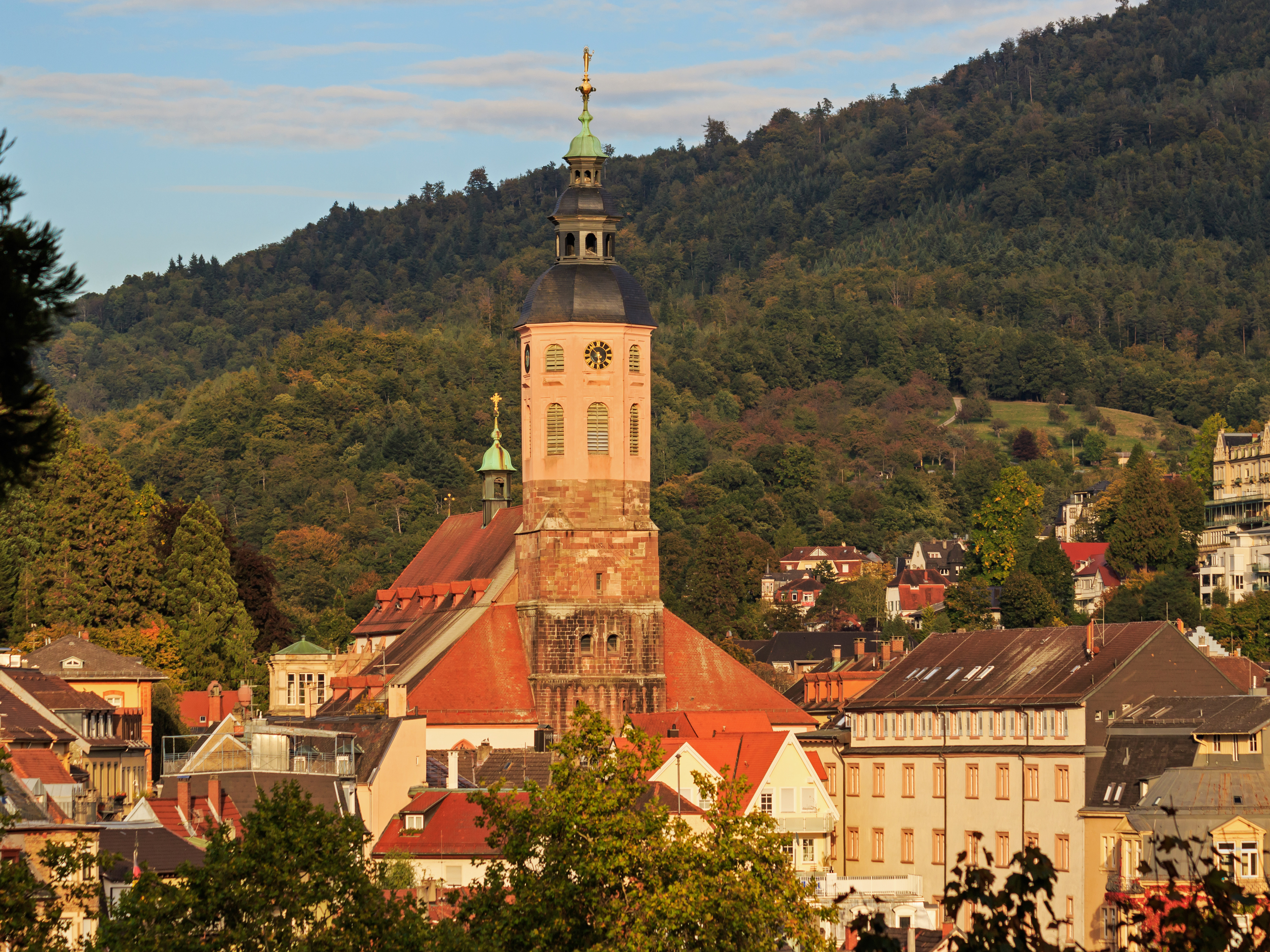
View from the Kurpark in Baden-Baden (BW, Germany) — CC BY-SA 3
History of Baden-Wurttemberg
Romans and the Limes frontier
The history of the land that is now Baden-Wurttemberg begins with the Romans, who occupied the region of Wurttemberg around the year 100 and built a frontier defence system called the Limes along the northern border of the empire, with forts, watchtowers, walls and wooden palisades. The Upper German-Raetian Limes runs for 550 kilometres between Rheinbrohl on the Rhine and Eining on the Danube, and about 164 kilometres of it run through Baden-Wurttemberg. The frontier was inscribed by UNESCO in 2005 as part of the Frontiers of the Roman Empire, reference 430, under criteria (ii)(iii)(iv).
After the Roman Empire weakened, Germanic tribes, above all the Alemanni, settled in the region. In the Middle Ages the land was divided into many duchies, counties, free cities and church territories, and the most prominent were the Margraviate of Baden and the Duchy of Wurttemberg. The castles, monasteries and medieval towns that visitors see today in Heidelberg, Tübingen and many other places all come from this period. The monasteries of Maulbronn, founded in 1147, and of Reichenau, founded in 724, were among the great centres of learning and art of medieval Europe.
Baden and Wurttemberg before 1952
In the 19th century, Baden became the Grand Duchy of Baden and Wurttemberg became the Kingdom of Wurttemberg, and both were members of the German Empire after 1871. The small Hohenzollern territory belonged to Prussia, and it was the home of the Hohenzollern family, which produced the German emperors. The cities of Stuttgart, Karlsruhe and Mannheim grew strongly during industrialisation, with factories, railways and technical universities, and the region became known for engineering and for the car industry that still defines it today.
After the Second World War, the region was divided by the occupation zones of the Allies. France occupied Baden and Wurttemberg-Hohenzollern, while the United States occupied Wurttemberg-Baden, forming three separate states. The division caused administrative and economic problems, and the movement to merge the three states into one united state grew stronger in the years after the war. The universities of the region, above all Heidelberg, founded in 1386 as the oldest university in Germany, kept their reputation through all these changes, and the cities kept their roles as centres of learning and industry.
The referendum and the birth of the state
On 16 December 1951, a referendum was held in all three states, and a majority of voters supported the merger. On 25 April 1952, the state of Baden-Wurttemberg was officially founded, as a state of the Federal Republic of Germany. It is the only state of Germany that was formed by merging three older states, and the process is regarded as a successful model of administrative unification after the war. The name of the state reflects its double origin, joining Baden with Wurttemberg, and the small Hohenzollern territory was included in the new state as well.
Since 1952, Baden-Wurttemberg has become one of the most prosperous regions of Europe, known for the car industry, for mechanical engineering and for its old universities. Stuttgart is the home of Mercedes-Benz and Porsche, and the state is also known for its Mittelstand, the network of medium-sized engineering firms that supply the world. The state has kept its regional diversity, though, and a traveller can still hear the difference between the dialects of Baden and of Swabia, and can still see the difference between the wine villages of the Rhine and the farming towns of the Alb.
Timeline
| Year | Event |
|---|---|
| About 100 | Romans occupy the region and build the Limes frontier |
| 724 | The monastery on the island of Reichenau is founded |
| 1147 | Maulbronn Monastery is founded |
| 1386 | Heidelberg University is founded, the oldest university in Germany |
| 1806 | Baden becomes a Grand Duchy and Wurttemberg becomes a Kingdom |
| 1945 | The region is divided into three states under French and American occupation |
| 16 December 1951 | A referendum supports the merger of the three states |
| 25 April 1952 | The state of Baden-Wurttemberg is officially founded |
| 1993 | Maulbronn Monastery is inscribed by UNESCO |
| 2000 | The monastic island of Reichenau is inscribed by UNESCO |
| 2005 | The Upper German-Raetian Limes is inscribed by UNESCO |

Bust of V.A.Zhukovsky in Baden-Baden (BW, Germany) — CC BY-SA 3
Travel to Baden-Wurttemberg
Getting to Baden-Wurttemberg
Baden-Wurttemberg has a developed transport system, with Stuttgart Airport as the main air gateway of the state, together with smaller airports at Karlsruhe and Friedrichshafen on Lake Constance. Frankfurt Airport, one of the largest airports in Europe, also lies close to the northern border of the state and is a convenient choice for international visitors. The German railway system links Stuttgart with Frankfurt, Munich and Zurich, and high-speed ICE trains run through the state on several lines.
Within the state, the railways and the motorways make it easy to move between the cities, and the regional trains serve the smaller towns of the Black Forest and the Swabian Alb. Visitors who want to explore the countryside should consider a car, because the forest roads and the lake shore are easier to reach by road than by train.
Cities not to miss
Stuttgart, the capital of the state, is the largest city and the centre of the German car industry, with the Mercedes-Benz Museum and the Porsche Museum as its two best known sights. The city also has the Schlossplatz square, the Wilhelma zoo and botanical garden, and many parks and vineyards inside the city itself. Heidelberg, with its castle on the hill and its old town beside the Neckar, is one of the most romantic cities of Germany and the home of the oldest university in the country.
Freiburg, at the edge of the Black Forest, has a great minster and the Bächle, the small water channels that run through the streets of the old town. Tübingen is a quiet university town on the Neckar, Ulm has a minster with a tower 161.5 metres high, and Baden-Baden is famous for its hot springs, which have been used since Roman times.
Food and wine of the state
The food of Baden-Wurttemberg carries the marks of Swabia and of Baden, with famous dishes such as Maultaschen, a kind of meat-filled pasta, and Spätzle, a soft egg noodle often served with cheese. Black Forest gateau, called Schwarzwälder Kirschtorte in German, is the best known dessert of the state, with layers of chocolate cake, fresh cream and cherries in kirsch.
The state is also one of the important wine regions of Germany, with two main wine areas, Wurttemberg along the Neckar and Baden along the Rhine. The vineyards of the Rhine valley are among the warmest in Germany, and the wines of the region, above all the red wines of Wurttemberg and the white wines of Baden, are worth tasting in the villages where they are made.
The seven World Heritage sites
Baden-Wurttemberg holds seven World Heritage sites, and they show the range of the history of the state. Maulbronn Monastery, inscribed in 1993 under reference 546 with criteria (ii)(iv), is the most complete medieval monastery north of the Alps. The monastic island of Reichenau, inscribed in 2000 under reference 974 with criteria (iii)(iv)(vi), holds early medieval churches on Lake Constance. The Upper German-Raetian Limes, inscribed in 2005 as part of the Frontiers of the Roman Empire, reference 430, with criteria (ii)(iii)(iv), runs through the north of the state.
The Prehistoric Pile Dwellings around the Alps, inscribed in 2011 under reference 1363 with criteria (iv)(v), include lakeside sites in Baden-Wurttemberg, above all on Lake Constance. The Weissenhof estate in Stuttgart, part of the Architectural Work of Le Corbusier, reference 1321, inscribed in 2016 with criteria (i)(ii)(vi), is a model settlement of modernist housing.
The Caves and Ice Age Art in the Swabian Jura, inscribed in 2017 under reference 1527 with criterion (iii), hold some of the oldest art of humanity. Baden-Baden, inscribed in 2021 as part of the Great Spa Towns of Europe, reference 1613, with criteria (ii)(iii), is the spa town of the Black Forest. Germany has 55 World Heritage sites in total, with 52 cultural and 3 natural sites.
Notable Places in Baden-Wurttemberg
Maulbronn Monastery and the island of Reichenau — Maulbronn Monastery, founded in 1147, is one of the best preserved medieval monastic complexes north of the Alps, and it was inscribed by UNESCO in 1993 under reference 546. The monastery belongs to the Cistercians, with a church, cloister, refectory and other buildings that keep their medieval layout, and it is famous as the place where the writer Hermann Hesse studied. The island of Reichenau lies in the western part of Lake Constance, and its Benedictine monastery, founded in 724, was inscribed in 2000 under reference 974. Visitors can reach the island by a causeway from the mainland and see its early medieval churches and vegetable gardens.
The Ice Age caves of the Swabian Alb — In 2017, UNESCO inscribed six limestone caves in the Lone and Ach valleys of the Swabian Alb, under the name Caves and Ice Age Art in the Swabian Jura, reference 1527. The caves hold some of the oldest works of art of humanity, including the Lion Man figurine and the Venus figurine, together with the oldest known musical instruments. The finds are displayed at the Prehistory Museum of Blaubeuren, about 90 minutes east of Stuttgart by road. The caves show that the Swabian Alb has been inhabited for more than 40,000 years, and they are among the most important archaeological sites of Europe.
The Black Forest, Lake Constance and Hohenzollern Castle — The Black Forest is the best known natural destination of the state, with pine forests, clear lakes such as the Titisee and the Schluchsee, waterfalls such as Triberg, and spa towns such as Baden-Baden. The town of Baden-Baden, famous for its hot springs since Roman times, was inscribed in 2021 in the Great Spa Towns of Europe, reference 1613. Hohenzollern Castle, on a cone-shaped mountain in the Swabian Alb, is one of the most photographed castles of Germany, and it was the home of the Hohenzollern family. Lake Constance, with the island of Reichenau, the city of Konstanz and the lakeside towns, is an ideal summer destination, with sailing, cycling around the lake and the flower gardens of Mainau island.
Heidelberg and the Neckar valley — Heidelberg is the most romantic city of the state, with a ruined castle on the hill above the old town and the Neckar river below. The castle, the old bridge and the university quarter make the city a place that visitors remember, and the university, founded in 1386, is the oldest in Germany. The Neckar valley below Heidelberg is lined with vineyards and small towns, and the river road from Heidelberg to Stuttgart is one of the prettiest drives in the state.
Stuttgart and the car museums — Stuttgart is the capital of Baden-Wurttemberg and the centre of the German car industry. The Mercedes-Benz Museum and the Porsche Museum are the two most visited sights of the city, and they tell the story of the car from its invention to the present day. The city also has the Schlossplatz, the Wilhelma zoo and botanical garden, and vineyards that reach into the city itself. The Weissenhof estate, part of the Le Corbusier World Heritage property, stands on a hill above the city and shows the modernist housing of the 1920s.
Frequently Asked Questions
Where is Baden-Wurttemberg in Germany?
Baden-Wurttemberg lies in the southwest of Germany, at 48.5378 N, 9.0411 E, with Wikidata identifier Q985. The state borders France to the west, Switzerland to the south, and the German states of Rhineland-Palatinate, Hesse and Bavaria. The capital of the state is Stuttgart, the largest city, followed by Mannheim and Karlsruhe.
When and how was the state of Baden-Wurttemberg founded?
The state was founded on 25 April 1952, after the three older states of Baden, Wurttemberg-Baden and Wurttemberg-Hohenzollern merged following a referendum held on 16 December 1951. It is the only state of Germany that was formed by merging three older states, and the name of the state reflects its double origin from Baden and Wurttemberg.
How many World Heritage sites does Baden-Wurttemberg have?
Baden-Wurttemberg has seven World Heritage sites, including Maulbronn Monastery inscribed in 1993, the monastic island of Reichenau inscribed in 2000, the Upper German-Raetian Limes inscribed in 2005, the Prehistoric Pile Dwellings inscribed in 2011, the Weissenhof estate inscribed in 2016, the Ice Age caves of the Swabian Alb inscribed in 2017, and Baden-Baden inscribed in 2021. Germany has 55 World Heritage sites in total.
Which cities should I visit in Baden-Wurttemberg?
Stuttgart, the capital, is famous for the Mercedes-Benz Museum and the Porsche Museum. Heidelberg has a castle and an old town beside the Neckar, Freiburg has a great minster and the Bächle water channels, Tübingen is a quiet university town, Ulm has a minster with a tower 161.5 metres high, and Baden-Baden is famous for its hot springs. Each city has its own character, and visitors should allow at least one day for each city.
What food is typical of Baden-Wurttemberg?
The typical dishes of the state include Maultaschen, a kind of meat-filled pasta, Spätzle, a soft egg noodle often served with cheese, and Black Forest gateau, with layers of chocolate cake, fresh cream and cherries in kirsch. The state is also an important wine region, with the Wurttemberg wine area along the Neckar and the Baden wine area along the Rhine.
How much time should I allow for Baden-Wurttemberg?
Visitors should allow at least one week to explore Baden-Wurttemberg, because the state is large and varied. A suggested plan is two days in Stuttgart, one day in Heidelberg, one day in Freiburg and the Black Forest, one day in Tübingen and the Swabian Alb, and two days at Lake Constance. The best time is spring and summer, when the weather is pleasant and outdoor activities are in full swing.
Verified
- Baden-Wurttemberg is a state of Germany, at 48.5378 N, 9.0411 E, with Wikidata identifier Q985, verified through the Wikidata API on 23 November 2026.
- The area is about 35,752 square kilometres, the population is about 11 million people, and the capital is Stuttgart, according to the sources cited below.
- The state was founded on 25 April 1952, after a referendum held on 16 December 1951, by the merger of Baden, Wurttemberg-Baden and Wurttemberg-Hohenzollern, according to the sources cited below.
- The Upper German-Raetian Limes runs for 550 kilometres between Rheinbrohl on the Rhine and Eining on the Danube, and it was inscribed in 2005 as part of the Frontiers of the Roman Empire, reference 430, with criteria (ii)(iii)(iv), according to UNESCO, checked on 23 November 2026.
- Maulbronn Monastery was founded in 1147 and inscribed in 1993 under reference 546 with criteria (ii)(iv), and the monastic island of Reichenau was inscribed in 2000 under reference 974, according to UNESCO, checked on 23 November 2026.
- The Prehistoric Pile Dwellings around the Alps were inscribed in 2011 under reference 1363 with criteria (iv)(v), the Architectural Work of Le Corbusier was inscribed in 2016 under reference 1321 with criteria (i)(ii)(vi), and the Caves and Ice Age Art in the Swabian Jura were inscribed in 2017 under reference 1527, according to UNESCO, checked on 23 November 2026.
- Baden-Baden was inscribed in 2021 as part of the Great Spa Towns of Europe, reference 1613, with criteria (ii)(iii), according to UNESCO, checked on 23 November 2026.
- Germany has 55 World Heritage sites in total, with 52 cultural and 3 natural sites, according to UNESCO, checked on 23 November 2026.
Sources
- Wikidata, Q985 — Baden-Wurttemberg as a state of Germany, with coordinates, area and capital, checked through the API on 23 November 2026.
- UNESCO, https://whc.unesco.org/en/list/430/ — the Frontiers of the Roman Empire, reference 430, criteria (ii)(iii)(iv), with the Upper German-Raetian Limes of 550 kilometres, checked on 23 November 2026.
- UNESCO, https://whc.unesco.org/en/list/546/ — Maulbronn Monastery Complex, reference 546, criteria (ii)(iv), checked on 23 November 2026.
- UNESCO, https://whc.unesco.org/en/list/1363/ — Prehistoric Pile Dwellings around the Alps, reference 1363, criteria (iv)(v), checked on 23 November 2026.
- UNESCO, https://whc.unesco.org/en/list/1321/ — the Architectural Work of Le Corbusier, reference 1321, criteria (i)(ii)(vi), checked on 23 November 2026.
- UNESCO, https://whc.unesco.org/en/list/1614/ — Mathildenhöhe Darmstadt, reference 1614, criteria (ii)(iv), checked on 23 November 2026.
Unverified
- The exact population of the state is given as about 11 million people, because different statistical sources give different figures by year, and the figure was not matched against the latest official statistics of the Federal Statistical Office of Germany.
- The name of the current minister-president of the state is not given in this article, because it changes with the state elections and it was not checked against the official site of the state.
- The exact opening hours of the museums and sights in the state change by season and by day of the week, and they were not verified against the official site of each sight, so this article gives no specific hours.
- Ticket prices for the museums and sights in the state change over time and by ticket type, and they were not verified against the official sites, so this article gives no specific prices.
- The reference numbers of some shared properties, such as the Prehistoric Pile Dwellings, the Weissenhof estate and the Great Spa Towns, are the shared numbers of the whole property, and each site inside the state was not matched one by one against the official UNESCO list.
Illustrations
- Hero: Baden-Wurttemberg. Free image: https://upload.wikimedia.org/wikipedia/commons/d/db/Castle_Lichtenstein_at_Lichtenstein-Honau%2C_Baden-W%C3%BCrttemberg.jpg — CC BY-SA 4.0.
- In body, Baden-Wurttemberg: View from the Kurpark in Baden-Baden (BW, Germany). Free image: https://upload.wikimedia.org/wikipedia/commons/1/1c/Baden-Baden_10-2015_img24_Stiftskirche.jpg — CC BY-SA 3.
- In body, Baden-Wurttemberg: Bust of V.A.Zhukovsky in Baden-Baden (BW, Germany). Free image: https://upload.wikimedia.org/wikipedia/commons/5/5c/Baden-Baden_10-2015_img28_Zhukovsky_bust.jpg — CC BY-SA 3.