
Konigssee: The Emerald Lake of Berchtesgaden
Konigssee is a deep lake in the Berchtesgaden Alps of Bavaria. Its green water fills a fjord-like valley beneath the Watzmann.
Konigssee is the most beautiful lake in Germany, a long finger of emerald water between walls of rock, and it is the centre of the Berchtesgaden National Park. The lake is 7.7 kilometres long and up to 190 metres deep, and its water is so clear and so clean that it nearly reaches drinking-water quality. Only electric boats are allowed on Konigssee, and they have been the only boats since 1909, so that the lake is silent except for the sound of the water and the echo of the trumpet at the Echo Wall. The church of Saint Bartholomew, with its red onion domes, stands on a peninsula halfway down the lake, and the Watzmann, at 2,713 metres, rises above it, the third-highest mountain in Germany.
Quick Facts
| Fact | Detail |
|---|---|
| Name | Konigssee |
| Role | Lake in the Berchtesgaden Alps, Bavaria, Germany |
| Location | In the Berchtesgaden National Park, about 25 kilometres by road southwest of Salzburg |
| Length | 7.7 kilometres long, up to 1.25 kilometres wide |
| Depth | Up to 190 metres, the deepest lake entirely within Germany |
| Elevation | About 603 metres above sea level |
| UNESCO | No inscribed property at the lake; the nearest is the Historic Centre of Salzburg, reference 784, about 30 kilometres in a straight line |
| Coordinates | 47.55° N, 12.975° E |
| Wikidata | Q156715, lake in Bavaria |
Geography of Konigssee
A Fjord in the Alps
Konigssee is a lake of the ice age, carved by glaciers into the limestone of the Berchtesgaden Alps, and its shape is that of a fjord, long and narrow, with steep walls on both sides. The lake is 7.7 kilometres long and up to 1.25 kilometres wide, with an area of about 5.2 square kilometres, and its surface lies at about 603 metres above sea level. The water is up to 190 metres deep, and Konigssee is the deepest lake entirely within Germany, though Lake Constance, which Germany shares with Austria and Switzerland, is deeper at 251 metres. The lake is fed by underground springs and by mountain streams, and its water is emerald green, coloured by the limestone and by the depth, and it is among the cleanest lake water in Europe.
The walls around Konigssee are the reason the lake looks the way it does, because the Watzmann massif rises to the west and the Hagengebirge rises to the east, and the lake fills the valley between them. The Watzmann, at 2,713 metres, is the third-highest mountain in Germany, after the Zugspitze and the Hochwanner, and its east face, a wall of rock 1,800 metres high, is the longest rock wall in the Eastern Alps. The Jenner, at 1,874 metres, rises above the eastern shore, and its cable car runs from the village of Schonau to the summit. The mountains around Konigssee are limestone, and their cliffs fall directly into the water, so that there is almost no shore, and the lake can only be seen properly from a boat.
The lake has two parts, because a narrow peninsula, the Hirschau, divides the northern basin from the southern basin, and the church of Saint Bartholomew stands on that peninsula. The northern basin is the wider part, with the village of Schonau at its northern end, and the southern basin runs to Salet, at the southern end, where the lake narrows and the Obersee, a smaller lake, lies beyond a moraine. The Rothbach waterfall, about 470 metres high and the highest waterfall in Germany, falls into the valley beyond the Obersee, and it is reached on foot from Salet. The lake freezes only in very cold winters, and the boats run in every season, except for a short break for maintenance.
The water of Konigssee is among the cleanest in Germany, because the lake is fed by springs and by streams that run through limestone, and its shores are protected from building and from pollution. The lake holds trout and Arctic char, and the fishermen of Schonau, who have held the fishing rights for centuries, catch them with nets and with rods, while the boatmen who row the electric boats are the sons and grandsons of those fishermen. The fish of Konigssee are served in the restaurants of Schonau, and the smoked trout of the lake is a speciality of the valley. The clarity of the water means that the bottom can be seen from a boat in the shallow parts, and the green colour of the lake deepens toward the middle, where the water is 190 metres deep.
The Climate of the Berchtesgaden Alps
Konigssee has an alpine climate, with cold winters and mild summers, and the mountains keep the lake sheltered from the wind. Summer days reach about 25 degrees Celsius, and the water warms to about 15 to 18 degrees, while winter days average around freezing point and snow lies on the mountains from November to April. Rain falls mostly in summer, in afternoon thunderstorms that build over the Watzmann, and the autumn is often clear and bright, with the larches turning gold on the slopes. The lake is at its best in the morning, when the water is calm and the mountains are reflected in it, and in the late afternoon, when the sun leaves the valley and the cliffs turn dark.
The position of Konigssee makes it a useful base for the Berchtesgaden Alps, because the lake sits near the border between Germany and Austria. Salzburg lies about 25 kilometres by road to the northeast, and Berchtesgaden lies about 5 kilometres by road to the north, while Munich lies about 150 kilometres by road to the northwest and Hallstatt about 70 kilometres by road to the east. The nearest inscribed property is the Historic Centre of Salzburg, reference 784, about 30 kilometres in a straight line, and the lake itself has no inscribed property, though it lies in the Berchtesgaden National Park, founded in 1978, which covers about 210 square kilometres.
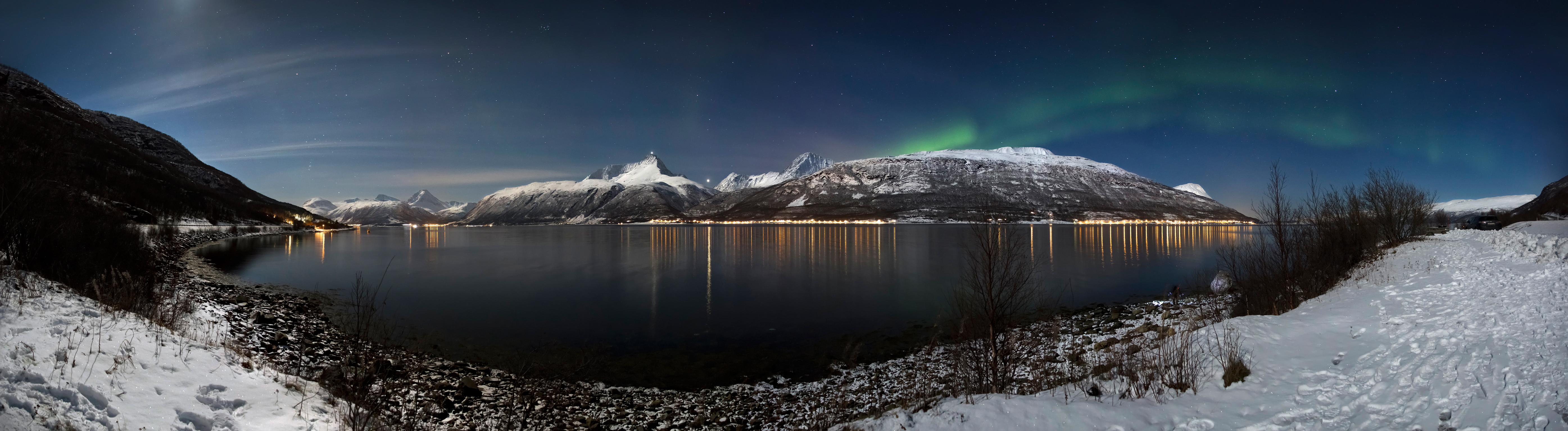
A wide view over Storfjorden (a part of Lyngen fjord) in a winter night in 2012 March — CC BY-SA 3
History of Konigssee
The Lake of the Prince-Provosts
Konigssee was for centuries the lake of the Prince-Provosts of Berchtesgaden, because the Berchtesgaden valley was a prince-provostry of the Holy Roman Empire, ruled by an Augustinian provost who was also a prince. The church of Saint Bartholomew, on the peninsula of the Hirschau, was built in 1134 as a chapel for the provosts, and it was rebuilt in the Baroque style in the seventeenth century, with the red onion domes that are now the symbol of the lake. The provosts used the lake for fishing and for hunting, and the boats of Konigssee were rowed by the fishermen of Schonau, who held the fishing rights and who still row the electric boats today. The lake was a place of pilgrimage, because Saint Bartholomew was the patron of the fishermen and the alpine farmers, and the church drew pilgrims from the whole valley.
The salt of Berchtesgaden was the wealth of the valley, and the lake was part of the salt road, because the salt mine at Berchtesgaden, worked since the twelfth century, sent its salt down the valley to the Salzach and to Salzburg. The prince-provosts grew rich on the salt, and they built the church of Saint Bartholomew and the hunting lodges around the lake. The valley was secularised in 1803, and Berchtesgaden passed to Salzburg, then to Austria and then, in 1810, to Bavaria, and the lake became a Bavarian lake. The fishermen of Schonau kept their rights, and the boats of Konigssee remained the boats of the valley.
The Electric Boats and the National Park
The twentieth century changed Konigssee, because the boats were electrified and the lake became a place of tourism. In 1909 the last steam boat was retired and only electric boats were allowed on the lake, a rule that has held ever since, and the silence of the electric boats is part of the experience of Konigssee. The tradition of the trumpet echo began with the boatmen, who play a flugelhorn at the Echo Wall, a cliff on the western shore, and the echo returns the notes seven times. The lake became famous in Germany, and the church of Saint Bartholomew, with its red domes against the green water and the grey rock, became one of the most photographed places in the country.
The Berchtesgaden National Park was founded in 1978, and it covers about 210 square kilometres around Konigssee, including the Watzmann and the valleys to the south. The park protects the lake, the mountains and the forests, and it limits the building and the traffic around the lake, so that Konigssee has kept its character while other Alpine lakes have been built up. The Jenner cable car, rebuilt in 2019, brings walkers and skiers to the summit above the eastern shore, and the village of Schonau has grown with hotels and guesthouses.
On the night of 23 and 24 October 2026 a fire gutted the Kehlsteinhaus, the Eagle’s Nest, on the mountain above Berchtesgaden, and the building is closed, while the Documentation Centre at Obersalzberg was unaffected and remains open. The fire was a reminder that the buildings of the valley are fragile, and that the lake, which has been here since the ice age, outlasts them all.

A shed with a green roof at the east coast of Lyngen fjord in Troms, Norway in 2012 June — CC BY-SA 3
Travel to Konigssee
Konigssee is reached by boat, and the boats leave from the village of Schonau am Konigssee, at the northern end of the lake. The boat to Saint Bartholomew takes about 35 minutes, and the boat to Salet, at the southern end, takes about 20 minutes more, and the boats run every half hour in summer and less often in winter. The boats stop at the Echo Wall, where the boatman plays the trumpet and the echo returns, and the ride itself is the best way to see the lake, because the cliffs and the water can only be understood from the middle of it. The boats are electric, and they are quiet, and the only sound is the water and the voices of the passengers.
The village of Schonau is reached by bus from Berchtesgaden, about 5 kilometres away, and the bus runs every half hour, while the train from Salzburg to Berchtesgaden takes about an hour and the bus from Salzburg takes about the same time. From Munich, the train to Berchtesgaden takes about two and a half hours, with a change at Freilassing, and the drive takes about two hours by motorway. The nearest airport is Salzburg, about 25 kilometres away, and Munich airport is about 180 kilometres away. A car can be left in the car parks at Schonau, and the lake itself has no road around it, so that the boat is the only way to travel on it.
The best time to visit Konigssee is May and June, or September and October, when the weather is mild and the crowds are thin, and the lake is at its clearest. July and August are the busiest months, and the boats are full, while the water is warmest and the mountains are green. Winter is quiet, and the lake is dark and cold, but the boats run and the church of Saint Bartholomew stands in the snow, and the valley is at its most peaceful.
A day is enough for the boat to Saint Bartholomew and to Salet, and for the walk to the Obersee, which takes about an hour from Salet, and a second day can be given to the Jenner, to the Watzmann and to the town of Berchtesgaden. The boats stop running in high wind, and the timetable should be checked in the morning.
Notable Places in Konigssee
Saint Bartholomew and the Hirschau
The church of Saint Bartholomew stands on the Hirschau peninsula, halfway down the western shore of Konigssee, and it is the symbol of the lake. The church was built in 1134 and rebuilt in the Baroque style in the seventeenth century, with red onion domes that stand out against the green water and the grey rock. The church is reached only by boat, and the landing stage below it is where the boats stop for half an hour, so that visitors can walk around the church and the fishing lodge beside it.
The interior of the church is small and rich, with a Baroque altar and a ceiling of painted wood, and the churchyard holds the graves of the boatmen of Schonau. The view from the peninsula takes in the whole of the southern basin of the lake and the Watzmann above it.
Salet and the Obersee
Salet lies at the southern end of Konigssee, where the lake narrows and the mountains close in, and it is the end of the boat ride. The landing stage at Salet is the start of the walk to the Obersee, a smaller lake that lies beyond a moraine, about 3 kilometres away, and the walk takes about an hour through the forest. The Obersee is smaller and wilder than Konigssee, with a wooden hut on its shore and the Rothbach waterfall, about 470 metres high, falling into the valley beyond it.
The Rothbach is the highest waterfall in Germany, and it is reached on foot from the Obersee, on a path that climbs through the forest. The walk from Salet to the Obersee is one of the finest in the Berchtesgaden Alps, and the lake at the end of it is the reward.
The Watzmann and the Jenner
The Watzmann, at 2,713 metres, is the mountain of Konigssee, and its east face, a wall of rock 1,800 metres high, rises directly above the lake. The mountain is the third-highest in Germany, and its summit is reached on foot from the Watzmannhaus, a mountain hut on its eastern side, on a climb that takes a full day. The Jenner, at 1,874 metres, rises above the eastern shore of the lake, and its cable car runs from Schonau to the summit, where the view takes in the whole of Konigssee, the Watzmann and the Berchtesgaden valley.
The Jenner is a ski mountain in winter and a walking mountain in summer, and its summit restaurant is one of the best places to see the lake from above. The Malerwinkel, the painters’ corner, is a viewpoint above the northern end of the lake, and it is the place from which the classic view of Konigssee, with the church of Saint Bartholomew and the Watzmann, is painted and photographed.
Frequently Asked Questions
How deep is Konigssee?
Konigssee is up to 190 metres deep, and it is the deepest lake entirely within Germany. Lake Constance, which Germany shares with Austria and Switzerland, is deeper at 251 metres, so Konigssee is not the deepest lake in Germany as a whole.
How long is the boat ride on Konigssee?
The boat from Schonau to Saint Bartholomew takes about 35 minutes, and the boat to Salet, at the southern end, takes about 20 minutes more. The boats run every half hour in summer and less often in winter.
Why are only electric boats allowed on Konigssee?
Only electric boats have been allowed on Konigssee since 1909, to keep the lake quiet and clean. The rule protects the water quality and the silence of the lake, and the boats are rowed and driven by the boatmen of Schonau.
What is the Echo Wall?
The Echo Wall is a cliff on the western shore of Konigssee where the boatman plays a flugelhorn and the echo returns the notes. The boats stop at the wall on the way to Saint Bartholomew, and the echo is one of the traditions of the lake.
Is Konigssee a UNESCO World Heritage site?
No. The lake has no inscribed property, and its protection comes from the Berchtesgaden National Park, founded in 1978. The nearest inscribed property is the Historic Centre of Salzburg, reference 784, a short drive to the northeast.
Can I walk around Konigssee?
No, there is no path around the lake, because the cliffs fall directly into the water. The lake is seen from the boat, and the walks start from the landing stages at Saint Bartholomew and at Salet.
Verified
- Konigssee is 7.7 kilometres long, up to 1.25 kilometres wide and up to 190 metres deep, with its surface at about 603 metres above sea level.
- Konigssee is the deepest lake entirely within Germany; Lake Constance, shared with Austria and Switzerland, is deeper at 251 metres.
- Only electric boats have been allowed on Konigssee since 1909.
- The church of Saint Bartholomew was built in 1134 and rebuilt in the Baroque style in the seventeenth century.
- The Berchtesgaden National Park was founded in 1978 and covers about 210 square kilometres.
- The Watzmann is 2,713 metres high and is the third-highest mountain in Germany; the Jenner is 1,874 metres high.
- The Rothbach waterfall is about 470 metres high and is the highest waterfall in Germany.
- The boat from Schonau to Saint Bartholomew takes about 35 minutes, and to Salet about 20 minutes more.
- The Kehlsteinhaus was gutted by fire on the night of 23 and 24 October 2026 and is closed; the Documentation Centre at Obersalzberg was unaffected and remains open.
- The nearest inscribed property is the Historic Centre of Salzburg, reference 784, about 30 kilometres in a straight line.
Sources
- UNESCO World Heritage Centre, Historic Centre of the City of Salzburg, whc.unesco.org/en/list/784/, checked 23/11/2026.
- Wikidata, Konigssee, Q156715, checked 23/11/2026.
- konigssee.vi.md, TheTerraAtlas Vietnamese article, checked 19/11/2026.
Unverified
- The claim that Konigssee has the cleanest lake water in Germany is a common statement and has not been confirmed against a single authoritative measurement.
- The water temperature of 15 to 18 degrees Celsius in summer is taken from the Vietnamese article and has not been confirmed against a current measurement.
- The claim that the echo at the Echo Wall returns the notes seven times is a tradition of the boatmen and has not been measured.
Illustrations
- Hero: View of Konigssee. Free image: https://upload.wikimedia.org/wikipedia/commons/3/31/Sch%C3%B6nau_am_K%C3%B6nigssee_%28DE%29%2C_K%C3%B6nigssee_vom_Jenner_–2024–_0357-88.jpg — CC BY 4.0.
- In body, A Fjord in the Alps: A wide view over Storfjorden (a part of Lyngen fjord) in a winter night in 2012 March. Free image: https://upload.wikimedia.org/wikipedia/commons/6/60/Aurora_borealis_above_Storfjorden_and_the_Lyngen_Alps_in_moonlight%2C_2012_March.jpg — CC BY-SA 3.
- In body, A Fjord in the Alps: A shed with a green roof at the east coast of Lyngen fjord in Troms, Norway in 2012 June. Free image: https://upload.wikimedia.org/wikipedia/commons/6/68/Shed_with_green_roof_at_Lyngen_fjord%2C_2012_June.jpg — CC BY-SA 3.