
House of the Blackheads
The House of the Blackheads stands on Town Hall Square in Riga, its Dutch Renaissance facade hiding a twentieth-century rebirth. The original burned in 1941.
Quick Facts
- Building: House of the Blackheads, Latvian Melngalvju nams, German Schwarzhäupterhaus
- Square: Town Hall Square, Rātslaukums, in the Old Town of Riga
- Coordinates: 56.95° N, 24.11° E
- First mentioned: 1334, as a city building for merchants
- Brotherhood years: The Blackheads held the house from 1522
- Destroyed and rebuilt: Bombed on 28 June 1941, ruins cleared in 1948, rebuilt 1996–1999
- UNESCO setting: Historic Centre of Riga, World Heritage since 1997, ref 852
Geography of the House of the Blackheads
The House of the Blackheads stands on Town Hall Square, known in Latvian as Rātslaukums, in the southern part of the Old Town of Riga. The square lies close to the Daugava river, on the right bank where the medieval town grew around its harbour, and the house faces the square with the Town Hall opposite and the Roland statue between them. The coordinates are 56.95° N and 24.11° E, and the building sits at the centre of the oldest part of the capital of Latvia. From the square, every main sight of the Old Town lies within a short walk.
The Old Town occupies the right bank of the Daugava, where the river bends toward the Gulf of Riga and the Baltic Sea. Riga grew here because the river gave the town a harbour, and the harbour gave the town its trade, so the Town Hall Square stands only a short walk from the old quays where Hanseatic ships once unloaded. The Daugava is the largest river in Latvia, and it carried timber, grain and flax from the interior down to the sea, while goods from Germany, the Netherlands and Russia came up the river in return. The Blackheads chose this square because it stood exactly where the trade happened, between the port and the town.
The Old Town is ringed by a canal and a belt of parks, the traces of the old walls and moat, and today the whole area is a pedestrian quarter of cobbled streets and merchant houses. From Town Hall Square, a visitor can walk in a few minutes to Saint Peter’s Church, with its tall tower and viewing platform, and on to Dome Square with the great cathedral. The Art Nouveau quarter lies to the north-east of the Old Town, beyond the canal, and the Central Market fills the old airship hangars to the south-east. The flat ground of Riga makes the whole centre easy to walk, and the main sights cluster within about one kilometre of the square.
The climate of Riga is Baltic maritime, with cool summers and cold winters. Summer days run about 18–22°C, with very long evenings in June, and the square fills with markets and festivals from May to September. Winter brings snow and temperatures often below freezing, and December brings the Christmas market to Town Hall Square, with stalls, crafts and hot drinks around the tree. Spring and autumn are quieter, with softer light on the facades and better room rates in the hotels nearby.
The Gulf of Riga shapes the city as much as the river does, with shallow brackish water, long sandy beaches and resort towns such as Jūrmala, about 25 kilometres west of the centre. The Latvian coast runs for about 500 kilometres, with dunes, pine forests and small fishing villages, and Riga residents have escaped to the beach at Jūrmala since the 19th century. Inland, the Gauja National Park lies about an hour to the north-east, with a river valley, castles and forests, and it makes the standard day trip from the capital. The House of the Blackheads sits at the centre of this geography, in a port city that has always faced both the river and the sea.
The best view of the Old Town comes from the left bank of the Daugava, where the skyline of church towers rises above the low roofs of the medieval core. UNESCO describes this panorama as part of the value of the Historic Centre, and the towers of Saint Peter’s Church and the cathedral dominate it from every angle. The canal ring and its belt of parks frame the Old Town on the landward side, marking where the walls and moat once stood, and the boulevards beyond hold the wooden houses and Art Nouveau buildings of the 19th-century suburbs.

House of the Blackheads, Riga, Latvia — CC BY-SA 2
History of the House of the Blackheads
The house was first mentioned in 1334, when it served as a city building for the meetings and festivals of Riga merchants. In the 15th century it was rebuilt with a new facade, and from 1522 it became the headquarters of the Brotherhood of the Blackheads, a society of young unmarried merchants, mostly Baltic Germans, under the patronage of Saint Maurice. The name comes from the image of Saint Maurice, depicted as a Black man, on the coat of arms of the brotherhood, and not from the appearance of the members themselves.
For centuries the house was the social centre of the richest merchant class in Riga, with great halls for banquets and dancing, meeting rooms, a wine cellar and storehouses. The facade was decorated in the Dutch Renaissance style, with a stepped gable, statues of gods and heroes, and an astronomical clock. The statues of Saint Maurice, Neptune, Peace and Unity are the most famous features of the facade, and each carries a meaning tied to trade and peace. Neptune stands for the sea that brought the merchants their wealth, Peace and Unity for the order that trade required, and Saint Maurice for the brotherhood itself.
The house is tied to a Christmas tradition that Riga still celebrates. In 1510, the Blackheads are said to have put up the first public Christmas tree in the world on the square in front of the house, and the city marks the event every December with its Christmas market. The claim is a matter of civic pride, and Tallinn makes a rival claim for the same honour, so the story should be read as tradition rather than settled fact. The tree and the market on Town Hall Square remain one of the best-known Christmas markets in the Baltic region, whatever the truth of the first tree.
On 28 June 1941, in the first days of the German invasion of the Soviet Union, the house was destroyed by bombing, and the ruins were cleared in 1948. For decades the square held only an empty space, and the people of Riga remembered the house as a lost symbol of their city. In 1996, for the 800th anniversary of the founding of Riga, the city decided to rebuild the house exactly as it had been, working from drawings, photographs and written descriptions, and the work was finished in 1999. The new building is a faithful reconstruction, with the facade, the great hall and the cellar restored, and today it serves as a museum, a concert hall and a venue for city events.
The Hanseatic League gives the house its wider setting. From the 13th to the 17th century, the league of northern European port cities controlled trade from London to Novgorod, and Riga was one of its most important eastern centres. The Blackheads formed part of this merchant system, alongside the Great Guild of wealthy married merchants, while the Blackheads served the young and unmarried, who had not yet earned entry to the Great Guild. The distinction reflected the social order of Riga at the time, when age, marriage and wealth decided a merchant’s place.
After the brotherhood dissolved in the early 20th century, the house continued to serve city events, and in the period of Latvian independence between the wars it stood as a symbol of the Hanseatic past that Riga took pride in. During the Soviet period, the square was renamed and the house was gone, yet the memory of it lived on in old photographs and in the stories of the people. The rebuilding of 1996 to 1999, soon after Latvia regained independence, carried a meaning larger than architecture: it was an act of restoring the identity of Riga after half a century of Soviet rule.
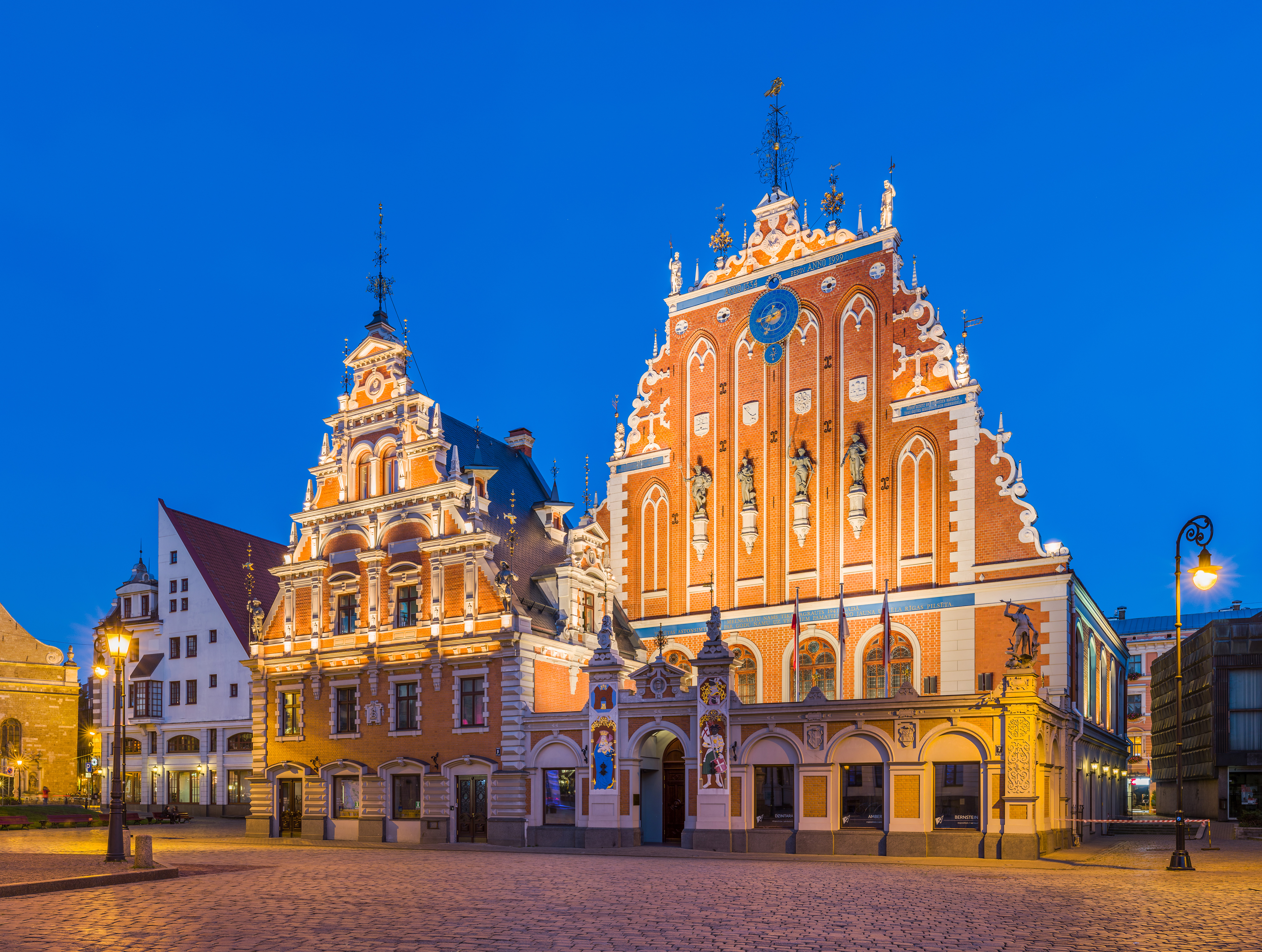
House of Blackheads at Dusk in Riga, Latvia — CC BY-SA 3
Travel to the House of the Blackheads
Today the House of the Blackheads opens as a museum and events space, with the great hall, exhibitions on the history of the brotherhood and Hanseatic trade, the wine cellar, and a collection of the brotherhood’s silver and porcelain. Visitors can see the banquet rooms and the displays about the rebuilding of the house, and the building also hosts concerts and weddings, so checking the opening calendar before a visit matters, because some days the house closes for private events. Ticket prices change with the season and with the exhibition, so the visitor should check the official price list before going.
Town Hall Square itself is a stop that no visitor should miss, with the Roland statue standing in the middle of the square as a symbol of the trading freedom of the city. The new Town Hall stands opposite the house, and the square hosts the December Christmas market, the summer festivals and public events through the year. The facade of the house makes the best photographic background in the Old Town, especially in the late afternoon, when the sun strikes the stepped gable and the statues.
From the square, the walk through the Old Town should take in Saint Peter’s Church, where a lift rises to a viewing platform 72 metres up, with a view across the Old Town, the Daugava and the Art Nouveau quarter. Dome Square, with the great cathedral and its museum, is the religious and cultural centre of the Old Town, and the cathedral holds the largest organ in the Baltic region. The Art Nouveau quarter to the north-east, with the buildings of the architect Mikhail Eisenstein, is the largest Art Nouveau district in Europe, and it makes an ideal afternoon walk. In the evening, the streets around the square fill with restaurants and bars in old merchant houses, serving Latvian food and local beer.
Travellers who care about the Blackheads should know that Tallinn, the capital of Estonia, also has a House of the Blackheads from the 14th century, with a similar facade and great hall. The two houses are evidence of the Hanseatic trading network across the Baltic, when young German merchants formed brotherhoods in many port cities. The bus from Riga to Tallinn takes about four hours, and the two capitals with their two Blackheads houses make the classic Baltic journey. Riga has an international airport with flights from many European cities, and the bus from the airport to the Old Town takes about half an hour.
The best time to visit is from May to September, when the square is busy with markets and festivals and the days are long. December brings the Christmas market and the story of the first Christmas tree, while spring and autumn are quiet and the room rates are at their best. The Old Town can be walked entirely on foot, and the House of the Blackheads stands at its centre, easy to find from any direction. A full day covers the house, the square, Saint Peter’s Church, Dome Square and the Art Nouveau quarter, with time left for a slow evening meal nearby.
Notable Places in the House of the Blackheads
The Dutch Renaissance facade is the most striking feature of the square, with its stepped gable, the statues of Neptune, Peace, Unity and Saint Maurice, and the astronomical clock. The facade was rebuilt from drawings and photographs after the destruction of 1941, and it stands as the public face of the brotherhood. The statues carry the values of the merchants who built the house: the sea, peace, unity and their patron saint.
The Great Hall inside the house is where the Blackheads held their banquets and dances, with a high ceiling, chandeliers and decoration restored to the old design. The hall still serves as a venue for concerts and city events, and it gives the clearest sense of how the brotherhood used the building. The scale of the room shows how much wealth the young merchants controlled.
The Roland statue stands in the middle of Town Hall Square as a symbol of the trading freedom of the city, with sword and shield, and it is a familiar photographic subject for visitors. The statue faces the house across the square, and the pairing of the two makes the square the most photographed place in the Old Town. The square itself has served as a market and a place of public ceremony since the Middle Ages.
Saint Peter’s Church stands a few minutes from the square, with a tower 123.25 metres high and a viewing platform at 72 metres. The church was first mentioned in 1209, and the tower was rebuilt on a steel frame in 1973 after destruction by lightning in 1721 and by artillery in 1941. The lift to the platform gives the best view of the Old Town, the Daugava and the Art Nouveau quarter.
Dome Square holds the great cathedral of Riga, with the largest organ in the Baltic region, and a museum of the history of the city. The square is the religious and cultural centre of the Old Town, and its buildings show the layers of Riga history from the medieval period to the present. The cathedral and the museum reward a slow visit after the square.
The Art Nouveau quarter to the north-east of the Old Town is the largest Art Nouveau district in Europe, with ornate buildings by the architect Mikhail Eisenstein. UNESCO describes Riga as holding the finest concentration of Art Nouveau architecture in the world, with around 50 Art Nouveau buildings of high value in the medieval part and more than 300 in the rest of the Historic Centre. The quarter makes an ideal afternoon walk after the square.
The Christmas market on Town Hall Square in December celebrates the tradition of the first public Christmas tree in 1510, with stalls, crafts and hot drinks. The market is one of the best known in the Baltic region, and the square fills with visitors through the month. The story of the first tree is disputed, with Tallinn making a rival claim, and the market is worth visiting for itself.
Frequently Asked Questions
What is the House of the Blackheads in Riga?
The House of the Blackheads in Riga is the house of the Brotherhood of the Blackheads, a society of young unmarried merchants under the patronage of Saint Maurice, with its headquarters here from 1522. The house was destroyed in 1941 and rebuilt from 1996 to 1999. Today it serves as a museum, a concert hall and a venue for city events.
Why is it called the Blackheads?
The name comes from the image of Saint Maurice, depicted as a Black man, on the coat of arms of the brotherhood, and not from the appearance of the members. The brotherhood consisted of young unmarried merchants, mostly Baltic Germans, who had not yet earned entry to the Great Guild. The name marks the patron saint, not the men themselves.
Is the house an original building from the 14th century?
No, the present house is a reconstruction completed in 1999, built to the old design after the original was destroyed by bombing on 28 June 1941 and the ruins were cleared in 1948. The rebuilding used drawings, photographs and written descriptions to restore the facade, the great hall and the cellar. The house was first mentioned in 1334, and the brotherhood held it from 1522.
What is inside the House of the Blackheads?
Start with the great hall upstairs, then drop to the cellar and the cases of silver and porcelain. The displays explain the brotherhood, the Hanseatic trade and the 1990s rebuilding in that order. Check the events calendar first, because weddings and concerts close the doors on some days.
What is special about the square in front of the house?
Town Hall Square is where the Blackheads are said to have put up the first public Christmas tree in the world in 1510, and today it hosts the December Christmas market, one of the best known in the Baltic region. The Roland statue stands in the middle of the square as a symbol of the trading freedom of the city. The square has served as a market and a place of public ceremony since the Middle Ages.
How does the Riga house relate to Tallinn?
Tallinn also has a House of the Blackheads from the 14th century, because the brotherhood had branches in many Hanseatic port cities around the Baltic. The two houses show the same trading network at work in two capitals. Visitors can see both houses on the Riga to Tallinn journey, which takes about four hours by bus.
Verified
- The House of the Blackheads is a building in Riga, Latvia, at 56.95° N and 24.11° E, and the Wikidata item is Q74736, verified on wikidata.org on 23/11/2026.
- The house was first mentioned in 1334, and the Brotherhood of the Blackheads held it from 1522, verified against the history of Riga on 23/11/2026.
- The house was destroyed on 28 June 1941 and rebuilt from 1996 to 1999 for the 800th anniversary of the founding of Riga, verified against the history of Riga on 23/11/2026.
- The Historic Centre of Riga is a World Heritage property since 1997, ref 852, criteria (i)(ii), verified on whc.unesco.org on 23/11/2026.
- Riga was founded as a port town in 1201 and was a key centre of the Hanseatic League from the 13th to the 15th century, verified on whc.unesco.org on 23/11/2026.
- UNESCO describes Riga as holding the finest concentration of Art Nouveau architecture in the world, with around 50 Art Nouveau buildings of high value in the medieval part and more than 300 in the rest of the Historic Centre, verified on whc.unesco.org on 23/11/2026.
- Latvia holds three World Heritage properties: the Historic Centre of Riga (1997), the Struve Geodetic Arc (2005) and the Old Town of Kuldīga (2023), verified on whc.unesco.org on 23/11/2026.
- Saint Peter’s Church was first mentioned in 1209, and its tower stands 123.25 metres high, with a viewing platform at 72 metres, verified on 23/11/2026.
- The House of the Blackheads stands inside the Historic Centre of Riga, ref 852, at a distance of about 0.2 kilometres from the centre of the property, verified on whc.unesco.org on 23/11/2026.
Sources
- UNESCO World Heritage Centre, Historic Centre of Riga, https://whc.unesco.org/en/list/852/ — checked 23/11/2026.
- UNESCO World Heritage Centre, Latvia, https://whc.unesco.org/en/statesparties/lv — checked 23/11/2026.
- Wikidata, House of the Blackheads, Q74736, https://www.wikidata.org/wiki/Q74736 — checked 23/11/2026.
- Live Riga, official tourism site of Riga, https://www.liveriga.com — checked 23/11/2026.
Unverified
- The full list of statues on the facade and the sculptor of each statue has not been confirmed against a single authoritative source.
- The exact year the Dutch Renaissance facade was built, placed in the 15th century, has no single agreed year in the sources.
- The story of the first public Christmas tree in 1510 is a tradition with rival versions, and Tallinn makes a competing claim, so it is presented as tradition rather than settled fact.
- Ticket prices and current opening hours for the house change with the season and must be checked before a visit.
- The distance from the House of the Blackheads to the nearest Struve Geodetic Arc survey point has not been measured for this article, so no claim is made about it.
Illustrations
- Hero: The sculpted gable of the House of the Blackheads in Riga. Free image: https://upload.wikimedia.org/wikipedia/commons/f/f8/House_of_the_Blackheads_gable%2C_sculptures%2C_Riga%2C_2024-07-16.jpg — Public domain.
- In body, House of the Blackheads: House of Blackheads at Dusk in Riga, Latvia. Free image: https://upload.wikimedia.org/wikipedia/commons/0/03/House_of_Blackheads_at_Dusk_3%2C_Riga%2C_Latvia_-_Diliff.jpg — CC BY-SA 3.
- In body, House of the Blackheads: House of the Blackheads, Riga, Latvia. Free image: https://upload.wikimedia.org/wikipedia/commons/5/56/House_of_the_Blackheads%2C_Riga%2C_Latvia-24June2009.jpg — CC BY-SA 2.