
Calella
Calella is the resort capital of the Costa del Maresme, a beach town with a Catalan soul. It lies 50 kilometres northeast of Barcelona, between sea and hills.
Quick Facts
| Item | Detail |
|---|---|
| Name | Calella |
| Location | Costa del Maresme coast, northeast of Barcelona province, Catalonia, Spain |
| Coordinates | 41.6169 N, 2.6642 E |
| Population | 20,207 people (2024, Idescat) |
| Area | About 8 square kilometres |
| Altitude | About 5 metres above sea level |
| Languages | Catalan and Spanish |
| Currency | Euro (EUR) |
| Highlights | Calella Lighthouse (1859), three beaches, Passeig Manuel Puigvert, Dalmau Park |
| UNESCO nearby | Spain has 50 World Heritage sites; the nearest is the Works of Gaudí in Barcelona, about 47 km away in a straight line |
| Wikidata | Q12540, municipality of Catalonia |
Calella is known across Europe as the resort capital of the Costa del Maresme, and the name fits. Three golden beaches stretch along its shore, a tree-lined seafront promenade runs beside them, and an old lighthouse stands on the headland above the town. German visitors in particular have come here for decades, and many youth groups spend their summer holidays in the town.
Yet Calella is not only a resort. It is also a working Catalan town, with an old quarter, a local market, fishermen’s houses and a daily life that goes on after the summer crowds leave.
The town is small enough to walk from the railway station to the beach in a few minutes, but it is large enough to have restaurants, bars, parks and walking routes up the hills behind it. That balance is what makes Calella work as a holiday base. Visitors can spend the morning on the beach, the afternoon in the old town or on the hill paths, and the evening on the promenade, and they can take the train to Barcelona or Girona for a day trip whenever they want a bigger city.
Geography of Calella
A narrow strip between sea and hills
Calella lies on a narrow strip of land between the Mediterranean Sea and a range of hills that runs parallel to the coast, a landscape typical of the Maresme, where the towns follow each other along the railway and the coastal road. To the northwest of the town is the Montnegre i el Corredor Natural Park, about 6 kilometres from the centre, with pine forests, oak woods and many walking trails. The Riera Capaspre stream flows through the town and reaches the sea near Garbí beach, dividing the shore into different stretches of sand.
The town covers only about 8 square kilometres, but its permanent population has passed 20,000 people, and in summer the number rises sharply with visitors and seasonal workers. Calella lies between Sant Pol de Mar to the southwest and Pineda de Mar to the northeast, on the Maresme coast that runs from Barcelona to the border of Girona province. The railway line and the coastal road join the towns of the Maresme into a single strip of settlements, and Calella is the largest and best known of them.
The Maresme is a long coastal strip between the sea and the Serralada Litoral, the coastal mountain range that runs parallel to the shore. The towns of the Maresme follow each other along the railway and the coastal road, from Montgat near Barcelona to the border of Girona province, and each town has its own beach, old quarter and fishing past. The hills behind the towns are covered with pine forest, vineyards and small farms, and the streams that cut through them, called rieres in Catalan, reach the sea between the towns.
The coast faces southeast, so the beaches get the morning sun and the sea breeze in the afternoon, and the water is warm enough for swimming from June to October. The coast road continues south past Barcelona toward Valencia, and inland lies Granada in Andalusia.
Three beaches along three kilometres of coast
The coast of Calella is about 3 kilometres long, with three main beaches following each other from southwest to northeast. Platja Gran lies directly in front of the centre of the town, wide and busy, and it is followed by Platja de Garbí to the northeast, and then by Platja de les Roques, a small cove under the cliffs of the lighthouse headland. All three beaches have fine golden sand, and the water shelves gently away from the shore, which suits families with small children and people learning to swim.
Platja Gran is the main beach, with full summer services such as sun loungers, umbrellas, beach sports areas and beach bars, and it often receives the Blue Flag for bathing water quality. Platja de Garbí is quieter and more open than the main beach, and it also often receives the Blue Flag. Platja de les Roques is the smallest of the three, a cove with rocks and sand, clearer water than the larger beaches, and a long-standing naturist area. The path down to the cove runs from the lighthouse area, and a small bar serves drinks in summer.
Mediterranean climate and getting there
Calella has a Mediterranean climate, with hot dry summers and mild winters with little rain, and spring and autumn are the most pleasant times for walking and sightseeing. Summer temperatures are usually between 27 and 31 degrees Celsius, with much sun and a cool sea breeze in the afternoon, while winter temperatures rarely fall below 8 degrees. The high season runs from June to September, when the sun is strong, the sea is warm and all services are open, but the beaches are also at their busiest.
Getting to Calella is easy, because the town stands on the R1 suburban railway line of Rodalies de Catalunya, which runs from Barcelona to Maçanet-Massanes along the coast. Calella station stands in the centre of the town, only a few minutes on foot from the beach, and the train to central Barcelona takes a little over an hour. The line also serves the neighbouring towns of Sant Pol de Mar, Arenys de Mar and Mataró, each with its own character, and it makes Calella a good base for day trips along the coast.

Calella Іспанія, пляж зі скелями — CC BY-SA 4
History of Calella
A fishing village on the road to Girona
Calella began as a small fishing village on the Mediterranean shore, with a life tied to the sea, to fishing and to coastal trade for many centuries. The position of the town, on the coastal road linking Barcelona with Girona, made it an early stopping place for merchants and travellers. In the Middle Ages a watchtower stood on the Capaspre headland to guard the coast, and the village grew slowly around the church and the small harbour.
The 19th century was the turning point for Calella, when the textile industry developed and wealthy families began to build seaside holiday homes. The Passeig Manuel Puigvert, with its old plane trees and wrought iron railing, is a mark of that period, when Calella began to be known as a resort of the middle class of Barcelona. The promenade is still the most beautiful street of the town, and its shade in summer and its view straight out to sea make it the image that appears on the postcards of Calella.
The lighthouse of 1859
The lighthouse of Calella is the symbol of the town, a white tower 10 metres high standing on the Capaspre headland, at a focal height of 50 metres above sea level. Construction began on 9 October 1856 by royal order, and the lighthouse was inaugurated on 15 December 1859, under the direction of the engineer Marià Parellada. It first ran on olive oil lamps, and in 1916 it became the first lighthouse in Catalonia to be electrified. Today the lighthouse still works, with a light flashing in groups of three and two every 30 seconds, visible from about 18 nautical miles, or about 33 kilometres, out at sea.
The interpretation centre inside the lighthouse keeper’s house presents the history of the lighthouse and of the optical signalling system of the coast, and the terrace around the lighthouse gives a panoramic view of the beaches of Calella and the Maresme coast. The centre opened to visitors on 13 June 2011, and it has become one of the most visited sights of the town. The lighthouse is both a working aid to navigation and a historic monument, and its white tower is visible from every beach of Calella.
Civil war, mass tourism and the town today
The Spanish Civil War left a deep mark on Calella, above all in the air raid shelter under Dalmau Park, which the local people built in 1937 to escape the bombing. The shelter is open to visitors on certain days, with narrow passages, shelter rooms and panels about daily life in wartime. After the war, Calella turned gradually toward tourism, and from the 1960s, when mass tourism in Europe boomed, the town became one of the best known beach destinations of the Catalan coast, above all for visitors from Germany, Britain and France.
From the late 20th century to today, Calella has kept two faces at once. It is a resort town, with hotels along the seafront and a summer season that fills the beaches, and it is also an ordinary town of Catalonia, with traditional festivals, sports competitions and a daily life that continues after the tourists leave. The town hosts the IRONMAN Barcelona triathlon, and its streets fill with athletes and supporters each year. The balance between resort and town is what gives Calella its character, and it is the reason many visitors return year after year.
Timeline
| Year | Event |
|---|---|
| Middle Ages | A watchtower on the Capaspre headland guards the coast of Calella |
| 19th century | The textile industry develops, and Calella becomes a seaside resort |
| 9 October 1856 | Construction of the Calella Lighthouse begins by royal order |
| 15 December 1859 | The Calella Lighthouse is inaugurated, under engineer Marià Parellada |
| 1916 | The lighthouse becomes the first in Catalonia to be electrified |
| 1937 | Local people build an air raid shelter under Dalmau Park during the Civil War |
| 1960s | Mass tourism booms, and Calella becomes a well known beach destination of Europe |
| 13 June 2011 | The interpretation centre of the lighthouse opens to visitors |
| 2024 | The permanent population of Calella reaches 20,207 people, according to Idescat |
Travel to Calella
The beaches and the seafront
The sea is the main reason visitors come to Calella, and the life of the town is organised around the three beaches and the seafront promenade. In the morning, Platja Gran is busy with swimmers and beach sports, in the afternoon visitors walk along the Passeig Manuel Puigvert, and in the evening the old town and the streets around the station become lively with restaurants and bars.
The beaches suit different tastes. Platja Gran is the place for families and for people who want full services, Platja de Garbí is the place for those who want more space and less noise, and Platja de les Roques is the place for quiet swimming and for snorkelling in clear water. The water is shallow near the shore on all three beaches, and the sand is fine and golden.
The lighthouse and Dalmau Park
The Calella Lighthouse is the most symbolic sight of the town, and the area around it gives the best views of the coast. The tower is 10 metres high, painted white, and it stands at 50 metres above sea level, with a light visible from about 18 nautical miles out at sea. The interpretation centre inside the keeper’s house explains the history of the lighthouse and the coastal signalling system, and the terrace gives a panoramic view of the beaches and the Maresme coast.
Dalmau Park is the largest green space of Calella, just behind the old town, with old trees, shaded paths and a playground for children. The park is where the local people come to relax, exercise and hold community activities, very different from the noisy tourist atmosphere of the seafront. Under the park lies the air raid shelter built in 1937, during the Spanish Civil War, which is open to visitors on certain days.
Day trips from Calella
Calella is a convenient base for day trips, thanks to the R1 train line along the coast. Barcelona is about an hour away by train, with its old town, the works of Gaudí and its museums, and Girona to the north is also easy to reach by train or by car. The neighbouring towns of Sant Pol de Mar, Arenys de Mar and Mataró are each worth a stop, with their own old towns, markets and beaches.
The nearest World Heritage site to Calella is the Works of Gaudí in Barcelona, inscribed in 1984 under reference 320, and the Sagrada Família, one of its seven component works, stands about 47 kilometres from Calella in a straight line. The Palau de la Música Catalana, another component of the same property, stands about 48 kilometres away. Tarraco, the Roman city near Tarragona, inscribed in 2000 under reference 875, is further away, about 130 kilometres in a straight line. Spain has 50 World Heritage sites in total, with 44 cultural, 4 natural and 2 mixed sites.
The old town and the Passeig Manuel Puigvert
The old town of Calella lies just behind the seafront promenade, with narrow streets, low houses and wrought iron balconies that recall the time when the town was still a fishing village. The church of Santa Maria i Sant Nicolau stands in the centre of the old town, and it is the main religious building of the town, with a facade and a bell tower that are easy to recognise from a distance.
The Passeig Manuel Puigvert is the finest seafront avenue of Calella, running along Platja Gran with old plane trees and a wrought iron railing from the 19th century. In the evening, the promenade becomes the main walking place of the town, with people strolling, cycling and sitting at the outdoor cafes.
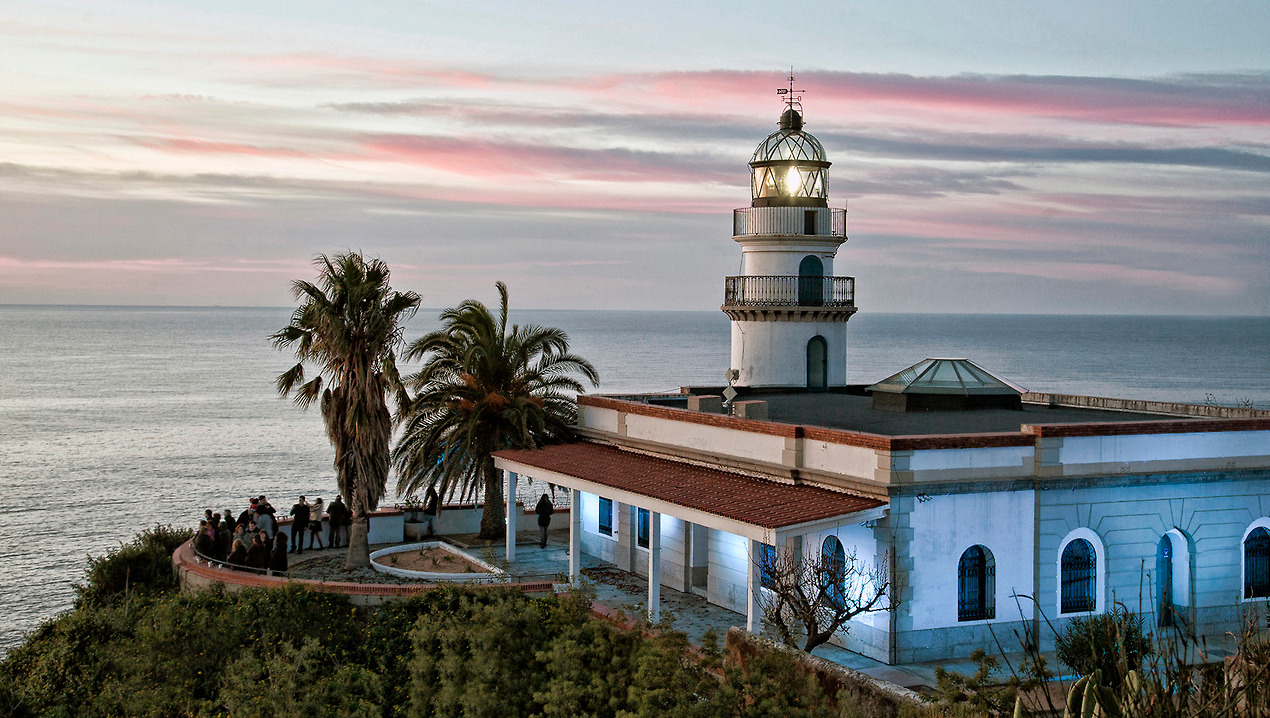
Calella’s lighthouse from the XIX century — CC BY-SA 3
Notable Places in Calella
Calella Lighthouse — The lighthouse is the symbol of the town, a white tower 10 metres high standing on the Capaspre headland, at a height of 50 metres above sea level. The lighthouse was begun on 9 October 1856 and inaugurated on 15 December 1859, and it first ran on olive oil lamps before becoming the first lighthouse in Catalonia to be electrified in 1916. Today the lighthouse still works, with a light flashing in groups of three and two every 30 seconds, visible from about 18 nautical miles out at sea. The interpretation centre in the keeper’s house explains the history of the lighthouse and the coastal signalling system.
Platja Gran and Platja de Garbí — Platja Gran is the main beach of Calella, directly in front of the centre of the town, with fine golden sand and shallow water that suits families with small children. The beach has full summer services, such as sun loungers, umbrellas, beach sports areas and beach bars, and it often receives the Blue Flag for bathing water quality. Platja de Garbí follows Platja Gran to the northeast, toward Pineda de Mar, with more space and less noise than the main beach, and it also often receives the Blue Flag.
Platja de les Roques — Platja de les Roques is the smallest of the three beaches of Calella, lying under the cliffs of the lighthouse headland at the southwestern end of the town. The beach is a small cove with rocks and sand, clearer water than the larger beaches, and it suits swimming, snorkelling and quiet relaxation. Part of the beach is set aside for naturists, following a long-standing custom of the Catalan coast. The path down to the beach runs from the lighthouse area, and a small bar serves drinks in summer.
Dalmau Park and the air raid shelter — Dalmau Park is the largest green space of Calella, just behind the old town, with old trees, shaded paths and a playground for children. The park is where local people come to relax and exercise, and it is very different from the tourist atmosphere of the seafront. Under the park lies the air raid shelter built by local people in 1937, during the Spanish Civil War, to escape the bombing. The shelter is open to visitors on certain days, with narrow passages, shelter rooms and panels about daily life in wartime.
The old town and the church of Santa Maria i Sant Nicolau — The old town of Calella lies just behind the seafront promenade, with narrow streets, low houses and wrought iron balconies that recall the fishing village that the town once was. The church of Santa Maria i Sant Nicolau stands in the centre of the old town, and it is the main religious building of the town. Old houses such as Casa Galceran, Casa Giol and Casa Salvador Sivilla, dating from the 15th to the 17th centuries, stand scattered through the old town, with stone facades and arched doorways.
Passeig Manuel Puigvert — The Passeig Manuel Puigvert is the finest seafront avenue of Calella, running along Platja Gran with old plane trees and a wrought iron railing from the 19th century. The promenade is the familiar image on the postcards of Calella, with shade in summer and a direct view out to sea. In the evening, the promenade becomes the main walking place of the town, with people strolling, cycling and sitting at the outdoor cafes, and it is lined with restaurants, bars and souvenir shops.
Frequently Asked Questions
Where is Calella and how long does it take to get there from Barcelona?
Calella lies on the Costa del Maresme coast, in Barcelona province, Catalonia, about 50 kilometres northeast of central Barcelona. Visitors take the R1 line of Rodalies de Catalunya from Barcelona to Calella station in a little over an hour, and the station stands in the centre of the town, only a few minutes on foot from the beach.
Which beaches does Calella have?
Calella has three main beaches following each other, Platja Gran directly in front of the centre, Platja de Garbí to the northeast, and Platja de les Roques, a small cove under the cliffs of the lighthouse to the southwest. All three beaches have fine golden sand and shallow water, and Platja Gran and Platja de Garbí often receive the Blue Flag. Platja de les Roques is quieter, with clearer water and a naturist area.
Can the Calella Lighthouse be visited?
The Calella Lighthouse has an interpretation centre for visitors, presenting the history of the lighthouse and the coastal signalling system, and the area around the lighthouse has panoramic views of the sea. The lighthouse was inaugurated in 1859 and was the first in Catalonia to be electrified in 1916, so it is both a working aid to navigation and a historic monument. Visitors should check the opening hours before going, because they change by season.
When is the best time to visit Calella?
The high season in Calella runs from June to September, when the sun is strong, the sea is warm and all services are open, but the beaches are also at their busiest. May and October are pleasant for those who want to avoid the crowds, because the weather is still warm and the sea is still warm enough for swimming. Winter in Calella is mild and quiet, good for walking and sightseeing, but many seafront tourist services close or shorten their hours.
Is Calella suitable for families with small children?
Calella suits families with small children well, thanks to the fine sand and shallow water, Dalmau Park with its playground, and the fact that all the main sights are within walking distance. The town has many family restaurants, shops and medical services, together with a convenient train line for a day trip to Barcelona.
What day trips can I make from Calella?
From Calella, visitors can take the train to Barcelona for the day, with its old town, the works of Gaudí and its museums, or travel north to Girona and the Costa Brava. The neighbouring towns of Sant Pol de Mar, Arenys de Mar and Mataró are also easy to reach by the R1 train line, each with its own character, old town, market and beach.
Verified
- Calella is a municipality of the Maresme region, Barcelona province, Catalonia, Spain, at 41.6169 N, 2.6642 E, with Wikidata identifier Q12540, verified through the Wikidata API on 23 November 2026.
- The permanent population was 20,207 people in 2024, according to Idescat, checked on 23 November 2026.
- The Calella Lighthouse was begun on 9 October 1856, inaugurated on 15 December 1859 under the engineer Marià Parellada, with a tower 10 metres high, a focal height of 50 metres and a range of 18 nautical miles, according to the sources cited below.
- The lighthouse was the first in Catalonia to be electrified, in 1916, and the interpretation centre opened on 13 June 2011, according to the sources cited below.
- The air raid shelter under Dalmau Park was built in 1937, during the Spanish Civil War, according to the sources cited below.
- The three beaches of Calella are Platja Gran, Platja de Garbí and Platja de les Roques, according to the sources cited below.
- Spain has 50 World Heritage sites, with 44 cultural, 4 natural and 2 mixed sites, according to UNESCO, checked on 23 November 2026.
- The nearest World Heritage site to Calella is the Works of Gaudí in Barcelona, reference 320, inscribed in 1984 under criteria (i)(ii)(iv), with the Sagrada Família about 47 kilometres away in a straight line, computed from coordinates on 23 November 2026.
Sources
- Wikidata, Q12540 — Calella as a municipality of Catalonia, with coordinates, checked through the API on 23 November 2026.
- Idescat, the Calella municipality page — the permanent population of 20,207 people in 2024, checked on 23 November 2026.
- Wikipedia, Calella — the history, the lighthouse and the beaches of Calella, checked on 23 November 2026.
- Wikipedia, Calella Lighthouse — the lighthouse begun in 1856 and inaugurated in 1859, checked on 23 November 2026.
- UNESCO, https://whc.unesco.org/en/list/320/ — the Works of Antoni Gaudí, reference 320, criteria (i)(ii)(iv), checked on 23 November 2026.
- UNESCO, https://whc.unesco.org/en/list/875/ — the Archaeological Ensemble of Tarraco, reference 875, checked on 23 November 2026.
Unverified
- The exact construction dates of the church of Santa Maria i Sant Nicolau and of the old houses Casa Galceran, Casa Giol and Casa Salvador Sivilla in the old town need checking against the site of the Calella town council or the heritage body of Catalonia.
- The fact that Calella hosts the IRONMAN Barcelona triathlon needs checking against the official IRONMAN site.
- The current opening hours and ticket prices of the lighthouse interpretation centre and of the Dalmau air raid shelter should be checked on the official site of the town of Calella before a visit.
- The number of Blue Flags awarded to each beach in the current season should be checked on the site of the Blue Flag organisation or the Calella town council.
- The exact journey time by R1 train from Barcelona to Calella under the current timetable should be checked on the site of Rodalies de Catalunya.
Illustrations
- Hero: Calella. Free image: https://upload.wikimedia.org/wikipedia/commons/8/8f/Pla%C3%A7a_de_Catalunya_%28Calella-Catalunya%29_06.jpg — CC BY-SA 4.0.
- In body, Calella: Calella Іспанія, пляж зі скелями. Free image: https://upload.wikimedia.org/wikipedia/commons/9/90/Calella_Spain_Platja_de_les_Roques_01.jpg — CC BY-SA 4.
- In body, Calella: Calella’s lighthouse from the XIX century. Free image: https://upload.wikimedia.org/wikipedia/commons/4/40/Far_de_calella.jpg — CC BY-SA 3.