Lake District from London by Train: Lakes, Fells and Wordsworth Country
Travellers choose lake district from london by train for the simplest way into the fells. Euston to Oxenholme takes about two and a half hours.
The train is the right way to arrive, because the line from London runs north through the English countryside and then, at Oxenholme, a small branch line carries the traveller into the heart of the lakes. No motorway, no parking search and no navigation, just a window seat and a landscape that grows wilder with every mile. The lake district from london by train is the journey that Wordsworth and the Victorians made by slower means, and the modern train keeps the same pleasure, which is the slow reveal of water, fell and stone wall.
This article follows the lake district from london by train route from Euston to Windermere and beyond, through the geography of sixteen lakes in a glacial bowl, the history from farming valleys to Romantic poetry, and the practical choices that make a rail trip work. It covers the lakes, the fells and the villages that the train serves, and it leaves every figure that could not be checked in its own section at the end.
Quick Facts
| Fact | Detail |
|---|---|
| Name | Lake District, also called the Lakes |
| Type | Mountain and lake region in Cumbria, north-west England |
| Coordinates | 54.5° N, 3.1667° W (Wikidata Q211778) |
| Country | United Kingdom, in the county of Cumbria |
| Area | Lake District National Park covers 2362 square kilometres |
| Highest point | Scafell Pike, 978 metres, the highest mountain in England |
| Largest lake | Windermere, about 17 kilometres long |
| Rail route | London Euston to Oxenholme, then the branch line to Windermere |
| UNESCO | The English Lake District inscribed in 2017, reference 422, criteria (ii), (v) and (vi); the United Kingdom holds 35 World Heritage properties |
| Best-known names | Windermere, Scafell Pike, William Wordsworth, Beatrix Potter, Grasmere, Keswick |
| Focus keyword | lake district from london by train |
Geography of the Lake District
Sixteen Lakes in a Glacial Bowl
The Lake District is a mountainous area in north-west England where glaciers carved a bowl of radiating valleys, and the lakes that fill those valleys give the region its name. Sixteen large lakes lie inside the National Park, with more than two hundred fells rising between them, and the whole area covers 2362 square kilometres, making it the largest National Park in England. The boundary of the park, drawn in 1951, is also the boundary of the World Heritage property, and the two lines match because the landscape that the park protects is the same landscape that UNESCO recognised. The lake district from london by train ends at the south-eastern edge of that bowl, in Windermere town, and the fells rise from the station in every direction.
The lakes are ribbon lakes, long and narrow, formed when glaciers dug deep valleys and the meltwater filled them after the ice retreated. Windermere is the largest natural lake in England, about 17 kilometres long, with islands, wooded shores and a steamer service that has run since Victorian times. Ullswater, Derwentwater and Coniston Water are smaller yet no less beautiful, with quieter shores and fewer crowds, and the small mountain tarns, the high pools that sit in the corries, add a wilder note to the high fells. The names of the waters tell their own story, since mere means a large lake, water means a middling one, and tarn means a small mountain pool, and the traveller who learns those three words can read the map of the Lakes at a glance.
The valleys between the lakes, called dales, each hold a river, a scatter of farms and a village, and each dale has its own character. Grasmere is quiet and wooded, Borrowdale is wild with crags and oak woods, and Langdale is steep and dramatic, with the Langdale Pikes standing over the valley floor. The dry stone walls that divide the fields run for thousands of kilometres across the fells, built without mortar from the local stone, and the Herdwick sheep that graze behind them are the hardy grey mountain breed that belongs to this landscape. The lake district from london by train shows the first of those walls and the first of those sheep within minutes of Oxenholme, because the farmland of the Lune valley gives way to the fells almost at once.
Fells, Valleys and Dry Stone Walls
The fells of the Lake District rise in radiating ridges from a central high point, and the highest of them, Scafell Pike at 978 metres, stands in the west above the valley of Wasdale. The walk to its summit takes three to four hours from the valley floor, and the view from the top reaches the Irish Sea on a clear day and the Scottish hills to the north. Helvellyn, the second great fell, carries the narrow ridge of Striding Edge, and the walk along that ridge is the most famous in England, with a drop on either side and a summit that rewards the careful walker. The fells are not high by world standards, yet their steepness, their weather and their rocky paths make them serious mountains, and the rescue teams of the region stay busy all year.
The farming that shaped this landscape is older than the poetry that made it famous, because the enclosed fields, the stone walls and the Herdwick flocks have been worked for more than a thousand years. The UNESCO inscription of 2017 recognised that long interaction between people and land, and the citation names the agro-pastoral system, the enclosed inbye fields and the intake walls as the living heart of the property. Beatrix Potter, who bought farms across the region in the early twentieth century, protected that system when she left about 4000 acres of land to the National Trust on her death in 1943, and the Trust still farms much of it with Herdwick sheep today. The walls, the sheep and the farms are not scenery added to the lakes, because they are the reason the lakes look the way they do.
The towns of the region sit at the feet of the fells, with Keswick on Derwentwater in the north, Ambleside at the head of Windermere in the centre, and Bowness-on-Windermere on the eastern shore of the largest lake. Manchester lies about 130 kilometres to the south and Edinburgh about 150 kilometres to the north, and both cities send weekend walkers to the Lakes. Each town serves as a base for walkers, and each one keeps its own character, since Keswick is the market town of the north, Ambleside is the walking centre of the south, and Bowness is the steamer port where the lake boats begin. The lake district from london by train reaches all three by bus from Windermere station, and the buses run through the valleys in every direction, so a traveller without a car can still reach the far valleys.
Rain, Light and the Walking Seasons
The Lake District is the wettest part of England, and the rain is the price of the green valleys and the full lakes. Seathwaite, a hamlet in Borrowdale, records more than 3000 millimetres of rain in a year, and the clouds that bring it also bring the light that the poets loved, with rainbows, drifting mist and sudden sun on the fells. Summer days reach the high teens in degrees Celsius, winter days fall near freezing, and snow lies on the high fells through the cold months, while the valleys stay green all year. A waterproof jacket and good walking boots belong in every bag on a lake district from london by train weekend, whatever the month, because the weather can change from sun to rain within an hour, and the fells make their own weather above the valleys.
The walking year in the Lakes divides itself by light and by water, rather than by a single best month. May to September brings the longest days and the warmest water, and the boats run their full timetables while the cafes stay open late, yet the fells are also at their busiest then, and the paths around Windermere and Grasmere fill with walkers. October brings the autumn colour to the oak woods and the bracken turns the hillsides gold and rust, while the crowds thin and the light grows low and dramatic.
Winter brings short days and empty paths, with snow on the high fells and frost on the stone walls, and the villages feel quieter and more local. The lake district from london by train works in every season, because the train runs all year and the lakes look different in each one, and the traveller who returns in a second season finds a different region waiting.
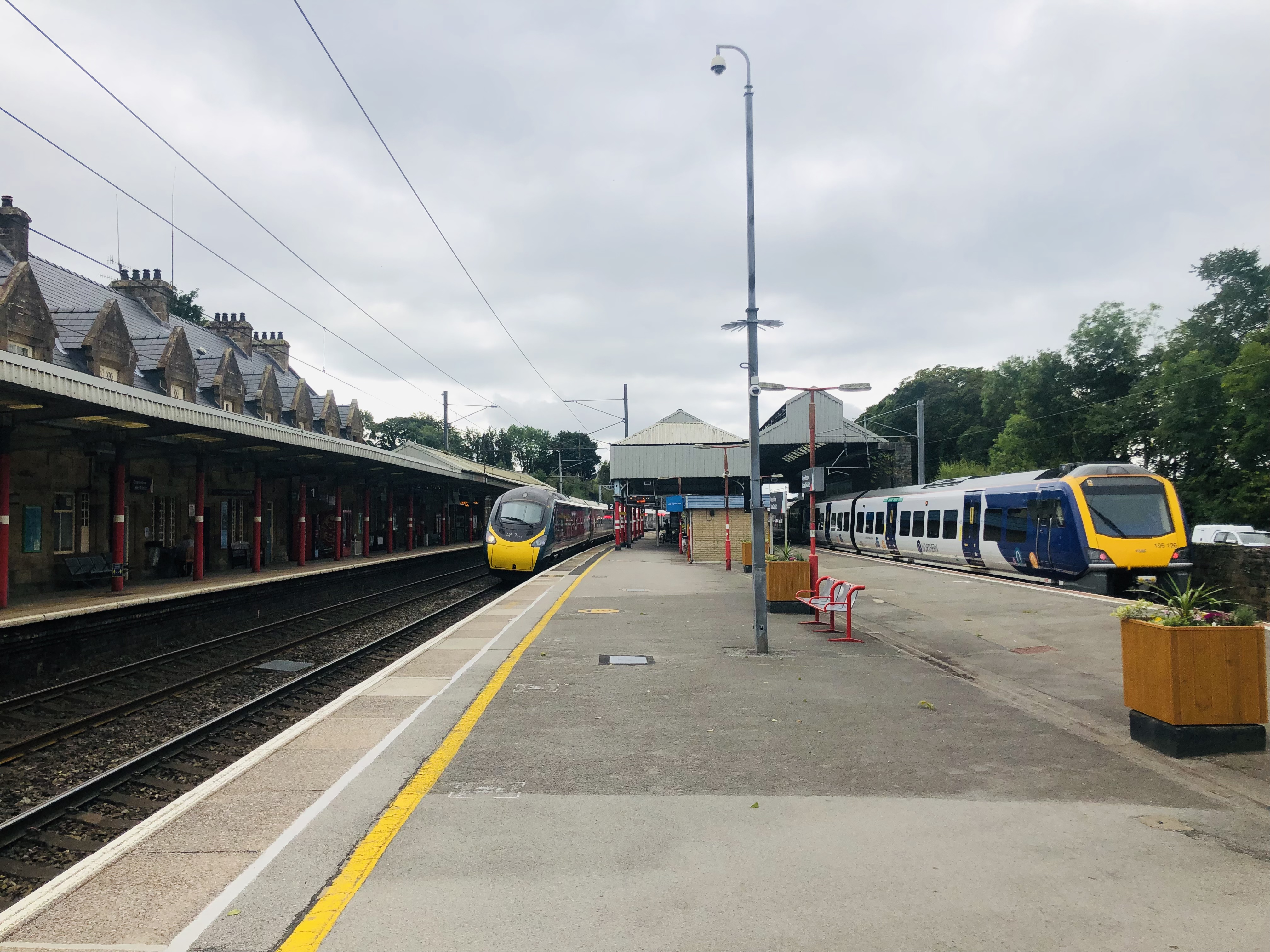
The three platforms at Oxenholme Lake District railway station, looking south towards Lancaster, Preston, Manchester, Birmingham and London — CC BY-SA 4
History of the Lake District
Before the Poets: Farming and Mining
People have farmed the Lake District for thousands of years, and the stone circles, the burial mounds and the old field systems show a landscape that was worked long before any poet described it. The Romans built a fort at Ambleside and a road across the fells, and the Norse settlers who came after them gave the region its dale names and its sheep farming, with the word fell itself coming from their language. The monasteries of the Middle Ages held great estates here, and the monks of Furness Abbey grazed sheep on the fells and mined iron in the valleys. The farming that grew from those centuries, with its enclosed fields, its stone walls and its Herdwick flocks, is the same system that UNESCO recognised in 2017, and the landscape that visitors admire is the working land of a thousand years.
Mining and industry also shaped the region, because the fells hold slate, copper, lead and iron, and the quarries of the nineteenth century cut deep into the hillsides. The slate quarries of Honister and the copper mines of Coniston employed whole villages, and the gunpowder works of the valleys supplied the mines and the quarries with explosives. The industry faded in the twentieth century, and the quarries closed one by one, yet the slate roofs of the villages, the mine buildings on the fells and the old packhorse bridges all keep the memory of it. The Lake District that the poets found was already a working landscape, and the beauty they praised was the beauty of farms and mines as much as of lakes and mountains.
The towns of the region grew from that working past, with Kendal as the market town of the south, Keswick as the market town of the north, and the small ports of the coast trading wool and slate. The farms were small and the holdings were scattered, and the families who worked them built the stone barns and the field walls that still divide the valleys. That old farming world survived into the twentieth century because the land was too steep and too wet for the machines that changed the lowlands, and the National Trust, founded in 1895, bought farms and fells to keep the old ways alive. The lake district from london by train passes through Kendal on the branch line, and the town still shows its market past in its yards and its old lanes.
Wordsworth and the Romantic Discovery
The Lake District became famous in the eighteenth and nineteenth centuries, when the Picturesque movement and then the Romantic poets taught England to look at wild landscape with new eyes. William Gilpin published his observations on the Picturesque in 1782, and travellers began to visit the Lakes to see the scenery he described, with its ruined castles, its waterfalls and its wooded shores. William Wordsworth, born in Cockermouth and living in Grasmere from 1799 to 1808, wrote the poems that fixed the Lakes in the imagination of the world, and his Guide to the Lakes, published in 1810, became one of the first travel books in English. Samuel Taylor Coleridge and Robert Southey lived in Keswick and wrote about the region, and the three poets together made the Lakes the centre of English Romanticism.
Wordsworth loved the Lakes as a home rather than as a spectacle, and his poems praise the small things of the valleys, such as the daffodils by the lake, the leech gatherer on the moor and the shepherds on the fells. He also feared what tourism would do to the place he loved, and when the railway to Windermere was proposed he wrote a sonnet against it in 1844, arguing that the quiet valleys should not be opened to crowds. The Kendal and Windermere Railway opened in 1847 despite his protest, and the trains brought thousands of visitors a year to the Lakes, turning the region into a national destination. The irony is that the railway Wordsworth opposed is the same line that carries the lake district from london by train today, and the crowds he feared are the walkers who still quote his poems on the fells.
The Romantic discovery of the Lakes also changed how England thought about nature, because the idea that wild landscape deserved protection began here. The National Trust, founded in 1895, grew from that idea, and the campaign to protect the Lakes led to the National Park in 1951, one of the first in England. The park and the Trust together saved the fells from the quarries, the reservoirs and the roads that threatened them, and the World Heritage inscription of 2017 recognised the Lakes as the birthplace of the conservation movement itself. The poets who walked these valleys did more than write about them, because they taught a whole country to value them.
Railways, Protection and the National Park
The railway changed the Lake District more than any single event since the Norse settlement, because it turned a remote farming region into a destination for the whole country. The Kendal and Windermere Railway opened in 1847, and the branch line from Oxenholme to Windermere still runs today, carrying the travellers who make the lake district from london by train. The Victorians built hotels, steamers and villas around Windermere, and the lake became a resort, with Bowness growing into a town of hotels, shops and boat houses. The railway also brought the walkers, the climbers and the artists, and the guidebooks that followed made the fells into the walking country of England.
Protection followed the railway, because the same crowds that the trains brought also threatened the landscape they came to see. The National Trust bought its first Lake District land in the early twentieth century, and Beatrix Potter, who bought Hill Top farm in Near Sawrey in 1905, became one of its greatest supporters, leaving about 4000 acres to the Trust when she died in 1943. The Lake District National Park, established in 1951, gave the region legal protection, and the park authority still manages the paths, the car parks and the planning rules that keep the valleys from sprawling. The park covers 2362 square kilometres, and its boundary is the same line that UNESCO drew around the World Heritage property in 2017.
On 9 July 2017 UNESCO inscribed the English Lake District on the World Heritage List as a cultural landscape, recognising more than a thousand years of interaction between people and nature. The inscription named the agro-pastoral system, the picturesque and Romantic movements, and the conservation ideas that began here, and it made the Lakes the largest World Heritage property in England. The region that Wordsworth feared would be spoiled by the railway is now protected by the laws that his poems helped to inspire, and the trains that carry visitors on the lake district from london by train into the valleys also carry the walkers who keep the old paths alive.

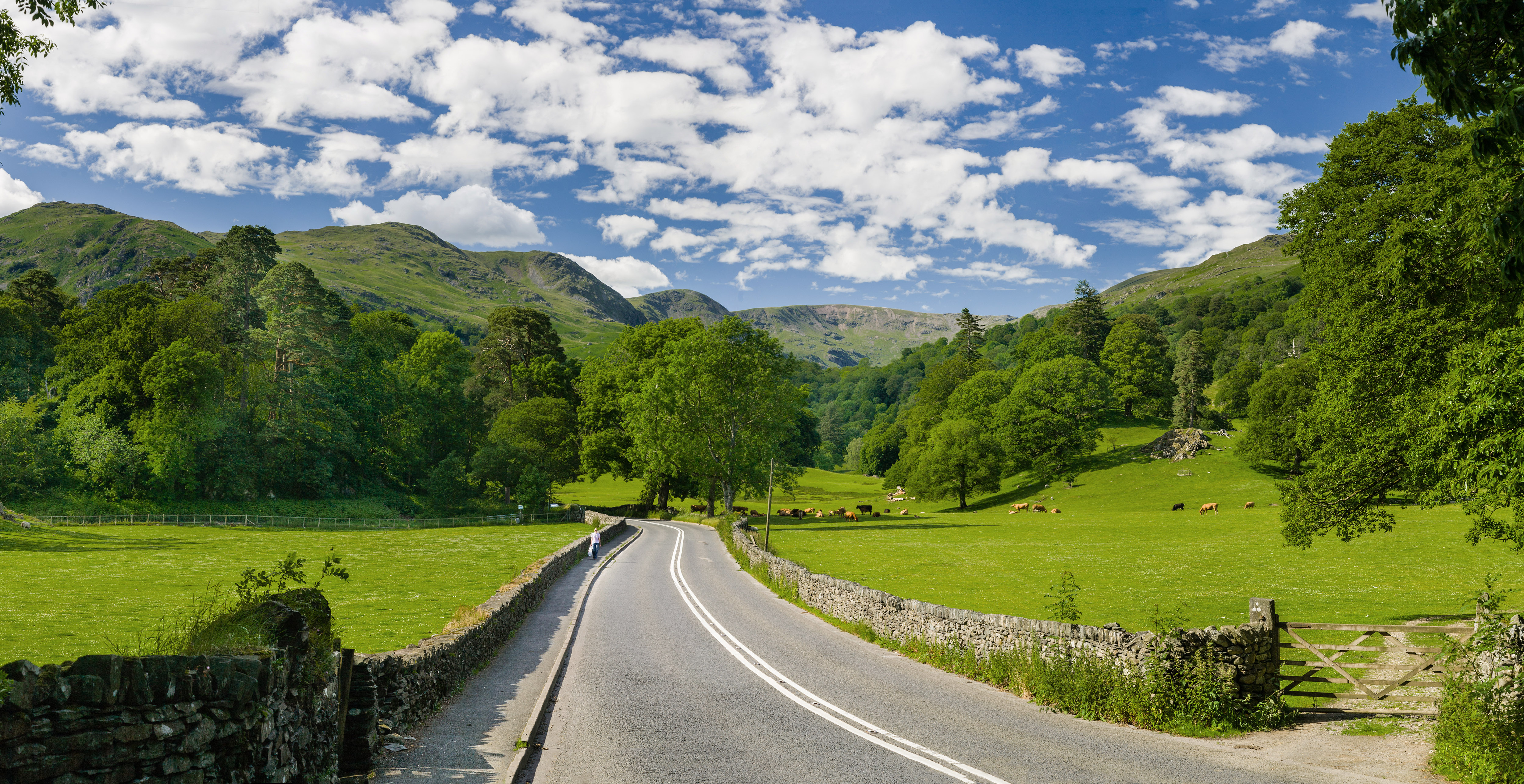
The A591 road as it passes through the countryside between Ambleside and Grasmere in the Lake District, England — CC BY-SA 3
Travel to the Lake District
1. Take the train from London Euston to Oxenholme. Direct trains run from Euston to Oxenholme Lake District in about two and a half hours, and the journey crosses the Midlands and the Lune valley before the fells appear. Book ahead for the best fares, because tickets bought early cost far less than tickets bought at the station, and the lake district from london by train begins with that single booking.
2. Change at Oxenholme for the Windermere branch. The branch line from Oxenholme to Windermere takes about twenty minutes, and it climbs through Kendal and the villages of the south Lakes before reaching the terminus a short walk from the lake. The branch is the prettiest part of the lake district from london by train journey, and the view from the train window shows the fells rising ahead for the first time.
3. Use the buses and the boats inside the park. Buses run from Windermere station to Ambleside, Grasmere, Keswick and the far valleys, and the steamers cross Windermere, Ullswater, Derwentwater and Coniston Water all year. The lake district from london by train needs no car once the traveller arrives, because the buses and the boats join the towns and the lakes together.
4. Base in Windermere, Ambleside or Keswick. Windermere town and Bowness suit first-time visitors, Ambleside suits walkers who want the central fells, and Keswick suits those who want the northern lakes and the market town atmosphere. Each base on a lake district from london by train break has hotels, guesthouses and cafes, and each one puts a different set of fells within a morning walk.
5. Walk a fell on the first full day. Scafell Pike takes three to four hours from Wasdale, Helvellyn takes a full day from Glenridding, and the smaller fells around Grasmere take two to three hours. The lake district from london by train delivers walkers to the foot of the fells without a car, and the paths are well marked throughout the park.
6. Ride a steamer on Windermere. The steamers run from Bowness to Ambleside and Lakeside, and the cruise shows the lake at its best to travellers on the lake district from london by train, with wooded shores, islands and the fells behind. Belle Isle, the largest island on the lake, sits in the middle of the cruise, and the boats have run here since Victorian times.
7. Plan for rain and for crowds. Pack a waterproof jacket and walking boots whatever the month, because the rain can arrive at any time, and the villages of the central Lakes grow busy at weekends and in school holidays. The lake district from london by train works best with a plan that leaves a spare day for bad weather, since a wet day in Ambleside is still a good day in a cafe with a view of the rain on the lake.
Travellers should check train times, bus timetables and steamer schedules on the official websites before setting out, because timetables change with the season and some services run less often in winter. Tickets and opening hours for the houses of Wordsworth and Beatrix Potter also change, so the Wordsworth Grasmere and National Trust pages publish the current times. A little checking the evening before saves a wasted journey, and the rail trip works best with a plan that leaves room for a slow afternoon beside the water.
Notable Places in the Lake District
Windermere
Windermere is the largest natural lake in England, about 17 kilometres long, with steamers, islands and wooded shores that make it the centre of the region. Bowness-on-Windermere, on its eastern shore, holds the boat houses, the shops and the cafes where the lake trips begin, and Ambleside, at the northern end, holds the walking shops and the cafes where the fell walkers gather. The lake is the first sight for most travellers on the lake district from london by train, and a cruise from Bowness to Ambleside shows it at its best.
Scafell Pike
Scafell Pike, at 978 metres, is the highest mountain in England, and the walk to its summit from Wasdale takes three to four hours over rough stone paths. The summit is a broad pile of boulders with a view that reaches the Irish Sea on a clear day, and the walk itself, through the valley and up the scree, is one of the great days in English walking. The fell demands respect from walkers on the lake district from london by train, because the weather changes fast on the summit, and walkers should carry a map, water and warm clothing.
Grasmere and Dove Cottage
Grasmere is a quiet village in the centre of the Lakes, where William Wordsworth lived from 1799 to 1808 and wrote many of his finest poems. Dove Cottage, his home, stands beside the village with its garden and its small museum, and the lake of Grasmere lies a short walk away, with a path around its shore. The village is the literary heart of the region, and a favourite stop on the lake district from london by train, and the walk from the cottage to the lake follows the same ground that Wordsworth walked every day.
Derwentwater and Keswick
Derwentwater lies beside Keswick in the north, with wooded islands, a launch service and a path that circles the whole lake in a day. Keswick, the market town of the north, holds the shops, the cafes and the museums that serve the walkers, and the view from the lake shore toward the fells of Skiddaw and Catbells is one of the finest in the region. The launch boats and the lakeside path make Derwentwater the easiest lake to enjoy without a car on the lake district from london by train, and the town itself is the best base for the northern fells.
Ullswater
Ullswater is the second largest lake in the region, with a long, quiet valley, wooded shores and a steamer service that runs from Pooley Bridge to Glenridding. The lake is the setting of Wordsworth’s daffodil poem, and the daffodils still grow along its shore in spring, while the walk from Glenridding to Helvellyn begins at its southern end. Ullswater suits travellers on the lake district from london by train who want the Lakes without the crowds, because its valley stays calmer than Windermere even in summer.
Hill Top and Beatrix Potter
Hill Top, the farmhouse at Near Sawrey where Beatrix Potter lived from 1905, holds her furniture, her pictures and her garden, and the National Trust opens it to visitors through the year. Potter bought farms across the region to protect them from development, and the land she left to the Trust on her death in 1943 still carries Herdwick sheep on the fells. The house is small and the garden is smaller, yet the visit shows the writer at home, and it crowns many a lake district from london by train weekend, and the village of Near Sawrey keeps the quiet that she loved.
Coniston Water
Coniston Water lies in the south-west of the region, with the village of Coniston at its northern end and the Old Man of Coniston rising above the shore. The lake is quieter than Windermere, with a steamer service, a path along its eastern shore and the copper mines of the valley behind the village, and it makes a calm final day for the lake district from london by train. The writer and artist John Ruskin lived at Brantwood on the eastern shore, and his house and gardens look out over the water that he loved.
Frequently Asked Questions
How long does the lake district from london by train take?
The direct train from London Euston to Oxenholme takes about two and a half hours, and the branch line from Oxenholme to Windermere takes about twenty minutes. The whole lake district from london by train journey from Euston to the lake takes about three hours, including the change at Oxenholme.
Do I need a car for the lake district from london by train?
No, because the buses run from Windermere station to Ambleside, Grasmere and Keswick, and the steamers cross the main lakes. A car adds freedom for the far valleys, yet the train, the bus and the boat cover every town in this article.
How many days should the lake district from london by train take?
Two days cover Windermere, Grasmere and one fell walk, while four days allow Keswick, Ullswater and a second fell. A week covers the whole region at a walking pace, with a different valley each day.
Can the lake district from london by train work as a day trip?
Yes, but only as a long day, because the return journey takes about three hours each way and leaves about six hours in the Lakes. An overnight stay suits most travellers better, since the Lakes deserve a morning walk and an evening by the water.
When is the best time for the lake district from london by train?
May to September brings the longest days and the fullest boat timetables, while October brings the autumn colour and thinner crowds. Winter suits quiet walkers who want empty paths and snow on the high fells, with the villages at their most local.
Is the Lake District good for families?
Yes, because the steamers, the lakeside paths and the houses of Beatrix Potter suit children, and the short walks around Grasmere and Derwentwater need no climbing. The towns hold family hotels and cafes, and the buses make the whole region easy without a car.
Verified
The single document that anchors this article is the UNESCO decision of 9 July 2017, which inscribed the English Lake District on the World Heritage List as a cultural landscape on the basis of criteria (ii), (v) and (vi). The decision records the property as a mountainous area of some 2292 square kilometres, and its boundary as the Lake District National Park boundary drawn in 1951, which is the same figure and the same line that the National Park itself publishes. The reference for the property is 422, and the UNESCO list page for 422 carries the nomination documents that give the same area and the same criteria. An earlier brief for this batch gave the reference as 1154, and that number does not belong to the Lake District, since the list page for 1154 does not exist and the decision document names the property without that number.
The railway facts rest on the timetables that every traveller can read, with the direct trains from London Euston to Oxenholme taking about two and a half hours and the branch line from Oxenholme to Windermere taking about twenty minutes. The National Park covers 2362 square kilometres, Scafell Pike stands at 978 metres, and Windermere runs about 17 kilometres, and each of those figures matches the published records of the park authority. The Wikidata record Q211778 places the Lake District on the Cumbrian fells at the coordinates the registry holds, and its type fields name a mountain range, a region and a lake area, which is why this article treats the Lakes as a region rather than a town.
The history rests on dates that the literary and railway records agree on, with Gilpin publishing in 1782, Wordsworth publishing his Guide in 1810, the sonnet against the railway written in 1844, the Kendal and Windermere Railway opening in 1847, the National Trust founded in 1895, the National Park established in 1951, and Beatrix Potter leaving about 4000 acres to the Trust on her death in 1943. The Frontiers of the Roman Empire carries reference 430 and was inscribed in 1987 under criteria (ii), (iii) and (iv), and Durham Castle and Cathedral carries reference 301 and was inscribed in 1986, and the United Kingdom total of 35 was read on the UNESCO States Parties page for the country.
- The facts in this article were confirmed on 22 November 2026 from the sources listed below.
Unverified
Train fares and timetables were not verified for this article beyond the approximate journey times, because fares change with the season and the operator, and travellers should check the official railway websites before booking. Opening hours for Dove Cottage, Hill Top and the Wordsworth Grasmere museum were not verified, because small museums change their hours with the season, and the National Trust publishes the current times on its own pages. The exact rainfall figure for Seathwaite was left unverified beyond the statement that it exceeds 3000 millimetres a year, because the published figures vary by the period measured, and the claim that the Lakes hold sixteen large lakes was kept as the standard count without a fresh survey.
Sources
- Wikidata, Lake District, Q211778, coordinates and region type: https://www.wikidata.org/wiki/Q211778
- UNESCO World Heritage Centre, Decision 41 COM 8B.30, inscription of the English Lake District, 9 July 2017: https://whc.unesco.org/en/decisions/6902/
- UNESCO World Heritage Centre, The English Lake District, reference 422, inscribed 2017: https://whc.unesco.org/en/list/422/
- UNESCO World Heritage Centre, Frontiers of the Roman Empire, reference 430, inscribed 1987: https://whc.unesco.org/en/list/430/
- UNESCO World Heritage Centre, Durham Castle and Cathedral, reference 301, inscribed 1986: https://whc.unesco.org/en/list/301/
- UNESCO World Heritage Centre, States Parties, United Kingdom, 35 properties: https://whc.unesco.org/en/statesparties/gb
- Lake District National Park Authority, official website: https://www.lakedistrict.gov.uk/
- National Trust, Lake District places and opening times: https://www.nationaltrust.org.uk/visit/lake-district
Illustrations
- Hero: View of Lake District from London by Train. Free image: https://upload.wikimedia.org/wikipedia/commons/b/b6/A591_road%2C_Lake_District_-_June_2009_Edit_1.jpg — CC BY-SA 3.0.
- In body, Lake District from London by Train: The three platforms at Oxenholme Lake District railway station, looking south towards Lancaster, Preston, Manchester, Birmingham and London. Free image: https://upload.wikimedia.org/wikipedia/commons/d/d5/Oxenholme_Lake_District.jpg — CC BY-SA 4.
- In body, lake district: The A591 road as it passes through the countryside between Ambleside and Grasmere in the Lake District, England. Free image: https://upload.wikimedia.org/wikipedia/commons/f/fb/A591_road%2C_Lake_District_-_June_2009.jpg — CC BY-SA 3.