
Day Trips from London: Stonehenge, Bath, Windsor, Oxford and the Cotswolds
Day trips from London open up the best of southern England in a day. Stonehenge, Bath, Windsor and Oxford all lie one or two hours away.
Day trips from London are the easiest way to widen a stay in the capital, because the railways and motorways of England fan out from the city in every direction. Most of the famous sights stand within one or two hours of travel, so a traveller can leave in the morning, spend a full day in a historic city or a country village, and return to London for dinner. No hotel change and no heavy luggage are needed, and a single base in London can serve a whole week of different days out.
This guide to day trips from London covers the routes that travellers search for most, with the geography of each direction, the history that made these places famous, and practical advice for going by train, by coach tour or by car. It groups the destinations by direction, so readers can pick a day that fits their interests, whether that is prehistory, royal history, university life or quiet villages.
Quick Facts About Day Trips from London
| Fact | Detail |
|---|---|
| Starting point | London, United Kingdom |
| Range | About 100 to 200 km around London |
| Travel time | Usually 1 to 2 hours each way by train or coach |
| Main groups | West, east, north and south |
| Highlights | Stonehenge, Bath, Windsor, Oxford, Cambridge, Canterbury, Cotswolds |
| World Heritage | Stonehenge 1986, Bath 1987, Blenheim Palace 1987, Canterbury 1988, Maritime Greenwich 1997 |
| Type | Travel route page, not a single place |
| Common search phrase | day trips from london |
| Wikidata | None, this is a travel route rather than a single place |
Geography of Day Trips from London
A City Built for Days Out
London stands in the south-east of England, on the River Thames, and it is the centre of a transport network that reaches every part of the island. The great stations of the city each serve a different direction, so the choice of station depends on the destination. Trains for Bath, Oxford and the Cotswolds leave from Paddington, trains for Windsor and the south-west leave from Waterloo, trains for Brighton and Canterbury leave from Victoria, and trains for Cambridge leave from King’s Cross. Saint Pancras serves the north and the Channel Tunnel, and it is the gateway for longer journeys out of the capital.
Day trips from London work so well because the distances are short and the network is dense. The train lines built in the nineteenth century still carry most day travellers, and the motorways built in the twentieth century carry the coaches and the cars. A traveller who understands the stations can plan a day out in minutes, and a traveller who joins a coach tour can leave the planning to someone else. The geography of day trips from London is therefore the geography of the stations, with each terminus opening a different part of England.
The land of southern England is low hills and flat plains, with fields, hedgerows and villages spread between the towns. The Cotswolds, north-west of London, are low limestone hills, famous for villages built of honey-coloured stone and for green pastures. Salisbury Plain, south-west of London, is open chalk downland, where Stonehenge stands in a wide landscape with few trees and a broad horizon. The contrast between the two landscapes is part of the pleasure of the west, because the Cotswolds feel enclosed and gentle while the plain feels open and ancient.
The Three Directions
The day trips from London fall into three groups, by direction and by character. The western group holds Stonehenge, Bath, Windsor, Oxford and the Cotswolds, and it is the most searched group, with the longest history and the most famous countryside. The eastern group holds Canterbury and Dover, with a medieval cathedral city and the white cliffs that face the English Channel. The northern and southern group holds Cambridge, Brighton and Blenheim Palace, for travellers who have already seen the west and want a change of air.
The western group is the best choice for a first day out, because it gathers two World Heritage properties, a royal castle and a university city into a single direction. The eastern group suits travellers who care about the history of the English Church and the coast, and the northern and southern group suits those who want a university, a seaside town or a great palace. Day trips from London reward a second and a third day, because each direction has a different landscape and a different story.
Southern England has a temperate maritime climate, with mild summers and damp winters, and snow is rare. The weather changes quickly, so a jacket and comfortable walking shoes belong in every day bag, whatever the forecast says. Summer gives the longest days and the warmest light, winter gives short days and early sunsets, and spring and autumn give the kindest balance of light and quiet.
The Cotswolds and Salisbury Plain
The Cotswolds are the finest rural landscape in southern England, with villages of honey-coloured limestone, green meadows and small streams. The best-known villages are Bibury, which the writer William Morris called the most beautiful village in England, Bourton-on-the-Water, where the River Windrush runs through the centre, and Stow-on-the-Wold, with its old market square. The whole area is protected as an Area of Outstanding Natural Beauty, and its villages keep their stone cottages, their churches and their village greens.
Salisbury Plain is a different world, a wide chalk downland where Stonehenge stands alone in open fields. The monument is visible from the road long before a visitor reaches it, and its great stones rise against a sky that seems larger than the sky over London. The plain holds other prehistoric monuments, including the stone circle at Avebury, and the whole landscape is a record of five thousand years of human life. Day trips from London to the west pass from the stone villages of the Cotswolds to the open plain in a single afternoon, and the change of landscape is one of the great pleasures of the route.

The last trip of the Victoria, City of London, Ontario, Canada (1897), p40 — Public domain
History of Day Trips from London
The Railway and the Victorian Day Out
The tradition of day trips from London began in the nineteenth century, when steam railways joined the capital to seaside towns and country villages. Victorian Londoners took the train to Brighton to bathe in the sea, to Windsor to see the royal castle, and to the countryside to escape the smoke of the city at the weekend. The railway lines built then still run today, and the great London stations still serve as gateways in every direction.
The day trip became a habit of city life, because the railway made the countryside cheap and quick to reach. Working people as well as the wealthy took excursion trains to the coast, and the seaside towns of the south grew around the railway stations. The history of day trips from London is therefore the history of the railway, and the modern coach tour is only the latest form of a journey that began with steam.
The stations themselves are part of the story. Paddington, opened in 1854, is a great iron and glass train shed by Isambard Kingdom Brunel. Saint Pancras, opened in 1868, is a Gothic palace of brick and iron, and King’s Cross, opened in 1852, is a plain brick building that has become famous through stories. A day out from London begins in one of these buildings, and the architecture is the first sight of the day.
Stonehenge and the Prehistoric Past
Stonehenge is the oldest destination on any day trip from London, with its stones raised between about 3000 and 2000 BC, in the Neolithic and Bronze Ages. For centuries people have argued about its purpose, whether it was a temple, an observatory or a burial place, and archaeologists still have no final answer. The stones were brought from far away, including the bluestones from the Preseli Hills in Wales, and their transport remains one of the great achievements of prehistoric Britain.
UNESCO inscribed Stonehenge with Avebury as a World Heritage property in 1986, under reference 373, recognising the value of the prehistoric stone circles. The visitor centre near the monument explains the life of the builders, and the walk around the stones gives the scale of the place. Day trips from London to Stonehenge usually pair the monument with Bath, because the two World Heritage properties stand about an hour apart by road, and together they show prehistory and the Roman and Georgian ages in a single day.
The mystery of Stonehenge is part of its appeal, because the stones keep their secret after five thousand years. Modern research has found that the monument was built in stages over fifteen centuries, and that it was used for burial as well as for ceremony. A visitor who walks the circle in the morning light understands why the place has drawn travellers for so long, and why it remains the most famous prehistoric monument in the world.
Bath, Windsor and the Royal Centuries
The city of Bath began with the Romans, who built public baths around a natural hot spring in the first century. In the eighteenth century Bath became the resort and social centre of the English nobility, with terraces of honey-coloured stone, an abbey and a bridge over the River Avon. UNESCO inscribed the city of Bath as a World Heritage property in 1987, under reference 428, and in 2021 Bath was inscribed again as part of the Great Spa Towns of Europe. The Roman Baths, Bath Abbey and the Pulteney Bridge are the sights that no visitor should miss, and the Circus and the Royal Crescent show Bath at the height of its Georgian glory.
Windsor Castle is the oldest and largest occupied castle in the world, with a history that begins in the eleventh century under William the Conqueror. Over nearly a thousand years it grew from a medieval fortress into a royal palace, and it was the main home of Queen Elizabeth the Second in her final years. Visitors see the State Apartments with their royal interiors, Saint George’s Chapel, where many kings and queens are buried, and the castle gardens above the Thames. The town of Windsor below the castle keeps the air of an old English town, with small streets, traditional pubs and Eton College across the river.
Blenheim Palace, near Oxford, is a Baroque palace inscribed by UNESCO in 1987, under reference 425, and it is the birthplace of Winston Churchill. The palace and its park show the power of the eighteenth-century aristocracy, and the house is still lived in by the family that built it. Day trips from London that pair Oxford with Blenheim Palace give a full day of university and palace in one direction.
Oxford, Cambridge and Canterbury
Oxford and Cambridge are the two oldest university cities of the English-speaking world, with histories that begin in the twelfth and thirteenth centuries. Oxford holds colleges of honey-coloured stone, the Bodleian Library and Christ Church, whose hall inspired scenes in the Harry Potter stories. Cambridge holds King’s College Chapel, with its Gothic fan vaulting and its famous choir, and the River Cam, where visitors ride in punts past the backs of the colleges. Both cities lie about an hour by train from London, and both repay a full day of walking.
Canterbury became the centre of the English Church in the sixth century, and its cathedral is the mother church of the Anglican Communion. UNESCO inscribed Canterbury Cathedral, Saint Augustine’s Abbey and Saint Martin’s Church as a World Heritage property in 1988, under reference 496. The city is a place of pilgrimage, made famous by the Canterbury Tales of Geoffrey Chaucer, and its medieval streets still follow the plan of the old city. Day trips from London to the east pair Canterbury with Dover, where the white cliffs stand above the Channel and the castle guards the port.
Maritime Greenwich, inscribed by UNESCO in 1997 under reference 795, is a different kind of day out, because it lies inside London itself, on the Thames to the east. The Royal Observatory, the Cutty Sark and the Old Royal Naval College mark the place where time itself is measured, at the Prime Meridian. Greenwich is the easiest of all the days out in this guide, because it needs only a boat or a short train ride, yet it holds a World Heritage property of its own.
Timeline of Day Trips from London
| Year | Event |
|---|---|
| About 3000 to 2000 BC | Stonehenge built on Salisbury Plain |
| First century | Romans build baths at Bath around the hot spring |
| Sixth century | Canterbury becomes the centre of the English Church |
| Eleventh century | Windsor Castle begun under William the Conqueror |
| Twelfth to thirteenth centuries | Universities of Oxford and Cambridge founded |
| Eighteenth century | Bath becomes the resort of the English nobility |
| Nineteenth century | Railways join London to Brighton, Windsor and the countryside |
| 1986 | Stonehenge inscribed by UNESCO, reference 373 |
| 1987 | Bath and Blenheim Palace inscribed by UNESCO |
| 1988 | Canterbury inscribed by UNESCO, reference 496 |
| 1997 | Maritime Greenwich inscribed by UNESCO, reference 795 |
| 2021 | Bath inscribed again in the Great Spa Towns of Europe |
Travel to Day Trips from London
Coach Tours and Independent Travel
The simplest way to take day trips from London is to buy a packaged coach tour for the day, with transport, a guide and entrance tickets already arranged. The most popular tours pair Stonehenge with Bath, Windsor with Stonehenge and Bath, or Oxford with the Cotswolds, because they gather several sights into one day that would be hard to arrange alone. Packaged tours suit first-time visitors who want to see a lot in a short time and who do not want to worry about timetables or tickets.
Travellers who prefer freedom can go by train, because the railways of England link London with most destinations in one to two hours. Trains to Bath and Oxford leave from Paddington, trains to Cambridge leave from King’s Cross, trains to Brighton and Canterbury leave from Victoria, and trains to Windsor leave from Waterloo or Paddington. The train gives control over time, so a traveller can stay longer in a place that pleases them and take lunch in a local town.
Coaches and hire cars are the best choice for the Cotswolds, because the finest villages have no railway station and public buses are rare. Small-group tours leave London by minibus and visit Bibury, Bourton-on-the-Water, Stow-on-the-Wold and Burford in a day, with about an hour in each village. Travellers who hire a car should remember that the British drive on the left, that village lanes are narrow, and that parking is limited in the old villages.
Planning the Day
Travellers should leave early, best before eight in the morning, to make full use of the daylight, especially in winter when the sun sets early. Day trips from London need a full day, and a late start wastes the morning in travel. Tickets for the famous sights should be booked ahead online, because Stonehenge, Windsor Castle and the Roman Baths can sell out on summer weekends.
A day bag should hold a jacket, because the English weather changes quickly, comfortable walking shoes, because most destinations need a lot of walking, and water and a snack, because the travel between sights can be long. Travellers should check the official website of each sight for opening hours and ticket details before the trip, because hours change with the season. The day trips from London in this guide are all possible in a day, but they are all better with an early start and a little planning.
Notable Places in Day Trips from London
Stonehenge. The most famous prehistoric stone circle in the world, standing on Salisbury Plain, with stones raised between about 3000 and 2000 BC. Visitors walk a path around the monument and visit the exhibition about Stone Age life. UNESCO inscribed it in 1986, reference 373, with Avebury.
Bath. The heritage city about an hour from Stonehenge, famous for the Roman Baths, the Georgian terraces of honey-coloured stone, Bath Abbey and the Pulteney Bridge. UNESCO inscribed it in 1987, reference 428, and again in 2021 as a Great Spa Town of Europe.
Windsor Castle. The oldest and largest occupied castle in the world, with nearly a thousand years of royal history. Visitors see the State Apartments, Saint George’s Chapel and the castle gardens, and the town of Windsor below holds traditional pubs and Eton College across the river.
Oxford. The oldest university city of the English-speaking world, with colleges from the twelfth century, the Bodleian Library and Christ Church. Visitors walk the old quads, visit the chapel, and climb the tower of Saint Mary the Virgin for a view of the city.
Cambridge. The second university city of England, with King’s College Chapel, the River Cam and its punts, and a market square at the centre. It lies about an hour by train from King’s Cross, and it suits travellers who love architecture and academic air.
Canterbury. The pilgrim city of England, with a cathedral that has been the centre of the English Church since the sixth century. UNESCO inscribed the cathedral, Saint Augustine’s Abbey and Saint Martin’s Church in 1988, reference 496.
The Cotswolds. The rural area of honey-coloured stone villages, green meadows and small streams, protected as an Area of Outstanding Natural Beauty. Bibury, Bourton-on-the-Water and Stow-on-the-Wold are the villages most visited on day trips from London.
Blenheim Palace. The Baroque palace near Oxford, inscribed by UNESCO in 1987, reference 425, and the birthplace of Winston Churchill. Its park and gardens are among the finest in England.
Brighton. The seaside city on the south coast, with a pier, a pebble beach and the Royal Pavilion, an Indian-style palace by the sea. It was the first seaside resort of the railway age, and it remains the easiest seaside day out from London.
Maritime Greenwich. The World Heritage site on the Thames inside London, with the Royal Observatory at the Prime Meridian, the Cutty Sark and the Old Royal Naval College. UNESCO inscribed it in 1997, reference 795.
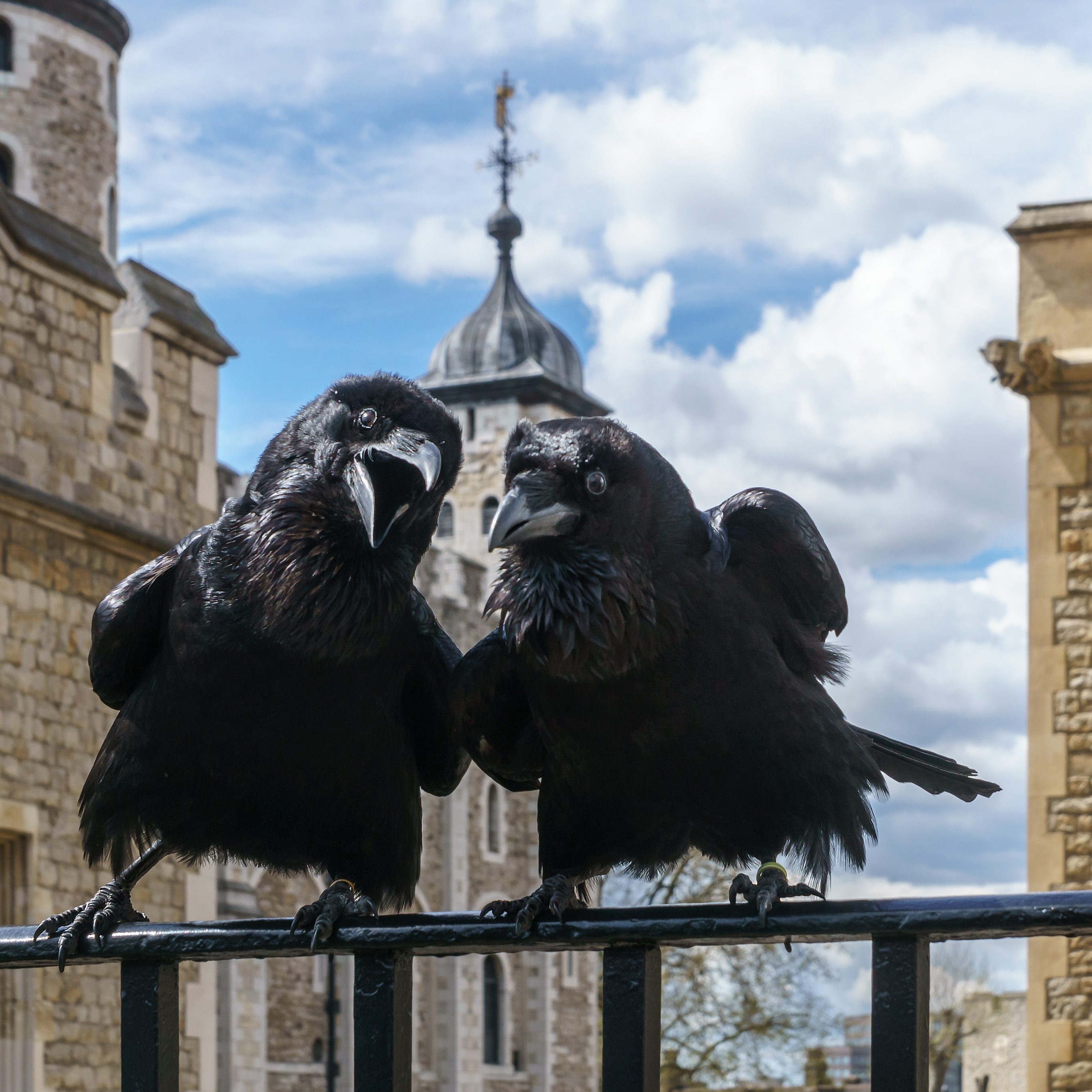
Jubilee and Munin, Ravens of the Tower of London — CC BY-SA 4
Frequently Asked Questions
Which day trips from London are the most popular?
The most popular day trips from London pair Stonehenge with Bath, because they gather two World Heritage properties into one day and show both prehistory and the Roman and Georgian ages. The tour usually leaves early in the morning, visits Stonehenge first, reaches Bath in the afternoon, and returns to London in the evening.
Can I visit Stonehenge and Bath alone by train?
Yes, but the journey needs careful planning, because Stonehenge has no railway station of its own. Travellers can take a train from London to Salisbury, then a bus to Stonehenge, and then return to Salisbury for a train to Bath. The independent route is more flexible than a packaged tour, but it takes longer and needs a check of the bus timetable.
Should I choose Windsor, Oxford or Cambridge for one free day?
All three lie about an hour by train from London, and all three are worth a day, so the choice depends on taste. Windsor suits travellers who care about royal history, with the oldest occupied castle in the world. Oxford suits those who love old university architecture and literature, while Cambridge suits those who want to ride a punt on the River Cam and see King’s College Chapel.
Can the Cotswolds be visited by train?
It is very hard, because the finest villages of the Cotswolds have no railway station and public buses are rare. The best way is to join a small-group tour for the day from London, or to hire a car and drive through Bibury, Bourton-on-the-Water and Stow-on-the-Wold. Drivers should remember the left-hand traffic, the narrow village lanes and the limited parking.
Which destinations on these day trips are World Heritage properties?
Many of them are, including Stonehenge inscribed in 1986, Bath and Blenheim Palace in 1987, Canterbury in 1988, and Maritime Greenwich in 1997. The United Kingdom holds 35 World Heritage properties. Oxford, Cambridge, Windsor and the Cotswolds are not inscribed, but they hold great historic and landscape value.
What should I pack for day trips from London?
Travellers should leave early, best before eight in the morning, and carry a jacket, because the English weather changes quickly, with comfortable walking shoes for the many walks. Tickets for the famous sights should be booked ahead online, and travellers should check the official website of each sight, because this guide gives no ticket prices.
Verified
This guide was built from the sources below, and every World Heritage date in it was re-checked on 22 November 2026. Stonehenge was inscribed by UNESCO in 1986 as reference 373, Bath in 1987 as reference 428, Blenheim Palace in 1987 as reference 425, Canterbury in 1988 as reference 496, and Maritime Greenwich in 1997 as reference 795. The United Kingdom holds 35 World Heritage properties, and the dates above come from the UNESCO World Heritage List.
Stonehenge was built between about 3000 and 2000 BC, the Romans built the baths at Bath in the first century, and Canterbury became the centre of the English Church in the sixth century. Windsor Castle began in the eleventh century under William the Conqueror, the universities of Oxford and Cambridge began in the twelfth and thirteenth centuries, and the first underground railway in the world opened in London in 1863. Bath was inscribed again in 2021 as part of the Great Spa Towns of Europe.
This page has no Wikidata record and no coordinates, because it describes a set of routes rather than one place. The day trips from London in this guide are therefore checked as a group, through the records of the places they visit, and the figures above rest on the sources listed below. Anything unconfirmed sits under Unverified.
Sources
- UNESCO World Heritage Centre, Stonehenge, Avebury and Associated Sites (https://whc.unesco.org/en/list/373/)
- UNESCO World Heritage Centre, City of Bath (https://whc.unesco.org/en/list/428/)
- Wikipedia, Stonehenge (https://en.wikipedia.org/wiki/Stonehenge)
- Wikipedia, Bath, Somerset (https://en.wikipedia.org/wiki/Bath,_Somerset)
Unverified
Ticket prices and packaged tour prices for day trips from London are not given in this guide, because prices change with the season and with the provider. Train and bus timetables to Stonehenge, the Cotswolds and the rural destinations should be checked on the official website of the operator on the day of travel.
The Changing the Guard ceremony at Windsor Castle does not take place every day, and its schedule should be checked before a visit. Current opening hours for the Roman Baths, Windsor Castle and Blenheim Palace change with the season, and they should be confirmed on the official website of each place. Real travel times between destinations in the high season may be longer than the one to two hours given here, and they should be checked on the day.
Illustrations
- Hero: Tower Bridge over the River Thames in London. Free image: https://upload.wikimedia.org/wikipedia/commons/9/93/HMS_Belfast_and_Tower_Bridge_before_sunrise.jpg — CC BY-SA 2.
- In body, Day Trips from London: The last trip of the Victoria, City of London, Ontario, Canada (1897), p40. Free image: https://upload.wikimedia.org/wikipedia/commons/9/9d/The_last_trip_of_the_Victoria%2C_City_of_London%2C_Ontario%2C_Canada_%281897%29%2C_p40.jpg — Public domain.
- In body, london: Jubilee and Munin, Ravens of the Tower of London. Free image: https://upload.wikimedia.org/wikipedia/commons/3/30/Jubilee_and_Munin%2C_Ravens%2C_Tower_of_London_2016-04-30.jpg — CC BY-SA 4.